Dubbing cost calculator: human voice actors vs AI
There is no universal price list for dubbing. The same drama can be quoted per word, per finished minute, per episode or per role, and usage rights, revisions and post-production are often billed on top. This dubbing cost calculator page first explains how human voiceover quotes are built and what a quote request should specify, then estimates how many credits AI Drama Voice needs for your word count, episodes and languages, so you can put the two side by side.
- Five pricing models
- Quote template
- Credits from word count
- Failed lines refunded
Updated Nov 5, 2026Fact-checked Nov 5, 2026
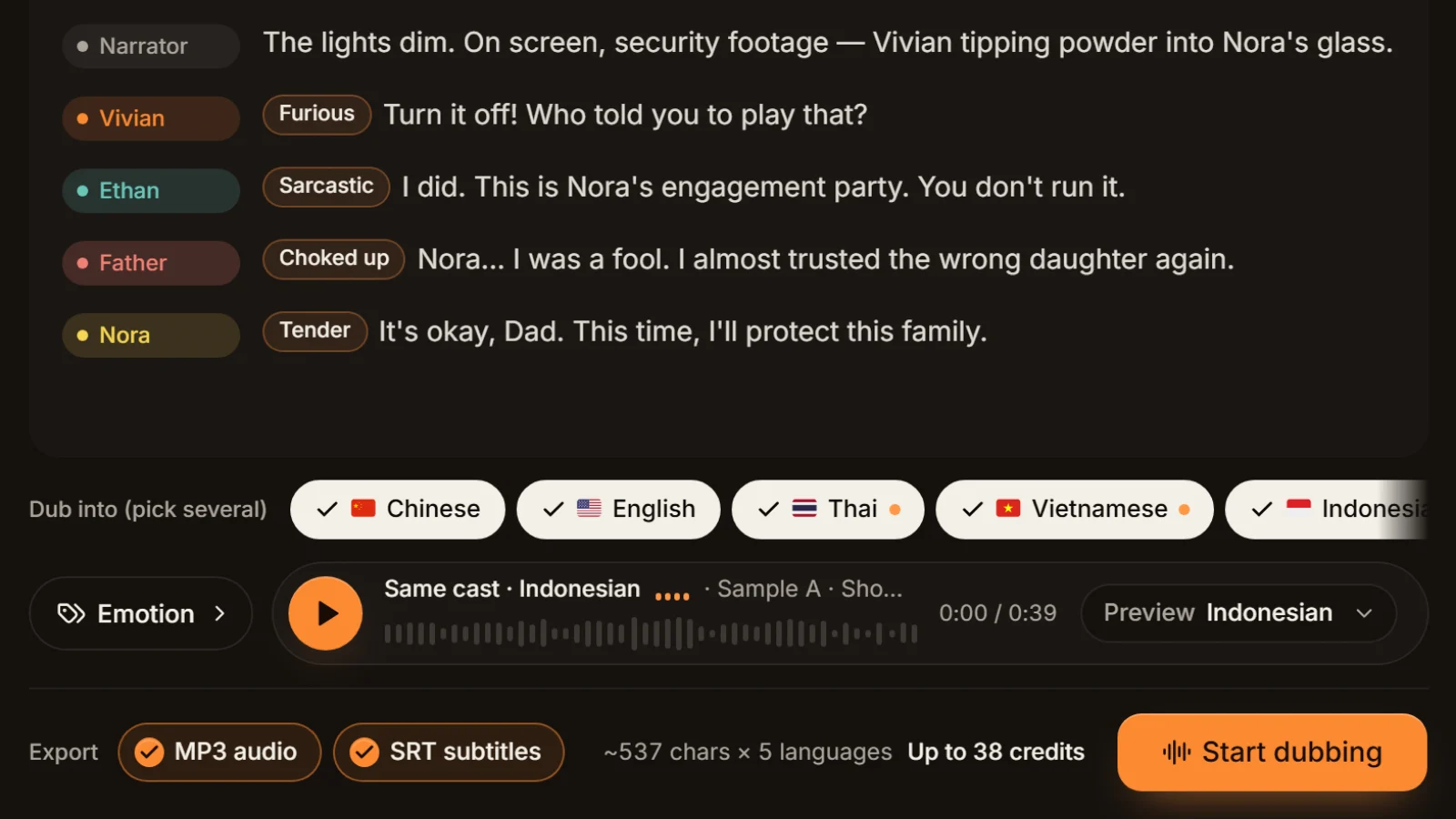
Sample A · Showdown at the engagement party
English · Script excerpt · 5 characters



Narrator
The champagne tower is barely up when Nora opens her eyes — she's back on the day they framed her.

VivianCold laugh
Sign the share transfer, little sister. Everyone's waiting on you.

NoraCalm
Sign it? Maybe look at the big screen first, Vivian.
Narrator
The lights dim. On screen, security footage — Vivian tipping powder into Nora's glass.
Estimate AI dubbing: characters, episodes, languages
The calculator uses the same billing rules as the dubbing workshop and reads the site's current rates and plans, so nothing here is a hard-coded price. Chinese is the original; every language you tick adds translation and voicing.
Credits per episode
164
All 3 languages, upper bound
Credits for 20 episodes
3,280
Reserved at most; unused credits come back
- Chineseoriginal38
- Englishtranslated + voiced63
- Indonesiantranslated + voiced63
What the current plans cover
- Creator$9.90/mo · 400 credits≈ 2 episodes
- Pro$24.90/mo · 1,200 credits≈ 7 episodes
- Studio$99.90/mo · 5,400 credits≈ 32 episodes
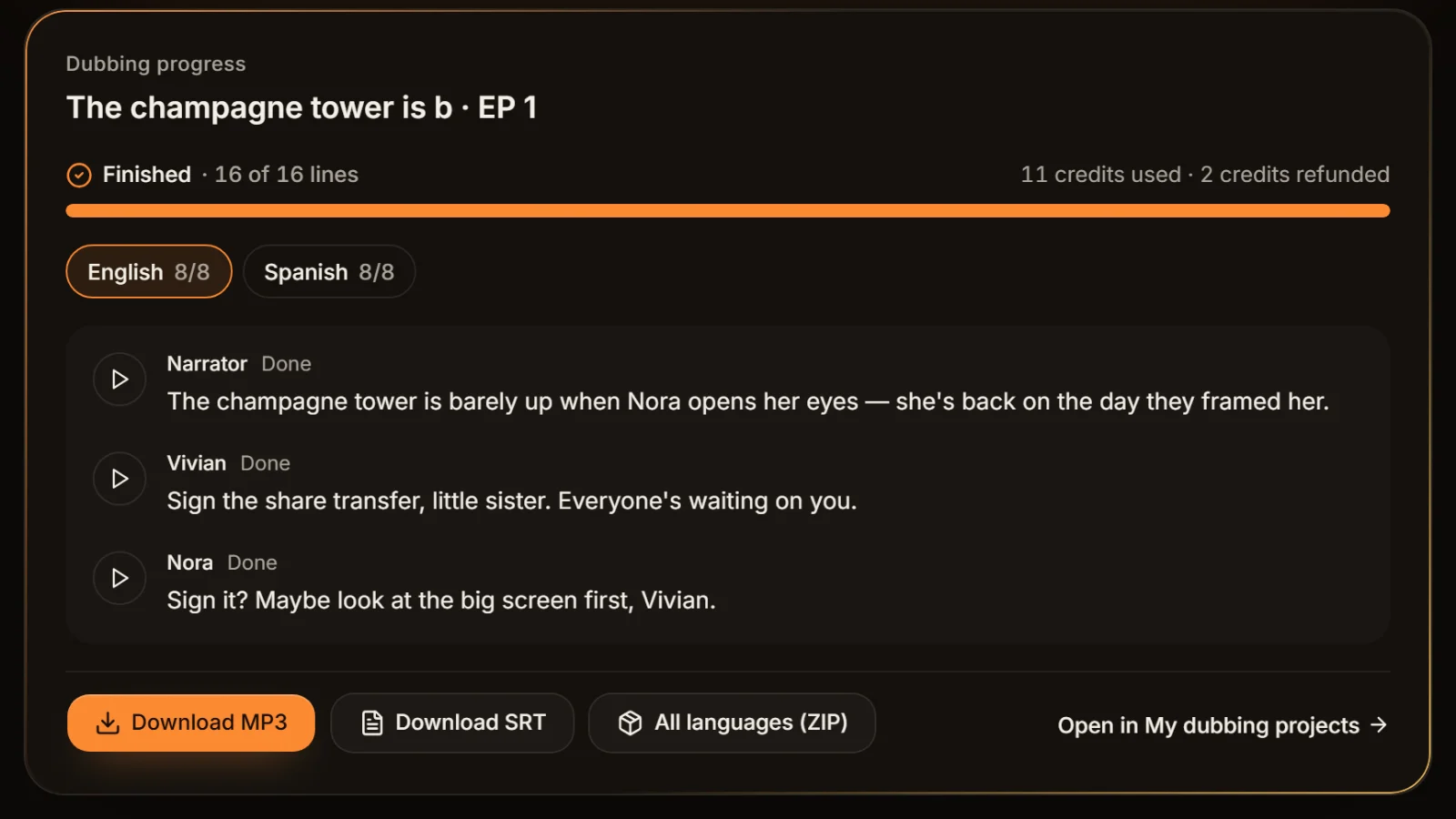
How we estimate: the same quote the workshop shows and the server reserves. The default voice model costs 9 credits per 1,000 billable characters; a Chinese character counts as 3.5 (it is a whole syllable of audio). A translated language reserves the original's voice cost × 1.6 plus translation at 2 credits per 1,000 characters, then settles at what the translated lines really cost — the difference is refunded. Cast analysis is free. Failed lines are refunded.
How to use the dubbing cost calculator
Run the dubbing cost calculator for the AI route first, then ask for human quotes on exactly the same workload, so both sides use the same yardstick.
- 01
Enter characters per episode and episodes
Count only spoken dialogue and narration, not scene headings or stage directions. Not sure how long an episode's script is? Work it out from the target length with the voiceover duration calculator.
- 02
Tick the languages
Chinese is the original. Each foreign language you tick adds translation and voicing for that version. More languages mean more credits, but the cast list is set only once.
- 03
Read the totals and plan coverage
The right side shows credits per episode, the total for every episode, and roughly how many episodes each current plan covers. Prices and credit amounts are on the pricing page.
Tip · The total is the most that will be reserved; dubbed versions settle on the actual translated lines and any surplus is returned.
- 04
Ask studios to quote the same workload
Put the word count, episodes, roles, languages and deliverables into the quote template below and send it to studios or voice actors, asking them to quote on that basis. Then compare with the AI estimate.
How dubbing and voiceover are usually quoted
If you hold three quotes you can't compare, it's usually because each uses a different unit. Convert them to one first.
Five common pricing models
| Model | Common for | How it's calculated | Ask about |
|---|---|---|---|
| Per word (per 1,000) | Audiobooks, story narration, long voiceovers | Total words ÷ 1,000 × rate per 1,000 | Source or final word count; do numbers and punctuation count |
| Per finished minute | Ads, explainers, recap videos | Finished length × rate per minute | How part-minutes are billed; audio length or video length |
| Per episode | Short dramas, comics, animated series | Episodes × rate per episode | Word and role limits per episode, and the overage rate |
| Per role or per line | Audio dramas, games, ad reads | Roles or lines × rate | Leads and supporting roles at the same rate; one actor for several roles |
| Per studio hour | Directed sessions | Studio hours × hourly rate + talent fee | Talent fee separate; setup and retakes billed |
Six things that move a human quote
- Usage rights: one platform, paid advertising, worldwide distribution or broadcast, and for a year or in perpetuity. Wider rights usually cost more.
- Number of roles: one actor voicing several characters costs very differently from casting each role, and multi-actor scenes add scheduling.
- Emotion and difficulty: crying, shouting, accents, foreign languages and lots of proper names all add recording time.
- Revisions: how many rounds are included, and whether a fix is a single line or a full re-record. Agree this upfront.
- Turnaround: rush jobs are usually charged extra, and busy actors may not be available at all.
- Post-production: noise clean-up, editing, syncing to picture, mixing and subtitles are sometimes included and sometimes extra.
How AI dubbing is billed
In AI Drama Voice, dubbing is charged in credits by the characters you generate. The Chinese original is billed by its characters; each dubbed language first reserves the original's voicing cost plus a translation fee, then settles on the actual translated lines and returns any surplus. Cast analysis runs in your browser and costs nothing, and if a line fails to generate, its credits come back automatically. Changing a line means regenerating only that line, billed by its own length.
So the cost of the AI route comes down to three things: total characters, number of languages, and how many lines you redo. The big difference from a studio is that rights tiers, scheduling, rush fees and per-role surcharges don't exist; but AI also doesn't replace a director shaping a performance in the booth. For key scenes, you can make a first pass with AI and then decide whether to bring in an actor. Plan prices are on the pricing page.
Why this page gives no market rates
Voiceover rates published online seldom say what unit they use, which rights they include or whether post-production is covered, so the same "per 1,000 words" figure can describe very different jobs. Rather than a range that looks precise but can't be checked, use the template below and ask at least three studios to quote on the same terms.
Voiceover quote template: what to specify before asking
Copy this table into a spreadsheet. You fill in the first two columns; the studio fills in the rates and totals.
| Item | What to write | Example |
|---|---|---|
| Project | Title or code name | Showdown at the Engagement Party, season 1 |
| Content type | Short drama, comic, audiobook, ad or recap | Vertical short drama |
| Workload | Total words or finished length, with episode count | 60 episodes, about 1,200 Chinese characters each |
| Roles | Main roles, narrator, crowd voices | 1 narrator, 2 leads, 6 supporting |
| Languages | Original language and dubbed versions | Chinese original, plus English and Indonesian |
| Deliverables | Audio format, stems, subtitles | MP3 + SRT per episode, one file per language |
| Usage rights | Platforms, regions, term, paid ads or not | Short-drama apps worldwide, term to agree |
| Revisions | Rounds included; per line or full re-record | 2 rounds of line fixes |
| Turnaround | First episode and full season | First episode within 3 working days |
| Pricing model | Per word, minute, episode, role or hour | Filled in by the studio |
| Rate and total | Rate, quantity, total, tax included or not | Filled in by the studio |
| Post-production | Clean-up, editing, sync, mix included or not | Filled in by the studio |
The same sheet works for an internal budget: list the AI credit total next to the human quotes, add the hours for translation checks, editing and review, and you have the full dubbing cost of the series.
Human vs AI dubbing: where the money goes
Not unit prices, just what you pay for. This sums up common practice; each studio's and tool's own terms decide the details.
| Cost item | AI dubbing (e.g. AI Drama Voice) | Human dubbing studio | AI first pass + human polish |
|---|---|---|---|
| Main unit | Script characters (credits) | Words, minutes, episodes, roles or studio hours | Each part billed its own way |
| Changing one line | Regenerate just that line | Per revision terms; may need a new session | AI part: edit and regenerate |
| Adding a language | Same cast, characters add up | New actors and a new quote per language | Dubbed versions usually stay AI |
| Rights and scheduling | Per the terms of service, no booking | Rights and dates must be agreed | Polished part follows actor terms |
| Subtitles | SRT exported per language | Usually made separately | Reuse the AI SRT and adjust |
| Best for | Volume, market tests, many languages | Flagship titles, brand work, directed sessions | Tight budgets with a few key scenes |
Checked Nov 2026 · A summary of common practice, not any particular studio's terms.
Six ways to bring short-drama dubbing costs down
Cut words before you get quotes
Human or AI, dubbing cost follows the word count. Removing narration the picture already tells and repeated lines is the most direct saving.
Settle the cast list first
Use one name per character and write down the relationships, and you will recast less. In AI Drama Voice, cast analysis is free, so adjust it until it's right before generating.
Make one sample episode
Before the whole season, finish one episode to lock voices, pace and emotional direction. It beats scrapping half a season.
Test markets before going wide
You don't need every language at once. Dub a few episodes in one or two target languages, then expand where the numbers are good.
Fix only the lines that need it
After review, fix line by line instead of redoing episodes. With AI dubbing, a fix is billed by that line's length only.
Buy only the rights you need
With human actors, license the platforms and term you will actually use; extending later keeps the first quote lower.
Frequently asked questions
There's no single price. A dubbing quote depends on the pricing model, the word count or length, the number of roles, usage rights, revisions and post-production, and published rates rarely state their terms, so this page doesn't give a market range. Use the quote template above with at least three studios; estimate the AI route with the dubbing cost calculator on this page.
Both are common: audiobooks and narration are often per word (per 1,000), ads and explainers per finished minute, short dramas per episode. Convert to one unit before comparing. AI Drama Voice bills AI dubbing by script characters.
For a human quote, use total words ÷ 1,000 × the rate per 1,000, plus post-production, and check whether it is one narrator or a full cast. For AI, enter episodes and words per episode in the calculator until they add up to the total and read the credit sum.
Script length, number of roles, number of languages and how much is redone. Human dubbing adds rights, scheduling and post; AI dubbing mostly depends on characters and languages. For our plan prices, see the pricing page.
Human dubbing is usually quoted per language, with translation on top. AI dubbing voices all languages with the same cast; each dubbed version adds its characters for translation and voicing, and ticking languages in the calculator shows the total.
No. Lines that fail to generate are refunded automatically, and cast analysis is free. Dubbed versions reserve the maximum first and settle on the actual translated lines, returning any surplus.




Budget done? Dub one episode Know the cost before you cast.
Paste an episode and get a free cast list; generate when you're happy, and failed lines are refunded automatically.
Billed by characters generated · Failed runs refunded automatically · Alipay, WeChat Pay and cards