How to dub a short drama with AI, from script to finished episode
Short drama dubbing rarely stalls at the recording itself. Time goes on finding voices, checking lines, assigning roles and redoing takes. This guide walks through how to dub a short drama in the order the work actually happens: getting the script into a shape an AI can read, giving every character their own voice and emotion, producing the Chinese and foreign-language versions in one run, and syncing and reviewing what you export.
- 7 steps
- Short dramas · motion comics · novel promos
- Script format examples
Updated Nov 5, 2026Fact-checked Nov 5, 2026
Sample A · Showdown at the engagement party
English · Script excerpt · 5 characters



Narrator
The champagne tower is barely up when Nora opens her eyes — she's back on the day they framed her.

VivianCold laugh
Sign the share transfer, little sister. Everyone's waiting on you.

NoraCalm
Sign it? Maybe look at the big screen first, Vivian.
Narrator
The lights dim. On screen, security footage — Vivian tipping powder into Nora's glass.
On this page
The seven steps of dubbing a short drama
Each step matches one action in the dubbing workshop. Go through them in order the first time; once you know the tool, most of your time goes into steps 4 and 5.
- 01
Step 1
Format the script: one line per row, speaker first
Write each line as "Name: line", one spoken line per row. Keep scene notes and camera directions if you like, but on their own rows, never mixed into dialogue.
Tip · Use one name per character for the whole series; don't switch between "Lin Wan" and "the heroine".
- 02
Step 2
Describe the characters in two or three lines
At the top of the script, note who the main characters are: how they relate, roughly how old they are, what they're like. This shapes voice casting, and it shapes forms of address in the foreign versions, such as how Thai or Indonesian speakers address an elder or a boss.
- 03
Step 3
Paste the script and generate the cast
Paste the script into the workshop and run the cast analysis. The AI lists the narrator and every character, assigns voices by gender, age and persona, and applies the emotion you mark in brackets to each line. This step costs no credits.
- 04
Step 4
Adjust voices: leads first, then supporting roles
Listen to the heroine, the male lead and the narrator first; once those three are right, the tone of the series is set. Give supporting roles voices that contrast clearly with the leads, so two characters never blur together in an argument. You can audition every voice in the voice library.
- 05
Step 5
Check the emotion tags
Focus on twists, confrontations and crying scenes. Tags like cold laugh, choked, furious and whisper apply line by line, and one wrong tag breaks the scene. Change the tag, or add a cue in brackets such as "(cold laugh)".
- 06
Step 6
Pick languages and generate
Chinese only? Tick Chinese. Going abroad? Tick English, Thai, Vietnamese, Indonesian and any others at the same time. Foreign versions are rewritten into natural spoken language first, then voiced by the same cast in one run.
- 07
Step 7
Export, sync and review
Download the MP3 and SRT for each language, bring them into CapCut, Premiere or your editor of choice, line them up with the picture and watch the whole episode. Any line that needs work goes back to the workshop: edit it and regenerate just that line.
How to write a script the AI dubs accurately
Half of an AI dub's quality is decided by the script. These habits cut down on wrong speakers, wrong emotions and rework.
The script format that works best
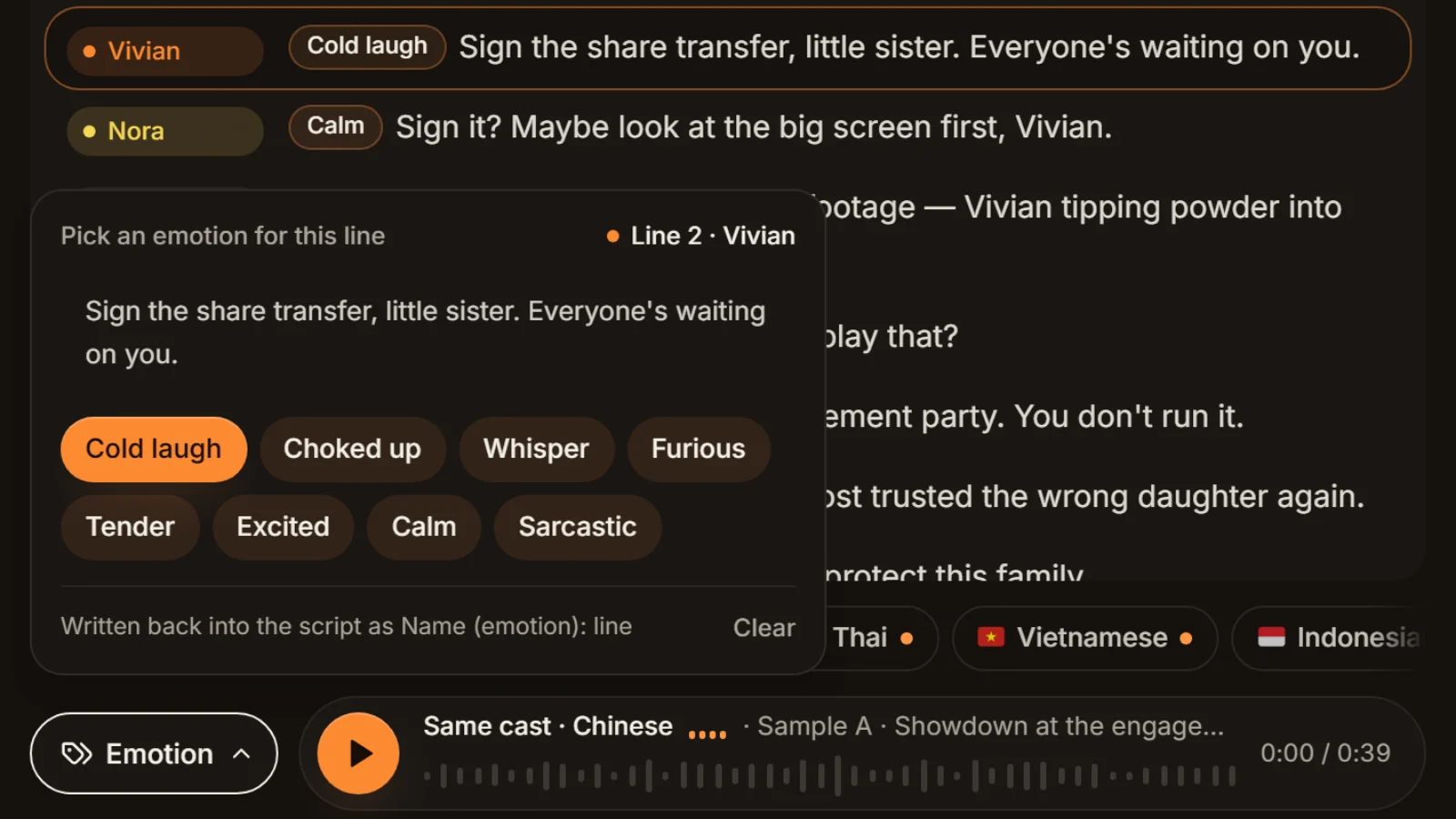
The safest format is "Name: line", one line per row. Put acting cues in brackets right before the line. Write narration as "Narrator: …" and inner monologue as "Lin Wan (thinking): …", so the system can tell them apart from ordinary dialogue.
| Type | Example | Notes |
|---|---|---|
| Dialogue | Gu Cheng: Have you lost your mind? This is our engagement party! | The everyday case, one line per row |
| With an emotion cue | Lin Wan: (cold laugh) Keep that glass. You'll want it for yourself. | The cue feeds the emotion tag |
| Narration | Narrator: Reborn on the day of her engagement, she finally saw it all. | Usually a steady narrator voice |
| Inner monologue | Lin Wan (thinking): This time, nobody gets to play me. | Same character, a softer delivery |
How long should an episode be?
A vertical short-drama episode often runs only a minute or two, and the amount of dialogue varies a lot: a fast revenge drama packs in far more lines per minute than a slow romance. Rather than guessing, estimate the running time from the script length with the dubbing length calculator and trim lines before you generate.
The most common mistake
Two characters' lines on one row, like "Lin Wan: Go. Gu Cheng: I'm not going." The AI will give both lines to Lin Wan. Every character's line needs its own row.
Narration, inner voice and dialogue
In dramas adapted from web novels, and in novel promo videos, narration is often more than half the script. Narration carries the plot and suits a steady, warm storyteller voice. Inner monologue is what a character thinks but doesn't say, usually lighter and closer than dialogue. Dialogue follows the relationships and the conflict. Written separately, the three give the episode depth instead of one voice reading from start to finish.
- Narration: one storyteller voice for the whole series
- Inner voice: the character's own voice, delivered softer
- Dialogue: emotion tagged by relationship and scene
Six ways to put emotion into an AI dub
Short dramas live on twists, and nothing kills one faster than a dub that sounds read. All of these work in the script or in the workshop.
Leave a pause before the twist
An ellipsis or a single narration line before the reveal makes the delivery slow down naturally, which lands harder than rushing into it.
One emotion per line
Split a line that cries and laughs at once into two lines, tagged choked and cold laugh. Two tags are easier to control than one line carrying both.
Keep arguments short
Long sentences are hard to shout. Break argument lines into short ones and tag them furious, and the rhythm sounds like a real fight.
Whisper is not inner voice
A whisper is said quietly to someone; inner voice is never said aloud. Keep them apart — they sound completely different.
Never recast a lead
Once a lead's voice is set, keep it for the whole series; viewers recognise characters by voice. The same goes for foreign versions, and AI Drama Voice keeps each character's voice the same in every language.
Fix one line before the episode
When the emotion is off, change the tag on the most important line and regenerate it. Once it sounds right, treat the other lines the same way.
Three ways to dub a short drama
No single method suits every drama. Here are the three common approaches, side by side on what short-drama teams care about most.
| AI multi-character dubbing (e.g. AI Drama Voice) | Generic TTS, line by line | Human voice actors | |
|---|---|---|---|
| Finds characters and assigns voices | Yes | No | Done by a director / casting |
| Per-line emotion | Tags apply per line | Mostly overall speed and pitch only | Depends on the actor |
| Turnaround for one episode | Generation takes minutes | Synthesise each line, then stitch | Booking, recording, editing |
| Other languages with the same cast | Yes | Pick new voices per language | New actors per language |
| Subtitles | SRT exported automatically | Usually a separate job | Usually a separate job |
| Best for | Volume releases, market tests | Single narrator, explainer videos | Flagship titles, brand work |
Checked Nov 2026 · A summary of common practice; real capabilities vary by tool and team.
After export: a sync and review checklist
Getting the AI dub back is only half the job. Once it is lined up with the picture in your editor, listen through the episode in this order; it finds the problems that hurt the viewing experience most, in the least time.
- 1.Missing lines and wrong speakers: is every line there, in the right character's voice?
- 2.Emotion: do the twist, the confrontation and the crying scene land?
- 3.Timing: do lines roughly match mouth movement and action on screen?
- 4.Pronunciation: are names, places and brand names read correctly?
- 5.Subtitles: are line breaks natural, with no screen crammed with text?
For foreign versions, have a native speaker listen to at least the key episodes, especially forms of address, slang and jokes. Changing a line only means editing it in the workshop and regenerating it; nothing else in the episode moves. For language-specific advice, see Thai dubbing, Vietnamese dubbing and Indonesian dubbing.
Get who is speaking right before you worry about how well they say it. A wrong speaker pulls viewers out of the story faster than a flat line.
Frequently asked questions
Not necessarily. For volume releases, testing a new genre or producing foreign-language versions, AI dubbing wins on speed and cost. For a big-budget flagship or a brand project, use AI for the first pass and have human actors redo the key scenes.
Yes. Write the script as "Name: line" and AI Drama Voice finds the narrator and every character and assigns each a voice. Using one name per character throughout makes it more accurate.
The cast list appears shortly after you run the analysis; generating the whole episode depends on the amount of dialogue and how many languages you tick. Compared with booking and editing a recording session, the time saved is mostly scheduling and rework.
Yes. Edit a line or its emotion tag in the workshop and regenerate only the lines you changed; everything else stays as it is.
Tick English, Thai, Vietnamese, Indonesian or any other language when you generate. Lines are rewritten into natural local speech, voiced by the same cast, and each language exports its own MP3 and SRT.
By the characters of your dialogue, plus translation for foreign languages. Cast analysis is free, and failed lines are refunded automatically. See the pricing page.




Dub your short drama now From script to cast in seconds.
Paste an episode, check the AI's cast list and emotion tags, and generate the full episode when you're happy.
Billed by characters generated · Failed runs refunded automatically · Alipay, WeChat Pay and cards