
Midnight Radio
Velvet · narrator
● Narrator
Opens with the rebirth at an even pace and leaves the same pauses in Spanish.
NarratorsMale9 languages
Most people looking for Spanish dubbing software want one thing: a Chinese short drama in Spanish, fast enough to test in Latin America. Paste the script into AI Drama Voice. The AI builds the cast list, applies the emotions you mark in brackets, rewrites the dialogue into the Spanish Latin American viewers actually speak, voices it with the same cast as the original, and gives you a Spanish MP3 plus an SRT file timed line by line.
Updated Nov 5, 2026Fact-checked Nov 5, 2026
Spanish · Showdown at the engagement party
Spanish · Script excerpt · 5 characters
NarratorCalm
Despertó el día de su compromiso. Esta vez no pensaba quedarse callada.
She woke up on the day of her engagement. This time she wasn't going to keep quiet.

Best friend · Su TianTender
Lin Wan, hoy estás preciosa. Anda, tómate una copa conmigo.
Lin Wan, you look gorgeous today. Come on, have a drink with me.

Heroine · Lin WanCold laugh
¿Esa copa? Mejor tómatela tú.
That glass? You'd better drink it yourself.

Fiancé · Gu ChengFurious
¡Ya basta, Lin Wan! ¿Te volviste loca?
That's enough, Lin Wan! Have you lost your mind?
This is the real dubbing studio, already set to Spanish. Swap in a few lines of your own and watch the AI split the roles and tag each line's emotion — this step costs no credits.
Narrator
Midnight Radio · 2 lines
5 roles · 8 lines
537 / 8,000 charsSame cast · Spanish
The first clip is from the Spanish version of Sample A, Showdown at the engagement party, played by the same cast as the Chinese original. The lines under it are a script excerpt from the episode (not all of them fall inside these few seconds). The other two clips are third-party Spanish voices for reference, transcribed as spoken: a drama-recap narrator and an older man's monologue.
Script excerpt · Spanish · Showdown at the engagement party
NarratorCalm
Despertó el día de su compromiso. Esta vez no pensaba quedarse callada.
She woke up on the day of her engagement. This time she wasn't going to keep quiet.
Best friend · Su TianTender
Lin Wan, hoy estás preciosa. Anda, tómate una copa conmigo.
Lin Wan, you look gorgeous today. Come on, have a drink with me.
Heroine · Lin WanCold laugh
¿Esa copa? Mejor tómatela tú.
That glass? You'd better drink it yourself.
Fiancé · Gu ChengFurious
¡Ya basta, Lin Wan! ¿Te volviste loca?
That's enough, Lin Wan! Have you lost your mind?

Father · Lin ZhenguoChoked up
Hija… perdóname.
My girl… forgive me.
Script excerpt · Spanish drama-recap voice · In the rain
Recap narrator
Shen Yu la encontró bajo la lluvia, rogándole que lo escuchara, intentando Lin Yu escapar de su agarre. Él la tomó del brazo, jurando que nunca quiso lastimarla, mientras las lágrimas de ella no dejaban de caer. Finalmente, él la abrazó con fuerza, prometiendo protegerla y no dejarla ir nunca más.
Shen Yu found her in the rain and begged her to listen while Lin Yu tried to pull free. He held her arm, swearing he never meant to hurt her, as her tears kept falling. At last he held her tight and promised to protect her and never let her go again.
Script excerpt · Spanish older male voice · Sea monologue
Old sailor
Este océano es una fuerza, un poder salvaje e indómito. Y ella inspira asombro con cada amanecer.
This ocean is a force, a wild and untamed power. And with every sunrise it inspires awe.
Translation, casting, voicing and subtitles happen on one screen, with no exporting in between.
Write it as “Name: line”; any line without a name is read by the narrator. Put the emotion in brackets at the start of a line, like “Lin Wan: (cold laugh) That glass…” — the bracketed cue is never read aloud.
The AI finds the narrator and every character, picks voices by gender, age and persona, and applies the emotion you mark in brackets to each line. Swap any voice that doesn't fit with one click.
Tip · Cast analysis is free, so adjust until it feels right before you generate.
Lines are rewritten into spoken Latin American Spanish, names stay in one pinyin spelling across the series, tú or usted follows the relationship between speakers, and the same cast voices it.
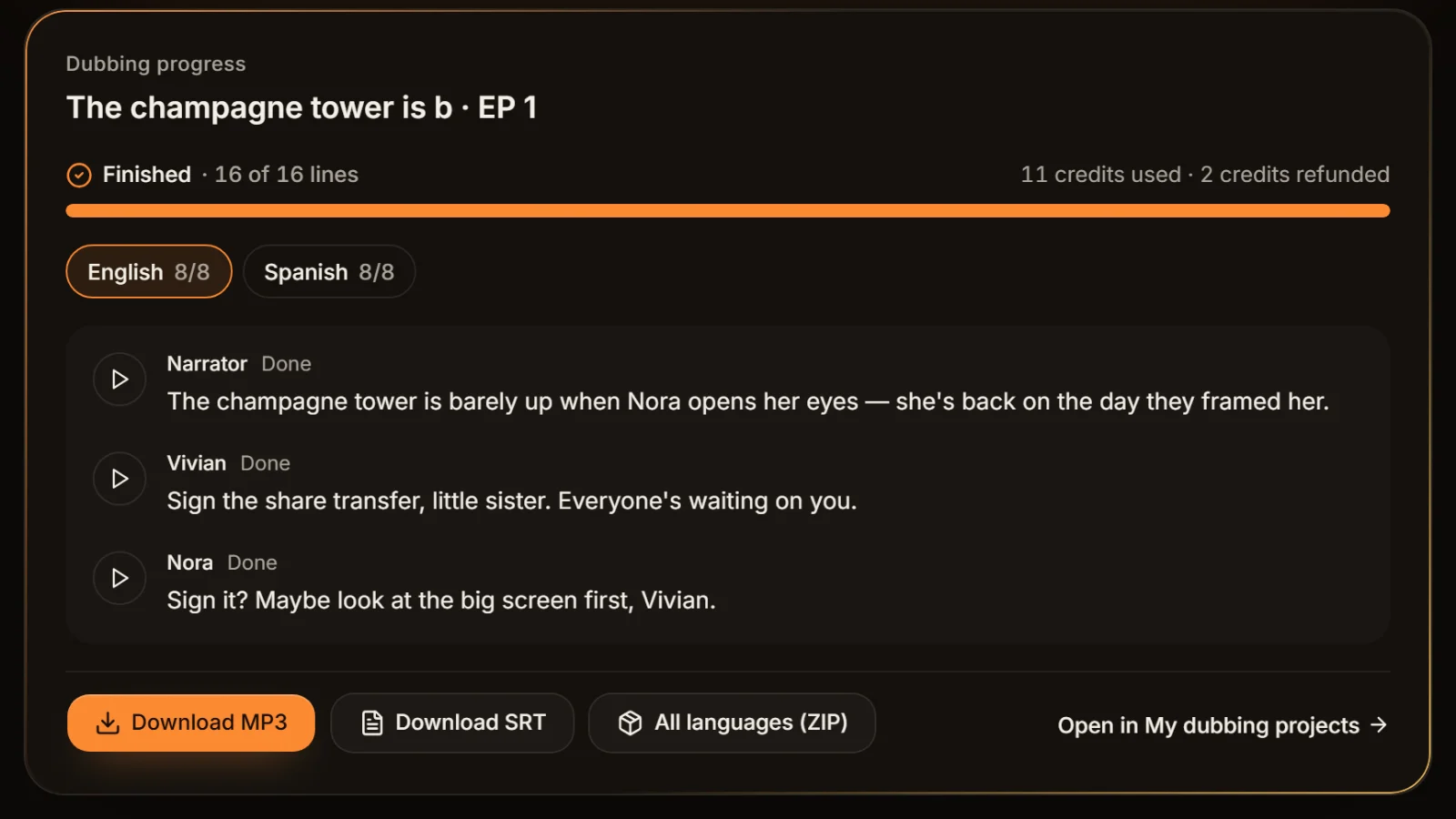
Generate the whole Spanish episode and download the MP3 and the SRT, or pack several languages into one ZIP, then line them up against the original in CapCut or any editor.
Spanish pronunciation is regular and easy to plan for. The real work is who is talking to whom, and in what tone.
Spanish · Español
Audiences on both sides of the Atlantic understand each other, but vocabulary, grammar and accent differ. AI Drama Voice writes Latin American Spanish, the natural first test for Mexico, Colombia or Argentina; for a show aimed at Spain, have a Spanish native review the wording.
Spanish · Español
Tú is the “you” for friends, lovers and peers; usted is the respectful “you” for elders, bosses and strangers. In a CEO romance the assistant uses usted and the boss answers with tú. When someone who always says usted suddenly switches to tú in a fight, that switch is part of the drama.
Spanish · Español
Spanish doesn't call an unrelated friend “sister”, and it has no “surname + job title” form like 顾总 (roughly “President Gu”). Friends use first names, the boss becomes Señor Gu or jefe, a 夫人 becomes señora, and a doubled pet name like 晚晚 usually turns into hija or mi niña from a parent.
Spanish · Español
The same sentence takes more syllables in Spanish than in Chinese, and far more characters on screen. Each SRT cue is one full line with no automatic line break, so on a vertical frame split long ones at a natural phrase in your editor.
The Chinese and Spanish versions share one cast. If you only ever release in Spanish, you can also cast a native voice that speaks Spanish only.
Velvet · narrator
● Narrator
Opens with the rebirth at an even pace and leaves the same pauses in Spanish.
Cold · villainous
● Heroine · Lin Wan
Cold laughs and sarcasm all episode; she uses tú with her friend, and the politer she sounds the colder it gets.
Bright · playful
● Best friend · Su Tian
Sweet on the surface; in Spanish she calls the heroine Lin Wan instead of a stiff “hermana”.
Deep · commanding
● Fiancé · Gu Cheng
His outburst is tagged furious and uses the Latin American ¿Te volviste loca?
Warm · grounded
● Father · Lin Zhenguo
His last line breaks; the pet name 晚晚 becomes hija.

Spanish · Latin warmth
● Native Spanish voice · Mateo
Speaks Spanish only — for a series released in Spanish alone that should sound locally made.
Each character keeps one voice in Chinese, Spanish and every other language, so viewers recognise the heroine whichever version they watch.
Each line goes to translation with its speaker and emotion and comes back as something a voice actor would say, kept close to the original length so timing holds.
Cold laugh, choked, furious and whisper tags apply line by line, so a Spanish argument never sounds like a news read.
Cue times come from where each dubbed line sits in the MP3, so subtitles drop onto your timeline without a transcription or timing pass.
You pay by characters, failed lines get their credits back automatically, and cast analysis is free.
Take a show that already performed in China, run a Spanish AI dub through paid tests, and only then decide whether a human polish is worth it.
Many characters and short, choppy lines: generate a whole multi-character Spanish episode at once instead of booking Spanish actors one by one.
A first-person narrator plus character dialogue, each with its own voice, steady enough for a daily Spanish recap channel.
Produce a first pass with AI so the client can approve lines and casting, then spend native reviewers' time on the scenes that matter most.
Most Spanish dubbing software is a read-aloud tool: type text, pick a voice, export. That works for narration and ads but not for a short drama, where five or six characters each need a fixed voice, every line needs an emotion, and forms of address shift with every relationship. Three questions sort the tools quickly: does it split the roles for you, does each character keep the same voice across languages, and does it export subtitles that are already timed?
Most Spanish-speaking viewers live in Latin America, and accents differ from country to country. Latin American film and TV dubbing has long used a deliberately neutral variety, español neutro, that audiences across the region accept. AI Drama Voice writes its Spanish dub in Latin American Spanish. If your show is mainly for Spain, use it for the first pass and have a Spanish native swap in vosotros, coche, ordenador and the like.
| Point | Latin American Spanish | Spain Spanish |
|---|---|---|
| Plural “you” | ustedes for everyone | vosotros (familiar) / ustedes (formal) |
| Something that just happened | ¿Te volviste loca? (simple past) | ¿Te has vuelto loca? (present perfect) |
| Car / computer / phone | carro, auto / computadora / celular | coche / ordenador / móvil |
| z, ce, ci | pronounced like s | in most regions, like English th |
| Words to watch | coger is vulgar in Mexico, Argentina and elsewhere | coger just means “take” or “grab” |
Chinese dramas set up relationships through titles: 顾总 tells you he is the boss, “sister” tells you two women are close, 晚晚 tells you it's family. Spanish has fewer titles, so that information moves elsewhere: usted for distance, Señor plus surname for rank, a first name or hija for closeness. Here is how a few lines from the sample were handled.
| Chinese original | Spanish (Latin America) | Character · emotion | What changed |
|---|---|---|---|
| 姐姐,你今天最漂亮了,陪我喝一杯嘛。 | Lin Wan, hoy estás preciosa. Anda, tómate una copa conmigo. | Su Tian · tender | “Sister” becomes her first name; anda carries the coaxing |
| 这杯酒?你还是留着自己喝吧。 | ¿Esa copa? Mejor tómatela tú. | Lin Wan · cold laugh | Tú between peers; the final tú sharpens the sarcasm |
| 你疯了吗? | ¿Te volviste loca? | Gu Cheng · furious | Simple past, as Latin America says it |
| 顾总,车已经在楼下了。 | Señor Gu, el auto ya lo está esperando abajo. | Assistant · calm | Usted from staff to boss; auto for “car” |
| 晚晚……爸爸对不起你。 | Hija… perdóname. | Lin Zhenguo · choked | The pet name becomes hija rather than a transliteration |

Tip
Don't add notes about who is who to the script: any line without a speaker name is read out by the narrator. Let titles and dialogue carry the relationship — “顾总,车已经在楼下了” already tells the translation to use usted.
Every Chinese character is one syllable, and Spanish needs noticeably more syllables for the same meaning — but it is also spoken faster. A cross-language study (Pellegrino and colleagues, 2011, in the journal Language) found Spanish speakers produce clearly more syllables per second than Mandarin speakers, so total line length does not grow in step with the syllable count. In practice most lines fit the original shots, and a few long ones run past the cut.
It depends on each tool's licence. Many free read-aloud tools allow personal use only, require attribution or cap the length, so read the terms before you publish. Platforms also have rules about labelling AI-generated content. MP3s exported from AI Drama Voice carry an implicit AI-generated label in their metadata; add the visible label your platform asks for when you publish. More in can AI voices be used commercially.
Run the episode with the most tangled relationships first, listen for tú and usted, then generate the rest episode by episode.
Use one pinyin spelling per character, such as Lin Wan and Gu Cheng, across subtitles and audio; don't mix translated and transliterated names.
Start a line with “(cold laugh)” or “(choked)” for more accurate emotion tags; the bracketed cue is never read aloud.
Latin America and Brazil are often launched together: tick Spanish and Portuguese in the same run and one cast voices both — see Portuguese dubbing and English dubbing.
For a series you plan to run for months, have a native Spanish speaker listen through each episode, focusing on slang, jokes and place names.
It depends on the job. For a single narration, any text-to-speech tool will do. For a short drama, pick one that splits the roles for you, keeps each character's voice fixed, keeps that voice when the language changes and exports timed subtitles. AI Drama Voice is built around that workflow: paste the script, cast it, tag the emotions, and export a Spanish MP3 and SRT in one run.
Most Chinese short dramas going abroad start in Latin America, so Latin American Spanish is the safer default. AI Drama Voice writes its Spanish dub in Latin American Spanish; there is no separate Spain option yet, so have a native from Spain review the wording for a show aimed there.
Spanish has more syllables but is spoken faster, so most lines fit the original. For the few that overrun, split them into two sentences in the Chinese script, or nudge the line in your editor; the SRT is timed from the real audio, so the overruns are easy to find.
It keeps the same AI voice. Each character uses the same voice in the Chinese and the Spanish version, and later episodes of the series reuse the same cast list. AI Drama Voice does not clone voices, so it cannot reproduce a real actor's voice.
Check each tool's terms; many free tiers are personal-use only or require attribution, and platforms have their own AI-labelling rules. AI Drama Voice's plans are on the pricing page, and cast analysis is free, so you can try before you decide.
Yes. Tick only Spanish and only the Spanish version is voiced. You can also tick English, Portuguese or any other language in the same run; each exports its own MP3 and SRT, or all of them in one ZIP.


Paste the script, confirm the cast, tick Spanish — the same cast performs the whole episode with feeling, and the MP3 and subtitles export together.
Billed by characters generated · Failed runs refunded automatically · Alipay, WeChat Pay and cards