Short drama dubbing software built for TikTok, YouTube Shorts and drama apps
The hard part of short drama dubbing software for overseas releases isn't making a voice speak English. It's shipping forty episodes in four languages on time and in the right shape. AI Drama Voice starts from the Chinese script: it casts every role, tags the emotion of each line, and has the same cast perform English, Thai, Vietnamese, Indonesian, Spanish, Portuguese, Japanese and Korean versions. Every episode and language comes out as an MP3 and an SRT, zipped together, ready for your editor to cut into a vertical episode.
- 8 foreign languages + Chinese
- MP3 + SRT per episode and language
- One ZIP for everything
- Failed lines refunded
Updated Nov 5, 2026Fact-checked Nov 5, 2026
English · for North America
English · Script excerpt · 3 characters
NarratorCalm
Reborn on the day of her engagement party, she could finally see the scheme behind every smile.

Lin Wan (lead)Cold laugh
Keep that glass. You'll want it for yourself.

Gu Cheng (fiancé)Furious
Have you lost your mind? This is our engagement party!
Try it: one script, switch the target language
The studio below starts in English. Paste a few lines of your own script, check the cast list and emotion tags, then switch to Thai or Indonesian and hear the same character. This step costs no credits.
Narrator
Midnight Radio · 2 lines
5 roles · 8 lines
537 / 8,000 charsSame cast · English
One scene, dubbed for three overseas markets
Sample A, 'The Engagement Party Strikes Back': the same cast performs the Chinese original, then English, Spanish and Brazilian Portuguese. Script excerpts below, with the English line for reference.
Script excerpt · English · for North America
NarratorCalm
Reborn on the day of her engagement party, she could finally see the scheme behind every smile.
Lin Wan (lead)Cold laugh
Keep that glass. You'll want it for yourself.
Gu Cheng (fiancé)Furious
Have you lost your mind? This is our engagement party!
Script excerpt · Spanish · for Latin America
NarratorCalm
Renació el día de su fiesta de compromiso y, por fin, pudo ver la trampa detrás de cada sonrisa.
Reborn on the day of her engagement party, she could finally see the trap behind every smile.
Lin Wan (lead)Cold laugh
Esa copa, mejor bébetela tú.
That glass? You'd better drink it yourself.
Gu Cheng (fiancé)Furious
¿Te volviste loca? ¡Hoy es nuestra fiesta de compromiso!
Have you gone mad? Today is our engagement party!
Script excerpt · Portuguese · for Brazil
NarratorCalm
Ela renasceu no dia da festa de noivado e, enfim, enxergou o golpe por trás de cada sorriso.
She was reborn on the day of her engagement party and finally saw the con behind every smile.
Lin Wan (lead)Cold laugh
Essa taça, é melhor você mesma beber.
That glass, you'd better drink it yourself.
Gu Cheng (fiancé)Furious
Você enlouqueceu? Hoje é a nossa festa de noivado!
Have you lost your mind? Today is our engagement party!
Delivering a whole series with short drama dubbing software: six steps
This is the full order from script to files your editor and platform partner can use. Most of the time goes into step 4, the review; the rest is ticking boxes and downloading.
- 01
Step 1
Pick the market, then the language
English for North America and other English-speaking markets, Spanish for Latin America, Portuguese for Brazil, and Thai, Vietnamese or Indonesian country by country in Southeast Asia. You don't need every language at once; start with one or two test markets.
Tip · Country-by-country notes are in our Southeast Asia short-drama market guide.
- 02
Step 2
Paste the Chinese script and confirm the cast
Paste an episode as 'Name: line'. The AI lists the narrator and every character, assigns voices and tags each line's emotion. Lock the lead and the villain first; every language reuses this cast list.
- 03
Step 3
Tick every target language and generate once
Select all the languages you need to deliver. Each line is translated into natural spoken language by a large language model, keeping who says it and how they feel, then voiced by the same cast.
- 04
Step 4
Review language by language and redo single lines
Listen to each language end to end, checking names, forms of address and jokes. Fix only the line that's wrong and regenerate it; failed lines refund their credits automatically.
- 05
Step 5
Export MP3 + SRT and bundle by language
Every episode and language gets one MP3 and one SRT, with subtitles timed line by line to the dub. Zip all languages together for the editor or an outsourcing team.
- 06
Step 6
Assemble the vertical episode, upload and label AI
Lay the audio and subtitles over the picture in CapCut or another editor, export the vertical cut and upload it. TikTok and YouTube both have labelling or disclosure rules for realistic AI audio and video; follow them on upload.
What each platform actually publishes before you deliver overseas short drama dubbing
The table lists only what each platform's own pages state. Where nothing is public, don't guess; ask your platform contact for their delivery sheet.
| Item | TikTok | YouTube Shorts | ReelShort | DramaBox |
|---|---|---|---|---|
| Format | Vertical feed; Help Center gives no fixed aspect ratio for regular videos | Only square or vertical videos count as Shorts | Listing describes 'vertical TV mini series' | Not stated in the listing |
| Length | Up to 10 minutes recorded in-app, up to 60 minutes uploaded | Up to 3 minutes for uploads after 15 Oct 2024 | Listing describes 'one-minute short movie episodes' | Not stated in the listing |
| Subtitle files | No sidecar format listed; SRT is usually burned into the picture | Accepts SubRip (.srt), plain UTF-8 | Delivery spec not public | Delivery spec not public |
| AI-generated content | Realistic AI images, audio and video must be labelled; AI-generated speech is listed as a case to label | Realistic altered or synthetic content must be disclosed, such as making a real person appear to say something they didn't | Not covered in the listing | Not covered in the listing |
| App interface languages | — | — | 22, incl. Indonesian, Thai, Vietnamese, Filipino, Spanish, Portuguese, Japanese, Korean | 16, incl. Indonesian, Thai, Vietnamese, Spanish, Portuguese, Japanese, Korean |
| What AI Drama Voice delivers | MP3 + SRT, assembled in CapCut before upload | MP3 + SRT; the SRT can be uploaded as a caption track | MP3 / SRT per the platform's sheet | MP3 / SRT per the platform's sheet |
Checked Nov 2026 · 'App interface languages' are the languages the App Store lists for the app; they don't mean every series is dubbed or subtitled in that language.
Sources:TikTok Help Center: Camera tools (video length)TikTok Help Center: About AI-generated contentYouTube Help: three-minute ShortsYouTube Help: supported subtitle filesYouTube Help: disclosing altered or synthetic contentApp Store: ReelShortApp Store: DramaBox
Why teams use AI Drama Voice for overseas short drama dubbing
When you compare short drama dubbing software, check whether it can manage many languages across dozens of episodes, not just whether one line sounds nice.
One cast list for every language
The lead sounds like the same woman in English, Thai and Spanish. New episodes and new platforms never mean recasting.
Line-by-line translation that keeps speaker and emotion
Each line is translated together with who says it and how. A cold laugh stays a cold laugh and a sob stays a sob, instead of a flat read of a machine-translated block.
Files already split by episode and language
One MP3 and one SRT per episode and language, zipped in one go, so nobody has to slice audio by hand before handing it over.
Redo one line, not the episode
When a native reviewer flags a line, change that line and regenerate it. Lines that fail to generate refund their credits automatically.
Foreign versions while the episode is still in production
There's no need to wait for the Chinese cut before translating the video. Dubs can be prepared while you shoot or generate images, so releases run in parallel.
Choosing short drama dubbing software: script-first vs video translation
Search for tools to dub short dramas for overseas release and you'll find two families. One starts from the finished Chinese video: it detects the voices and subtitles on screen, translates them, dubs and renders a new video. The other starts from the script and produces each language's dub and subtitles before any video exists. Neither replaces the other; they sit at different points in the pipeline, and the right one depends on what you already have.
How the two routes differ
| Script-first (e.g. AI Drama Voice) | Video translation (e.g. GhostCut) | |
|---|---|---|
| Starts from | The Chinese script (text) | A finished, edited video |
| How speakers are found | From character names in the script; the cast list is editable | Its site says it automatically identifies multiple speakers in the video |
| What you get | MP3 + SRT per episode and language (ZIP optional) | Its site says you can download the dubbed video, clean voice audio and subtitles |
| Best moment to use it | After the script is locked, before the cut | When the Chinese episode is already edited or live |
| What it doesn't do | No video rendering, no lip sync | Its published workflow starts with a video upload; script-only dubbing is not described |

When script-first is the better fit
- The series isn't shot or illustrated yet: foreign dubs are produced alongside, so they're nearly ready when the Chinese version launches
- AI comic dramas and motion comics: the visuals are generated from the dialogue anyway, so dubbing from the script is the shortest path
- Four or five languages for one series: one cast list covers them all, instead of a separate video translation per language
- The script is still changing: editing a line means regenerating that one line, not re-running a whole video
Keeping multilingual deliveries organised
Sixty episodes in four languages is 240 audio files and 240 subtitle files. Fix the folder structure from episode one: series / language / episode, with each episode's MP3 and SRT side by side and the episode number and language code (en, th, id) in the file name. Before handing over, spot-check the first, a middle and the last episode of every language to make sure names and forms of address stay consistent.
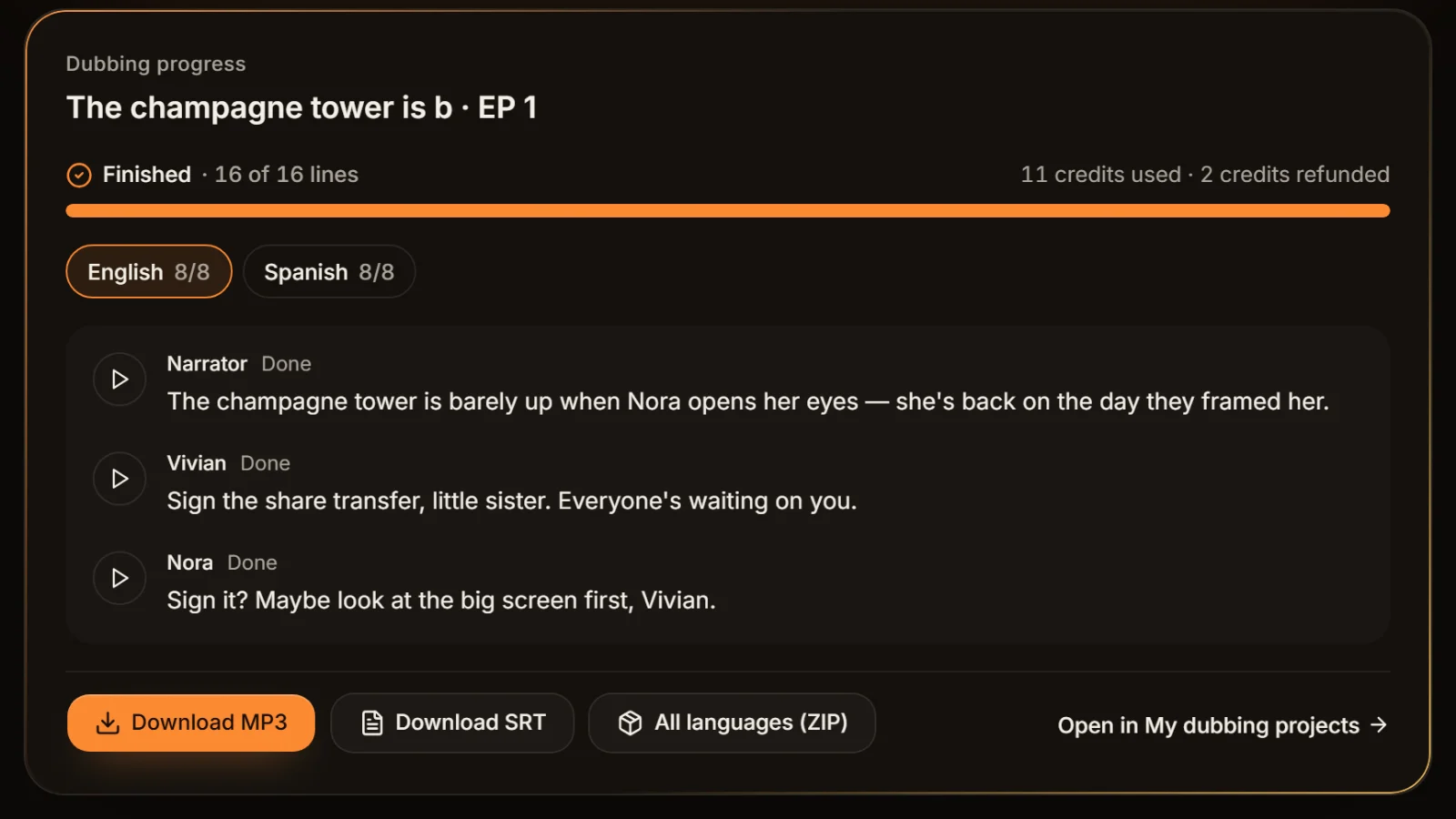
Don't skip the AI label
TikTok's Help Center lists making a subject say something they didn't say, such as AI-generated speech, as content to label; YouTube asks for disclosure of realistic altered or synthetic content. Turn on the AI-generated content setting when you upload an AI-dubbed live-action drama. For releases in China, see how to label AI-generated content.
Do overseas dubs need human voice actors?
In testing and high-volume release, AI dubbing earns its place through speed and consistency: a character keeps the same voice across dozens of episodes and a rewrite costs one line. For a flagship series, test with the AI version first and bring in native voice actors to polish the key scenes once the numbers justify it. Either way, have a native speaker listen through every episode at least once.
Five checks before you hand files to an overseas platform
One spelling per name, all series long
English and Spanish versions use pinyin (Lin Wan); Vietnamese audiences expect Sino-Vietnamese readings. Pick one form per language and keep it; our short-drama localization guide has a reference table.
Break subtitles the platform way
The SRT is split line by line with the dub. Keep a vertical frame to two lines at most and break long lines at natural phrase boundaries in the editor.
Estimate length before locking the script
Foreign versions run longer or shorter than the Chinese one. If a platform caps episode length, check first with the script duration calculator.
Keep the Chinese version alongside
Review the Chinese and foreign versions on the same timeline; missing lines and flat emotion jump out immediately.
Ask the platform for its delivery sheet
Apps like ReelShort and DramaBox don't publish their content delivery requirements. Get the file format, naming and subtitle rules from your partner contact, then export to match.
Frequently asked questions
Short drama dubbing software falls into two groups: video translation tools that start from a finished video (detecting voices and subtitles, then translating and dubbing), and script-first multi-character tools such as AI Drama Voice that turn the script into multilingual MP3 + SRT. If you already have the cut, use the first; if you have the script and need several languages, use the second.
TikTok takes a video, not a separate audio track: combine the MP3 and SRT into a vertical episode in CapCut or a similar editor, then upload. TikTok's Help Center says uploads can run up to 60 minutes, and content with realistic AI speech should carry the AI-generated label (checked 2026-11).
ReelShort hasn't published its dubbing workflow. What its App Store page does show is that it offers vertical mini series and supports 22 interface languages. If you supply series to an app like this, the dub and subtitle spec comes from the delivery sheet the platform gives you; AI Drama Voice can export MP3 and SRT per episode and language to match it.
It depends on what you have. Dubbing from the script skips the loop of cutting the Chinese version, then stripping, detecting and translating it; one cast list covers several languages and a rewrite costs one line. An older series with no usable script is simpler to translate as video. Pricing is per character of dialogue; see the pricing page.
Not always. For volume releases and market tests, AI dubbing wins on speed and character consistency; for a flagship series you can test the AI version first, then have native voice actors polish the key scenes. In both cases, get a native speaker to review.
No. AI Drama Voice delivers audio and subtitles: an MP3 per episode and language, an SRT timed line by line, and a ZIP of everything. The vertical episode is assembled in CapCut, Premiere or another editor. It also doesn't do lip sync or voice cloning.





One script, every overseas market One cast. Every market.
Paste the script, confirm the cast, tick your target languages. The same cast performs them all, and every episode ships as MP3 + SRT.
Billed by characters generated · Failed runs refunded automatically · Alipay, WeChat Pay and cards