AI Voiceover Mispronunciation: Fixing Misread Chinese Characters
AI voiceover mispronunciation in Chinese is rarely random. It clusters in a few predictable places: one- or two-character lines built on characters like 还, 行, 长 and 重; period-drama words such as 中计, 早朝 and 可汗; family names; and digits or abbreviations. This guide explains why an AI voice picks the wrong reading, compares the three standard fixes (pinyin hints, homophone swaps and a pronunciation dictionary), gives you a checklist of the characters that trip up short-drama and xianxia scripts, and shows exactly what you can and cannot do about it in AI Drama Voice and in CapCut (Jianying).
- 3 fixes compared
- Drama + period word list
- Works for CapCut too
Updated Nov 5, 2026Fact-checked Nov 5, 2026
Sample B · The sweeper who shook the sect
English · Script excerpt · 5 characters

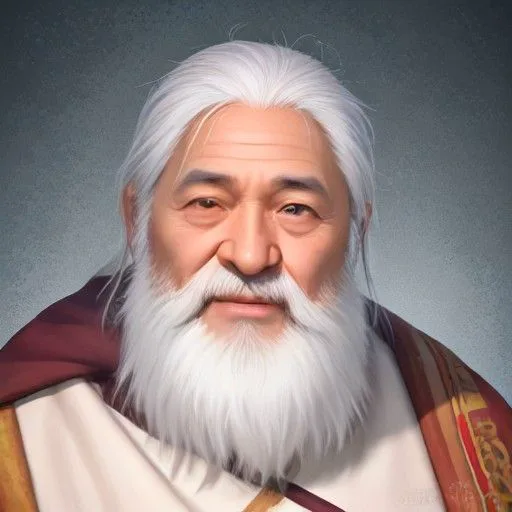
Narrator
The Azure Cloud Sect tournament roars around the arena. Ye Chen, who swept leaves for three years, steps up with a bamboo sword.

Xiao LingSarcastic
A yard sweeper thinks he can stand against me?

YunyaoWhisper
Brother Ye, don't push it... he's the best in the inner sect.

Ye ChenCalm
Three years of sweeping. I only practiced one strike.
On this page
- 1How to fix AI voiceover mispronunciation in 5 steps
- 2Why AI voices misread Chinese characters
- 3Chinese characters AI voices misread most in drama scripts
- 4Pinyin hint, homophone swap or pronunciation dictionary?
- 5The three fixes, with before-and-after lines
- 6Fixing misread characters in AI Drama Voice
- 7Fixing misread characters in CapCut (Jianying) text-to-speech
- 86 script habits that prevent misread characters
- 9Frequently asked questions
How to fix AI voiceover mispronunciation in 5 steps
Whatever tool you use, the order is the same: find every error first, work out why it happened, then redo only the lines that are wrong.
- 01
Step 1
Listen through and log every misread line
Note the line number, the character and what it was read as. Don't stop to fix the first one you hear; collect the whole episode's problems first so you can deal with them in one pass.
Tip · A character that is misread once is usually misread again. Search the script for it (Ctrl+F) as soon as you log it.
- 02
Step 2
Work out which kind of error it is
Match it to one of the four causes below: a line too short to give context, an ambiguous word split, a rare name or period term, or a number or abbreviation that was not written the way it should be said. The cause decides the fix.
- 03
Step 3
Pick a fix your tool supports
If the tool has pinyin hints or a pronunciation dictionary, use them; one entry fixes every occurrence. If not, reword the line or swap in a homophone. When you are also producing foreign-language versions, prefer rewording.
- 04
Step 4
Regenerate only the broken lines
Voice the corrected lines again with the same voice and the same emotion and leave everything else untouched. Re-dubbing a whole episode wastes credits and can change lines that were already right.
- 05
Step 5
Check the subtitles and the other languages
After a homophone swap the subtitle shows the substitute character, so fix that cue in your editor. Then listen to character names in the foreign versions and make sure they are said the same way in every episode.
Why AI voices misread Chinese characters
To stop AI voiceover mispronunciation, start with why it happens. The errors are not random, and once you know where they come from you can avoid most of them in the script itself.
How a voice model picks a reading
Classic text-to-speech does three things before it speaks: it turns digits and symbols into words, splits the sentence into words, and chooses a reading for each character from a dictionary plus the context. Newer end-to-end and large-model voices no longer have separate steps; they learn readings from huge amounts of speech. The principle is the same: the model guesses from context. The fuller the sentence and the more common the words, the better the guess. A one-word line, a rare period term or an unusual family name is where it guesses wrong. Many common characters are polyphonic: 行 is xíng in 一行人 (a group of people) but háng in 行业 (an industry).
The four situations that cause most errors
| Situation | Example line | Why it goes wrong |
|---|---|---|
| Too little context | “还?” “行。” “长了。” | With one or two characters the model falls back on the most frequent reading |
| Ambiguous word split | “他的头发长了。” (His hair has grown / is long) | 长了 can be zhǎng (grew) or cháng (got longer); even a person needs more context |
| Rare names and period terms | “单于遣使求和。” “曾先生到了。” | These readings are rare in everyday text, so the model prefers the common one |
| Digits, symbols, abbreviations | “比分 3:0。” “打 110。” | Numbers have several spoken forms and the model cannot know which you want |
Why comic and xianxia dramas get more errors
AI comic dramas, xianxia and palace dramas are full of period titles, ranks, place names and technique names, and their lines are often very short (“放肆!” Insolence! “退下。” Leave us.). Rare words plus short lines hit both weak spots of AI voices at once, which is why these genres usually have more misread characters than modern city dramas.
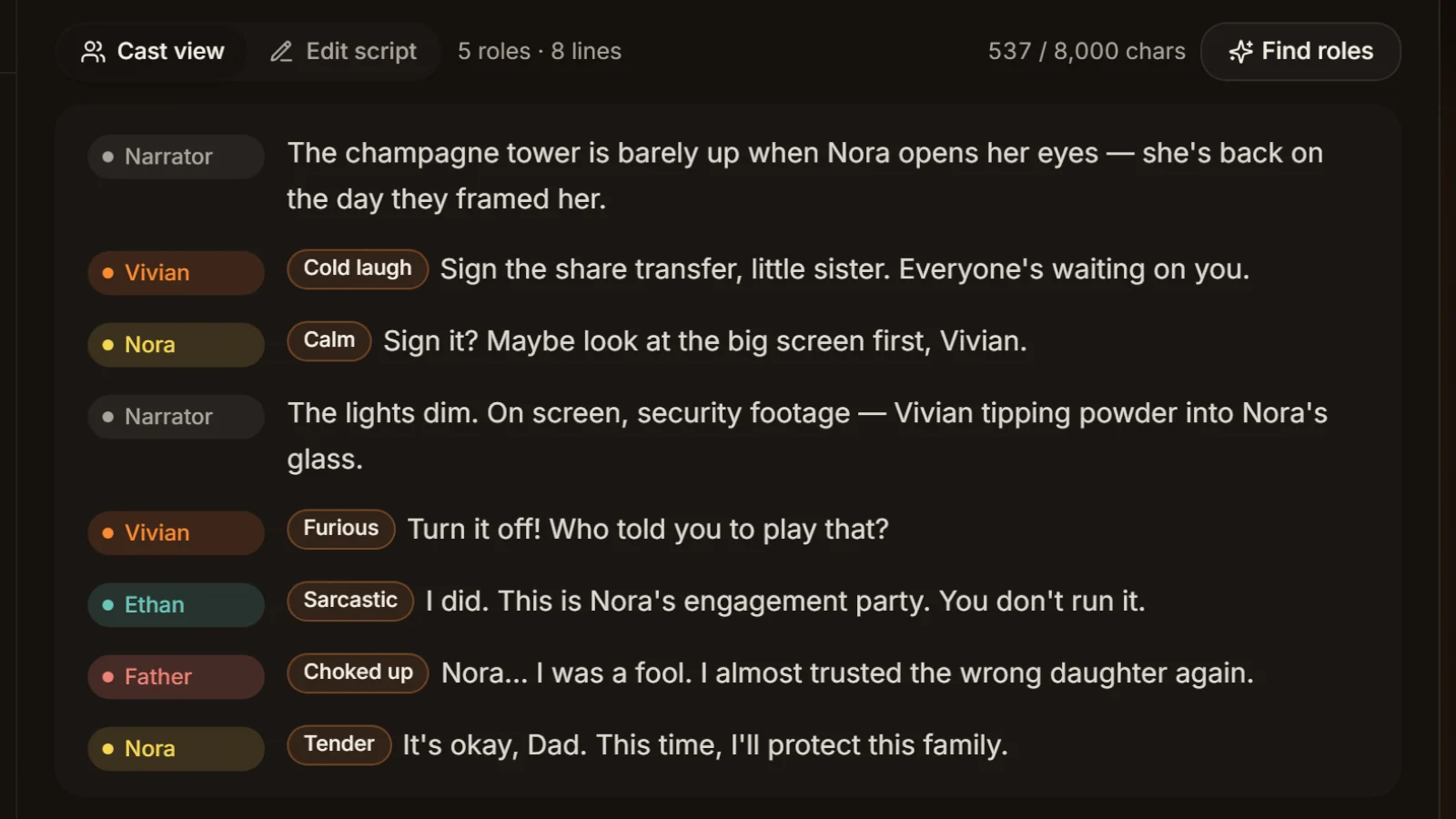
Chinese characters AI voices misread most in drama scripts
The quickest cure for AI voiceover mispronunciation is to find the risky characters before you generate. Every example below is a typical short-drama line; search your script for these characters.
Modern short dramas
| Character | Example line (meaning) | Correct here | Often read as |
|---|---|---|---|
| 还 | 这笔钱,你什么时候还? (When will you pay it back?) | huán | hái |
| 行 | 我在这一行干了十年。 (Ten years in this business.) | háng | xíng |
| 长 | 你长大了,翅膀硬了? (All grown up now?) | zhǎng | cháng |
| 重 | 七年后,我们在机场重逢。 (We met again.) | chóng | zhòng |
| 当 | 一句玩笑,你还当真了? (You took it seriously?) | dàng | dāng |
| 着 | 别着急,慢慢说。 (Don't panic.) | zháo | zhe |
| 露 | 今天还是露馅了。 (The act finally slipped.) | lòu | lù |
| 薄 | 你这个薄情的男人! (You heartless man!) | bó | báo |
| 恶 | 可恶,又让他跑了! (Damn it, he got away!) | wù | è |
| 强 | 做不到就别勉强。 (Don't force yourself.) | qiǎng | qiáng |
| 差 | 陆总明天出差。 (Mr. Lu travels for work tomorrow.) | chāi | chà |
| 落 | 你的手机落在我车上了。 (You left your phone in my car.) | là | luò |
Period, palace and xianxia dramas
| Character / word | Example line (meaning) | Correct here | Often read as |
|---|---|---|---|
| 中 | 娘娘,您中计了。 (You fell for it, Your Highness.) | zhòng | zhōng |
| 朝 | 明日早朝,本王自有分寸。 (At court tomorrow…) | cháo | zhāo |
| 降 | 降者不杀! (Surrender and live!) | xiáng | jiàng |
| 宿 | 紫微星宿有异。 (The stars are restless.) | xiù | sù |
| 藏 | 秘境里藏着上古宝藏。 (A hidden ancient treasure.) | cáng / zàng | the same reading twice |
| 参 | 这株千年人参,献给师尊。 (A thousand-year ginseng.) | shēn | cān |
| 调 | 即刻调兵,守住城门。 (Move the troops now.) | diào | tiáo |
| 传 | 《列仙传》里记过这门功法。 (Recorded in a classic.) | zhuàn | chuán |
| 大夫 | 快传大夫! (Call a physician!) | dàifu | dàfū |
| 便宜 | 此事可便宜行事。 (Act at your discretion.) | biànyí | piányi |
| 可汗 | 可汗已率兵南下。 (The Khan marches south.) | kèhán | kěhàn |
| 单于 | 单于遣使求和。 (The Chanyu sues for peace.) | chányú | dānyú |
Family names that get misread
Names are the worst offenders because a wrong reading repeats every time the character appears, in every episode. These family names are common in short dramas; listen closely the first time each one comes up.
| Family name | Correct reading | Often read as |
|---|---|---|
| 单 | Shàn | dān |
| 解 | Xiè | jiě |
| 曾 | Zēng | céng |
| 仇 | Qiú | chóu |
| 查 | Zhā | chá |
| 朴 | Piáo | pǔ |
| 区 | Ōu | qū |
| 尉迟 | Yùchí | wèichí |
| 长孙 | Zhǎngsūn | chángsūn |
| 万俟 | Mòqí | wànsì |

Pinyin hint, homophone swap or pronunciation dictionary?
No single fix suits every case of AI voiceover mispronunciation. It depends on what your tool supports and whether you also need foreign-language versions.
| Point | Pinyin hint | Homophone swap | Pronunciation dictionary |
|---|---|---|---|
| What you do | Assign a reading to that character | Replace it with a single-reading character that sounds right | Store “word = reading” once |
| Needs tool support | Yes (per-character reading or SSML-style markup) | No, works anywhere | Yes |
| How long a fix lasts | This occurrence only | This occurrence only | Every episode from now on |
| Effect on subtitles | None | Subtitle shows the substitute; fix it by hand | None |
| Effect on translation | None | May confuse the translation | None |
| Best for | One or two rare spots | Emergency fix when the tool has no pronunciation feature | Names, places and techniques that recur |
Checked Nov 2026 · Summarised from how common voice tools work; check what your own tool actually offers.
The three fixes, with before-and-after lines
Fix 1: pinyin hint
In tools that support it, you usually select the character and pick the right reading from a list; developer speech APIs often use an SSML phoneme-style tag, with syntax that differs by vendor. Be careful: in a tool without this feature, writing 这一行(háng) makes the brackets and the pinyin part of the line. They get spoken and they land in the subtitles.
Fix 2: homophone swap
Replace the risky character with one that has only one reading and sounds right. It works in any tool, which makes it the standard emergency fix when an AI voice or CapCut's text-to-speech misreads a character. The cost is that the text changes: the subtitle shows the substitute, and a translation may be thrown off.
| Before (misread) | After (for the voice only) | Reading you want |
|---|---|---|
| 这笔钱,你什么时候还? | 这笔钱,你什么时候环? | huán |
| 娘娘,您中计了。 | 娘娘,您众计了。 | zhòng |
| 今天还是露馅了。 | 今天还是漏馅了。 | lòu |
| 可恶,又让他跑了! | 可务,又让他跑了! | wù |
| 单于遣使求和。 | 蝉于遣使求和。 | chányú |
| 曾先生到了。 | 增先生到了。 | Zēng |
Fix 3: pronunciation dictionary
A pronunciation dictionary maps a word to its reading once, and every later occurrence follows it. A lead whose family name is 单, a villain called 尉迟, a technique named after 龟兹: recurring names like these are exactly what a dictionary is for. Some speech platforms and dubbing apps offer it under names such as custom pronunciation, lexicon or pronunciation rules.
Bonus fix: say it differently
Many misreadings come from lines that are too short or too literary. Giving the model more context, or a more common word, is more reliable than any markup, and it leaves subtitles and translations intact.
| Before | After | Why it works |
|---|---|---|
| 还? | 钱呢?什么时候还我? | With 钱 and 我 added, 还 can only be huán |
| 我在这一行干了十年。 | 这个行业,我干了十年。 | 行业 is a high-frequency word that is almost never misread |
| 他的头发长了。 | 他的头发又长出来了。 | 长出来 can only be zhǎng |
| 你还当真了? | 你还真信了? | Avoids the polyphonic character entirely |
Fixing misread characters in AI Drama Voice
First what the tool can and cannot do, then the workflow that actually works.
Straight answer
AI Drama Voice has no pronunciation dictionary and no per-character reading setting today. Brackets in the middle of a line are treated as part of the line: write 这一行(háng) and háng is spoken and ends up in the subtitle. Only a bracket at the very start of a line, as in 林晚(冷笑):, is read as an emotion or a delivery note.
Before generating: run the script past the word list
- 1.Paste the script into the workshop, but don't generate yet.
- 2.Search the script for the risky characters in the list above and for every name in your series sheet.
- 3.Reword first: add context or swap in a common word. Rewording has no side effects on subtitles or translations.
- 4.Use a homophone only where you can't reword, and note it so you can fix the subtitle later.
- 5.Click Analyze cast, check the cast and emotion tags, then generate. Cast analysis is free.
Found it after generating: re-voice only those lines
Paste the misread lines as a new short script with exactly the same speaker names, set each character back to the voice it used before, and generate just those lines. You are charged only for their characters; see pricing. Download the new MP3, cut the old line out in your editor and drop the new one in, then correct the subtitle. The editing steps are in the CapCut (Jianying) sync guide.
Making foreign versions too? Keep homophones out of the translation
Foreign versions are made by translating your Chinese line by line, then voicing it with the same cast. If 可恶 becomes 可务 in the script, the translator sees a word that does not exist. The safe approach: when you generate several languages at once, only reword. If you really need a homophone, generate the foreign versions from the original text first, then generate the Chinese version separately from the edited text. For a script layout that dubs well, see the short-drama script format.
Fixing misread characters in CapCut (Jianying) text-to-speech
Many creators first meet this problem in Jianying's or CapCut's built-in text-to-speech. Menus move between versions, so here is the approach rather than exact buttons.
- 1.Check whether your version has a per-character reading option: in some versions you can select a character in the read-aloud text and choose its reading. The entry and its name change between versions.
- 2.If there is no such option, swap in a homophone in the text that is read aloud, and generate the audio.
- 3.The read-aloud result is a separate audio clip. Once the audio is right, change the on-screen subtitle back to the correct character; try it on one line first to make sure your version does not re-generate the audio when the text changes.
- 4.Write digits and abbreviations the way they are said, for example 二〇二六年 instead of 2026年 and 三比零 instead of 3:0.
For multi-character dramas
Voicing and fixing a full cast line by line inside an editor is slow. Voice the whole multi-character episode in AI Drama Voice first, export MP3 + SRT, and use the editor only for cutting and the odd subtitle fix.
6 script habits that prevent misread characters
The best fix for AI voiceover mispronunciation is a script that never triggers it. These habits work with any voice tool.
Write numbers as they are spoken
2026年 becomes 二〇二六年, 3:0 becomes 三比零, and 110 becomes 幺幺零 or 一百一十 depending on the scene.
Spell out abbreviations
Mr. 陆 becomes 陆先生 and No.7 becomes 七号. When a character really speaks English, give that its own line.
Avoid one-word lines
还? and 行。 are the easiest to misread. Add an object or a particle and both the reading and the emotion become more stable.
Keep a pronunciation sheet per series
One row each for names, places, sects, techniques and ranks, with the reading. Whoever reviews the audio checks against it, so nothing is missed when people change.
Keep polyphones out of lead names
If the script isn't final, avoid polyphonic characters in the leads' names. A name appears dozens of times per episode, and one wrong reading means dozens of fixes.
Give period terms full sentences
Words like 早朝, 星宿 or 降者不杀 are read correctly far more often inside a complete sentence. More on period scripts in period drama dubbing.
Frequently asked questions
It depends on the tool. If it supports pinyin hints or a pronunciation dictionary, use them; one entry fixes every occurrence. If not, reword the line to give more context, or swap in a homophone with the right reading, then regenerate only the affected lines.
First check whether your version offers a per-character reading option. If it doesn't, put a homophone in the read-aloud text, generate the audio, then change the on-screen subtitle back to the correct character.
Usually because the line is too short to give context, the word split is ambiguous, a name or period term is rare in everyday text, or a number has several spoken forms. Complete sentences and common words avoid most of it.
Write them exactly as they should be said: 二〇二六年 rather than 2026年, 三比零 rather than 3:0, 陆先生 rather than Mr. 陆. That way you don't depend on any tool's number rules.
Not with Chinese polyphones, because the foreign lines are translated and then voiced. Do check that name transliterations stay consistent and listen for English heteronyms like read, lead and live. Homophone swaps in the Chinese can mislead the translation, so reword instead when you dub several languages.
Not today. AI Drama Voice has no pronunciation dictionary or per-character setting, and pinyin in brackets mid-line is read aloud. Reword the line or use a homophone, then regenerate just those lines.





Check the readings before you generate Fix the script, not the take.
Paste your script into the workshop, run it past the word list, and look at the free cast analysis before you voice the episode.
Billed by characters generated · Failed runs refunded automatically · Alipay, WeChat Pay and cards