Midnight Radio
Velvet · narrator
● Narrator
Sets up the rebirth at an even pace, with pauses at line ends.
NarratorsMale9 languages
The hard part of Japanese dubbing software isn't pronunciation — it's who speaks to whom, and how politely. Paste a Chinese short-drama or motion-comic script into AI Drama Voice. The AI splits the roles, tags every line's emotion and rewrites the dialogue into Japanese by relationship: keigo from the assistant to the company president, casual speech between lovers, ore for the domineering CEO, watakushi for the rich young lady. The same cast voices it, and you export a Japanese MP3 and an SRT file timed line by line.
Updated Nov 5, 2026Fact-checked Nov 5, 2026
Japanese · Showdown at the engagement party
Japanese · Script excerpt · 5 characters
NarratorCalm
婚約パーティーの日、彼女は目を覚ました。今度こそ、黙ってはいない。
On the day of the engagement party, she opened her eyes. This time she would not stay silent.

Best friend · Su TianTender
今日の主役はあなたなんだから。ほら、一杯だけ付き合って?
Today's all about you, you know. Come on, just one drink with me?

Heroine · Lin WanCold laugh
そのお酒、あなたが飲めば?
That drink? Why don't you have it?

Fiancé · Gu ChengFurious
いい加減にしろ!今日は俺たちの婚約パーティーだぞ!
Knock it off! This is our engagement party!
This is the real dubbing studio, set to Japanese with a motion-comic sample loaded. Change a few lines and watch the cast list and emotion tags update — this step costs no credits.
Narrator
Storyteller · 2 lines
5 roles · 7 lines
504 / 8,000 charsSame cast · Japanese
Sample in production · sign in to generate it now
The first clip is from the Japanese version of Sample A, Showdown at the engagement party, played by the same cast as the Chinese original; the lines are a script excerpt from the episode (not all of them fall inside these few seconds). The other two are third-party Japanese multi-voice clips, transcribed as spoken, to compare a live-action drama delivery with an anime delivery.
Script excerpt · Japanese · Showdown at the engagement party
NarratorCalm
婚約パーティーの日、彼女は目を覚ました。今度こそ、黙ってはいない。
On the day of the engagement party, she opened her eyes. This time she would not stay silent.
Best friend · Su TianTender
今日の主役はあなたなんだから。ほら、一杯だけ付き合って?
Today's all about you, you know. Come on, just one drink with me?
Heroine · Lin WanCold laugh
そのお酒、あなたが飲めば?
That drink? Why don't you have it?
Fiancé · Gu ChengFurious
いい加減にしろ!今日は俺たちの婚約パーティーだぞ!
Knock it off! This is our engagement party!
Father · Lin ZhenguoChoked up
すまなかった……父さんが悪かった。
I'm sorry… your father was wrong.
Script excerpt · Drama style · After the last train (romance)
Segawa
うん。
Yeah.
Haruka
資料、誰に直してもらえばいいんですか。
Who's going to fix my documents now?
Segawa
送ってくれればいい。毎晩でも見るよ。
Just send them to me. I'll look every night if I have to.
Haruka
毎晩は、迷惑です。
Every night would be a bother.
Segawa
迷惑じゃない。……毎晩、声が聞けるなら。
It's no bother… if I get to hear your voice every night.
Narrator
春香は、うつむいたまま歩いた。缶を持つ指に、力が入る。
Haruka walked on with her head down, her fingers tightening around the can.
Haruka
……大阪、遠いですね。
…Osaka's far away, isn't it.
Segawa
新幹線で二時間半。週末なら、帰ってこられる。
Two and a half hours by bullet train. I can come back on weekends.
Haruka
帰ってくるんですか。
You'd come back?
Script excerpt · Anime style · The guild clerk leaves on time (isekai)
Guild master
……うむ。書きなさい、レオン君。
…Very well. Write it, Leon.
Leon
わかったよ。で、これ、いつまでに?
Fine. So when's it due?
Mina
今日の六時までです。
By six o'clock today.
Narrator
時計の針が五十八分を指した。勇者の顔から、ドラゴンと戦ったときより血の気が引いていく。
The clock hand reached fifty-eight. The hero went paler than he had fighting the dragon.
Leon
無理だ!二分で三十一件なんて、魔王を倒すより難しい!
Impossible! Thirty-one forms in two minutes is harder than beating the Demon King!
Mina
では、明日の朝九時に。受付は九時からです。
Then tomorrow at nine. The desk opens at nine.
Leon
明日でいいのか?
Tomorrow's okay?
With this Japanese dubbing software, translation, casting, voicing and timing all happen on one screen, from Chinese script to Japanese episode.
Short-drama scripts and motion-comic panel dialogue both work. Write “Name: line”; lines without a name go to the narrator. Put the emotion in brackets at the start, like “(cold laugh)” — the cue is never read aloud.
The AI finds the narrator and every character and picks voices by gender, age and persona, so the male and female leads each get their own voice. Swap any that don't fit.
Tip · Cast analysis costs nothing, so get the casting right first.
Each line goes to translation with its speaker and emotion and comes back as spoken Japanese, with names kept consistent and keigo and pronouns chosen by relationship, then the same cast voices it.
Download the Japanese MP3 and SRT and line them up against the original in CapCut or any editor; if you also ticked Korean or English, pack everything into one ZIP.
Japanese shares kanji with Chinese and looks close. In dubbing, that closeness is exactly where the traps are — and where Japanese dubbing software most often slips.
Japanese · 日本語
In Chinese, “President Gu, the car is ready” is one sentence for everyone. In Japanese you first decide who is speaking to whom: an assistant uses honorific and humble forms with the president, the president answers in plain form, lovers use casual speech (tameguchi). Get the direction wrong and viewers think the relationship changed.
Japanese · 日本語
Japanese has many words for “I”, and sentence endings carry identity. The domineering CEO says ore, the gentle second lead says boku, the rich rival says watakushi and ends with desu wa, the old sect master says washi and ends with ja. None of that is visible in the Chinese, so the rewrite has to add it.
Japanese · 日本語
Japanese kanji have on and kun readings, and the same character reads differently in different words. 林 in a Chinese name is usually rin, but it is also the common Japanese surname Hayashi; 今日 can be kyō or konnichi. Writing names in katakana is the safest way to pin the reading.
Japanese · 日本語
Japanese uses a lot of kana, so the same line usually takes more characters than Chinese. Each exported SRT cue is one full line with no automatic break; on a vertical frame, break after a particle (wa, ga, o, ni) or a comma, never in the middle of a word.
The Chinese character voices speak Japanese directly, so each character sounds the same in both versions. For a Japanese-only release with a more native accent, switch to voices that speak Japanese only.
Velvet · narrator
● Narrator
Sets up the rebirth at an even pace, with pauses at line ends.
Cold · villainous
● Heroine · Lin Wan
Her cold line is “anata ga nomeba?” — polite on the surface, all thorns underneath.
Deep · commanding
● Fiancé · Gu Cheng
Ore and da zo in his outburst: rough, masculine speech.
Bright · playful
● Best friend · Su Tian
No “onee-chan” (that means a real sister); she says “today's all about you” instead.
Japanese · anime
● Native Japanese voice · Hina
Bright anime delivery for motion comics, anime-style heroines and girl characters.

Japanese · calm
● Native Japanese voice · Aoi
Calm and composed, for city-drama heroines and narration.
Each character keeps one voice in Chinese, Japanese and every other language, so a comic series still sounds like itself after it changes language.
Each line goes to translation with its speaker and emotion, so keigo and pronouns have something to go on instead of lines translated in isolation.
Cold laugh, choked, furious and whisper tags apply line by line, so Japanese arguments rise and fall like the original.
SRT cue times come from where each dubbed line sits in the MP3, so there's no transcription or timing pass in CapCut.
You pay by characters, failed lines get their credits back automatically, and cast analysis is free.
These are the kinds of shows where Japanese dubbing software pays off fastest.
Anime-style motion comics are a natural fit: school, isekai and romance personas map neatly onto Japanese character speech. See AI anime voice dubbing.
In CEO romances, contract marriages and office love stories, rank is the plot — and Japanese keigo makes the status gap audible.
A first-person narrator plus character dialogue, each with its own voice, for Japanese novel-promo videos and audio content.
Produce an AI first pass for the client to approve lines and casting, then bring in a native polisher for the key scenes.
Plenty of Japanese dubbing software does one thing: read Japanese text aloud. For a short drama or a motion comic that falls apart fast. Five or six characters need their own voices, every line needs an emotion, and above all the Japanese has to be written right — keigo direction, pronouns and sentence endings are all tied to the persona. When you compare tools, check whether they go straight from a Chinese script to Japanese, split the roles for you and export timed subtitles.
Here are the relationships short dramas use most and how a typical line sounds in Japanese for each. AI Drama Voice chooses keigo from the speaker and the surrounding lines; the clearer the relationship in the script — titles, the lines themselves — the better the choice.
| Relationship | Chinese line | Typical Japanese | Register |
|---|---|---|---|
| Assistant → president | 顾总,车准备好了。 | 顧社長、お車の準備ができております。 | Honorific + humble |
| President → assistant | 把车开过来。 | 車を回してくれ。 | Plain (instruction) |
| Lovers | 等我一下。 | ちょっと待ってて。 | Casual (tameguchi) |
| Daughter-in-law → father-in-law | 爸,您先吃。 | お義父さん、どうぞ召し上がってください。 | Polite + honorific |
| Maid → young lady | 小姐,夫人在等您。 | お嬢様、奥様がお待ちです。 | Polite + honorific |
顾总 usually becomes 顧社長 or simply 社長 in Japanese; a chairman is 会長, a 夫人 is 奥様, a young lady is お嬢様 and a young master is 坊ちゃま or 若様. Watch “sister” in particular: onee-chan means an actual older sister, so friends use a first name with -chan or no title at all. Translate it literally and viewers think the two women are siblings.
| Chinese original | Japanese | Character · emotion | What changed |
|---|---|---|---|
| 姐姐,今天你最漂亮了,陪我喝一杯嘛。 | 今日の主役はあなたなんだから。ほら、一杯だけ付き合って? | Su Tian · tender | “Sister” dropped; shuyaku (the star) points to the party |
| 这杯酒,你还是留着自己喝吧。 | そのお酒、あなたが飲めば? | Lin Wan · cold laugh | Ending on a question is colder than an order |
| 你闹够了没有! | いい加減にしろ! | Gu Cheng · furious | Masculine imperative, short and hard |
| 顾总,车已经在楼下了。 | 顧社長、お車の準備ができております。 | Assistant · calm | O-kuruma and orimasu: double politeness |
| 晚晚……爸爸对不起你。 | すまなかった……父さんが悪かった。 | Lin Zhenguo · choked | A Japanese father saying tō-san of himself reads more naturally than a transliterated pet name |
Watch out
Don't put notes about relationships in the script: any line without a speaker name is read out by the narrator. Let titles carry the relationship — write 顾总, not “the man” — so the Japanese keigo has something to go on.
You can do the first review without any Japanese. The Chinese and Japanese SRT files match cue for cue, so run through this checklist and most problems show up; leave the rest to a native polisher.
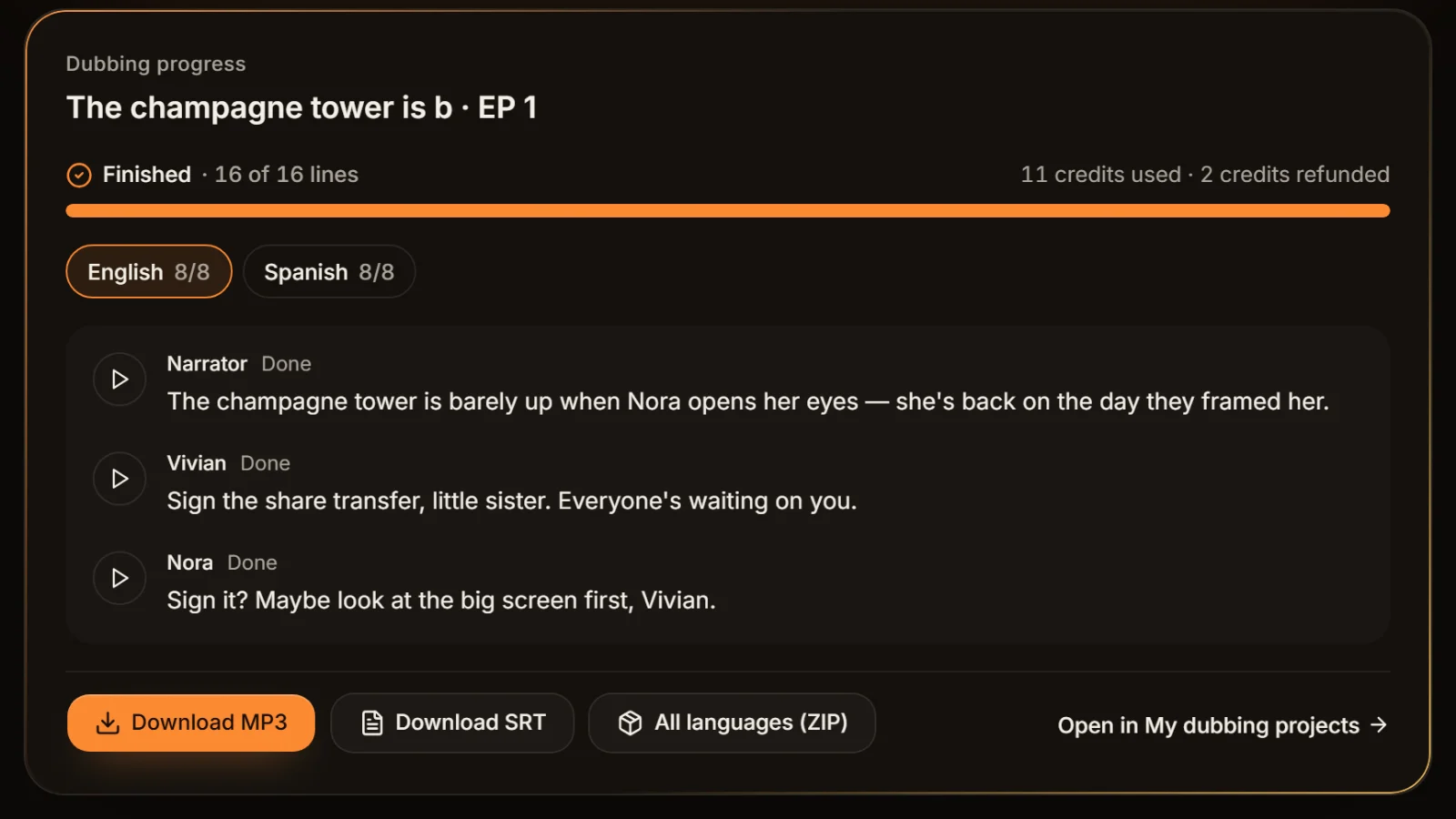
Yes. SRT cue times come from where each dubbed line sits in the MP3. Import the MP3 onto an audio track and the SRT as captions from the same starting point and they line up. Step by step: the CapCut / Jianying sync guide. If a word is read wrongly, see fixing misread characters in AI voices.
Lines that say 顾总, 林小姐 or 爸 give the Japanese far more to go on than lines that only say “he” or “you”.
Settle each name's reading in the first episode and keep the same spelling for the whole series so subtitles and audio stay consistent.
Motion comics and anime-style stories suit a bright voice like Hina; city romance sounds more like Japanese TV drama with a composed voice like Aoi.
East Asian audiences know these genres well: tick Japanese and Korean in one run and one cast voices both — see Korean dubbing.
For a series you'll run for months, have a native Japanese speaker listen through, focusing on keigo, jokes and onomatopoeia.
It depends on what you're dubbing. For a single narration, any Japanese read-aloud tool will do. For short dramas and motion comics, pick one that goes straight from a Chinese script to Japanese, casts the roles, keeps each voice fixed and exports timed subtitles. AI Drama Voice is built around that workflow, and cast analysis is free to try.
Yes. The AI finds the narrator and every character and gives each a voice by gender, age and persona, so leads, villains and narrator all sound different; you can swap any voice by hand.
Yes. Keigo, pronouns and sentence endings carry the relationships and personas, so Chinese titles like 顾总, 姐姐 and 晚晚 all need Japanese equivalents. AI Drama Voice sends each line to translation with its speaker and emotion and picks keigo by relationship; for flagship shows, have a native review it.
Start by counting cues: the Chinese and Japanese SRT files match line for line, so equal counts mean nothing was dropped. Then back-translate the Japanese subtitles, listen for consistent name readings and check that juniors use keigo with their bosses. Leave the fine detail to a native polisher.
Yes. SRT cue times come from where each dubbed line sits in the MP3, so importing the MP3 and SRT from the same start point lines them up. See the CapCut / Jianying sync guide.
No. Paste the Chinese script and tick Japanese; the lines are rewritten into spoken Japanese and then voiced, and you can tick Korean, English and other languages in the same run. Plans are on the pricing page.


Paste the script, confirm the cast, tick Japanese — the same cast performs the whole episode with feeling, and the MP3 and subtitles export together.
Billed by characters generated · Failed runs refunded automatically · Alipay, WeChat Pay and cards