Short drama localization: translate, rename, adapt, dub
Short drama localization is the work of making a Chinese short drama sound like a local show to viewers in the target market. The lines get translated, names and forms of address follow local habits, money, holidays, jokes and taboos get swapped, and the dub and subtitles still have to fit the picture. This guide first separates translation, localization and local remakes, then gives a four-step checklist you can follow, a CEO-drama scene in Chinese, English, Thai and Indonesian, and reference values for subtitle line length and reading speed.
- 4 steps
- Market checklist
- 4-language CEO scene
- Subtitle spec table
Updated Nov 5, 2026Fact-checked Nov 5, 2026
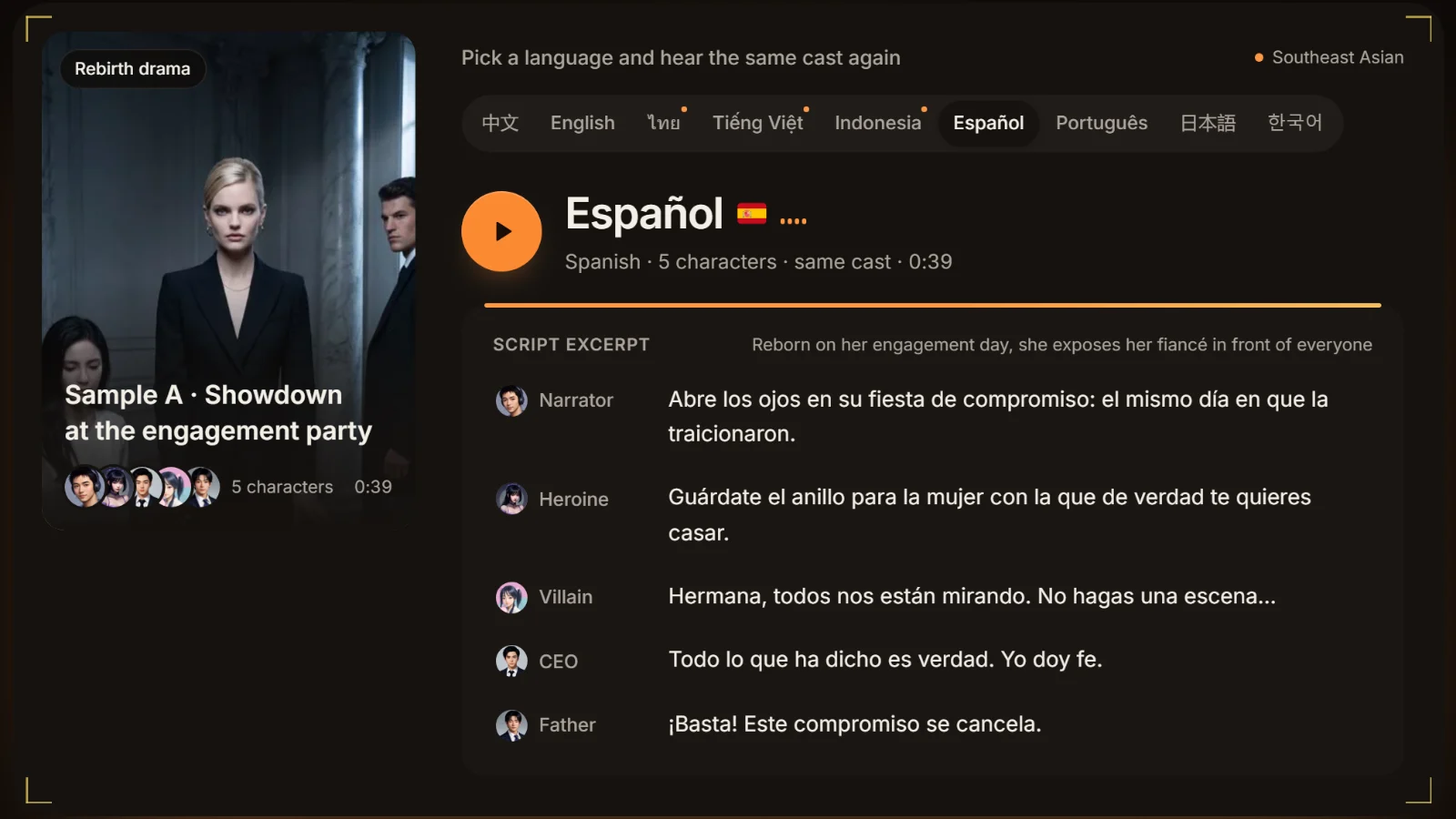
Sample A · Showdown at the engagement party
English · Script excerpt · 5 characters



Narrator
The champagne tower is barely up when Nora opens her eyes — she's back on the day they framed her.

VivianCold laugh
Sign the share transfer, little sister. Everyone's waiting on you.

NoraCalm
Sign it? Maybe look at the big screen first, Vivian.
Narrator
The lights dim. On screen, security footage — Vivian tipping powder into Nora's glass.
On this page
- 1How to do short drama localization in four steps
- 2What short drama localization means, and how it differs from translation and remakes
- 3A short drama localization checklist for Southeast Asia, Latin America, Japan and Korea
- 4One CEO-drama scene localized into English, Thai and Indonesian
- 5Subtitle line length and reading speed by language
- 6Five common short drama localization mistakes
- 7Frequently asked questions
How to do short drama localization in four steps
Order matters: get a faithful translation first, localize on top of it, and dub last. Do it the other way round and every changed title means another re-dub.
- 01
Step 1
Translate: start with a faithful line-by-line draft
Translate the script one line per row with the speaker marked, and keep emotion cues such as a cold laugh or a sob. Don't paraphrase whole passages. This draft's only goal is that nothing is lost; sounding good is the next step.
Tip · If the script itself is messy, start with our short-drama script format guide.
- 02
Step 2
Rename and retitle: one reference table for the whole series
List every character's name and every relationship title (president, madam, big sister, young master), fix the spelling for each target language, and apply the table across the series. The more tangled the relationships, the more this table matters.
- 03
Step 3
Adapt: money, holidays and taboos, item by item
Turn amounts into something local viewers can feel, find local equivalents for holidays and customs, and replace internet slang with expressions locals get. Review anything touching religion, royalty or territory line by line; cutting is better than risking it.
- 04
Step 4
Dub and subtitle: line up voice, text and picture
Send the localized lines to dubbing, generate subtitles from the same source, and break lines to the target language's width. AI Drama Voice voices every language with the same cast and exports a line-timed SRT. Finish with a native speaker listening to the whole episode.
What short drama localization means, and how it differs from translation and remakes
People often lump localization in with translation. Translation makes a show understandable; localization makes it feel local. Take the Chinese line 'President Lu, madam has been waiting downstairs for two hours.' A literal English rendering is fine, but if the Thai version copies the 'Lu-President' structure word for word, Thai viewers will find it odd. Localization rewrites the line the way Thai speakers address a boss and the boss's wife.
| Translation | Localization | Local remake | |
|---|---|---|---|
| What changes | Language only | Language plus names, titles, money, holidays, jokes, taboos | Script, cast and locations |
| Picture | Unchanged | Unchanged (subtitles and overlays may change) | Reshot |
| Investment | Lowest | Medium | Highest |
| How it feels | Understandable, but clearly foreign | Lines sound like locals talking | It is a local show |
| Best for | Quick genre tests | Series you're launching seriously | Proven hits in a priority market |
The workload in localization sits in adapting, not translating. Once the draft exists, a native reviewer has to judge line by line whether locals would say it that way, whether the joke lands and whether a shot could offend. That's why the rules are best set by someone who knows the market, then applied in bulk.
A short drama localization checklist for Southeast Asia, Latin America, Japan and Korea
Three market columns, one row per type of content to handle. For language details, the native reviewer has the final say.
| Item | Southeast Asia (Thai, Vietnamese, Indonesian) | Latin America (Spanish, Brazilian Portuguese) | Japan and Korea |
|---|---|---|---|
| Names | Thai and Indonesian versions usually keep pinyin names; Vietnamese viewers of Chinese dramas expect Sino-Vietnamese readings (the surname Lu becomes Lục) | Keep pinyin or switch to local names; choose one and stick to it | Both languages use either their own reading of the characters or a transliteration of the Chinese; pick one for the series |
| Titles | Thai คุณ, พี่, น้อง with ค่ะ / ครับ marking gender and politeness; Vietnamese anh, chị, em are the relationship; Indonesian Kak, Pak, Bu | Spanish tú vs usted marks closeness; señor and señora for 'sir' and 'madam' | Japanese keigo, -san, -sama; Korean 존댓말 / 반말 and -님 |
| Money | Converting a Chinese 'hundred million' straight into rupiah or dong gets the scale completely wrong; say 'a fortune' instead | Use local currency or a vague phrase | Same for yen and won: convert the sense of the amount |
| Holidays | Red envelopes are อั่งเปา in Thailand's Chinese community and angpao in Indonesia, so they carry over | Explain the red envelope or swap it for a cash gift | Japan has otoshidama and Korea sebaetdon as New Year equivalents |
| Taboos | Indonesia is majority Muslim, so review pork and drinking jokes; Thailand has a specific criminal provision on content about the monarchy; Vietnam banned the film Barbie in 2023 over a map | Handle religious jokes carefully | Handle lines and shots touching history and territory carefully |
| Slang | Most Chinese internet memes need a local replacement or a cut | Same | Same |
Sources on sensitive content: Vietnam's Barbie ban in a Reuters report carried by The Jakarta Post (2023-07-03); Thailand's Section 112 explained by ARTICLE 19.
Forms of address: the five titles every CEO drama uses
| Title | English | Thai | Vietnamese |
|---|---|---|---|
| President Lu | Mr. Lu | ท่านประธาน | Lục tổng / Tổng giám đốc |
| Madam | Mrs. Lu / ma'am | คุณนาย | Phu nhân |
| Big sister (friend) | sis / first name | พี่ | chị |
| Young master | young master | คุณชาย | thiếu gia |
| Dad / Mom | Dad / Mom | พ่อ / แม่ | bố / mẹ |
| Title | Indonesian | Japanese | Korean |
|---|---|---|---|
| President Lu | Pak Lu | 陸社長 | 회장님 / 대표님 |
| Madam | Nyonya | 奥様 | 사모님 |
| Big sister (friend) | Kak | first name + -chan / -san | 언니 |
| Young master | Tuan muda | 坊ちゃん | 도련님 |
| Dad / Mom | Papa / Mama | お父さん / お母さん | 아빠 / 엄마 |
One CEO-drama scene localized into English, Thai and Indonesian
The four lines below are our own example script, showing how one scene handles titles, names and the 'red envelope' in each language. There is no audio here; this is about the text.
| Chinese original | English |
|---|---|
| Secretary (calm): 陆总,夫人在楼下等了两个小时了。 | Mr. Lu, your wife has been waiting downstairs for two hours. |
| Lu Jingchen (cold laugh): 让她等着。 | Let her wait. |
| Lin Wan (calm): 陆景琛,离婚协议我签好了。 | I've signed the divorce papers, Jingchen. |
| Lin Wan (choked): 妈每年给的红包,我一分没动,都还给你们陆家。 | Every red envelope your mother gave me at New Year, I never spent a cent of it. Your family can have it all back. |
| Chinese original | Thai |
|---|---|
| Secretary (calm): 陆总,夫人在楼下等了两个小时了。 | ท่านประธานคะ คุณนายรออยู่ข้างล่างสองชั่วโมงแล้วค่ะ |
| Lu Jingchen (cold laugh): 让她等着。 | ให้เธอรอไปก่อน |
| Lin Wan (calm): 陆景琛,离婚协议我签好了。 | ลู่จิ่งเฉิน ฉันเซ็นใบหย่าแล้ว |
| Lin Wan (choked): 妈每年给的红包,我一分没动,都还给你们陆家。 | อั่งเปาที่แม่ให้ทุกปี ฉันไม่เคยแตะเลยแม้แต่บาทเดียว คืนให้ครอบครัวคุณทั้งหมด |
| Chinese original | Indonesian |
|---|---|
| Secretary (calm): 陆总,夫人在楼下等了两个小时了。 | Pak Lu, Nyonya sudah menunggu di bawah selama dua jam. |
| Lu Jingchen (cold laugh): 让她等着。 | Biarkan dia menunggu. |
| Lin Wan (calm): 陆景琛,离婚协议我签好了。 | Lu Jingchen, surat cerainya sudah kutandatangani. |
| Lin Wan (choked): 妈每年给的红包,我一分没动,都还给你们陆家。 | Semua angpao dari ibumu setiap tahun, sepeser pun tidak pernah kusentuh. Semuanya kukembalikan ke keluarga Lu. |
- 'President Lu': English uses Mr. Lu; Thai uses the job title ท่านประธาน, and since the secretary is a woman she ends with ค่ะ; Indonesian uses Pak plus the surname
- 'Madam': English simply says your wife; Thai คุณนาย is the respectful term for the wife of a man of standing; Indonesian uses Nyonya
- Using the full name signals a break: Thai and Indonesian keep the full name for impact, while in English a full name sounds stiff and the given name Jingchen works better
- 'Red envelope' and 'a cent': English has to explain that it's a New Year gift; Thai and Indonesian already have อั่งเปา and angpao, and 'a single cent' becomes บาท and sepeser
Put the relationships at the top of the script
Open the script with two or three lines such as 'Lin Wan is Lu Jingchen's wife; the secretary is a woman.' AI Drama Voice translates each line together with its speaker, so clear relationships make titles and sentence-final particles more accurate.
Subtitle line length and reading speed by language
Foreign subtitles usually run longer than Chinese. These figures come from Netflix's per-language subtitle style guides; vertical drama apps may differ, so treat them as an upper reference.
| Language | Max characters per line | Reading speed, adult content | Max lines |
|---|---|---|---|
| Simplified Chinese | 16 characters | 9 characters per second | 2 |
| English | 42 characters | 20 characters per second | 2 |
| Thai | 35 characters (tone marks and stacked vowels not counted) | 17 characters per second | 2 |
| Vietnamese | 42 characters | 17 characters per second | 2 |
| Indonesian | 42 characters | 17 characters per second | 2 |
The numbers make one thing clear: what Chinese says in one 16-character line often fills a full line or two in English or Indonesian. Vertical frames are narrower than landscape ones, so break lines at natural phrase boundaries. The SRT AI Drama Voice exports is split line by line with the dub, so you only adjust breaks in your editor; see syncing SRT in CapCut.

Style guides: Simplified Chinese, English, Thai, Vietnamese, Indonesian.
Five common short drama localization mistakes
Names switching between pinyin and English
If a character is Lu Jingchen in episode 3 and Jason in episode 10, viewers think it's someone else. Once a name is set, use the table for the whole series.
Titles copied from the Chinese structure
Carrying 'Lu-President' or 'Sister Wang' over word for word sounds unnatural in most languages. Settle the relationship first, then find the local form of address.
Amounts copied as numbers
A Chinese 'hundred million' in another currency can be wildly off in scale. When unsure, say 'a fortune' or 'everything the family owns'.
Dubbing before the script is locked
Start dubbing before the title table is final and every fix means a re-dub. Lock the localized script, then dub.
Reading subtitles instead of listening
Smooth subtitles don't guarantee a natural dub; particles, sentence endings and pauses have to be heard. Listen to each episode at least once, especially twists and fights.
Frequently asked questions
It's the process of making a Chinese short drama feel local to viewers in the target market: translating the lines, handling names, forms of address, money, holidays, internet slang and taboos, then dubbing and subtitling. It goes further than translation, which changes only the language, and stops short of a remake, which recasts and reshoots.
There's no standard public rate: quotes usually go by script word count or video length, and depend on the language and whether localization review and native polishing are included. We found no verifiable public industry rate, so we don't print a number here; ask for translation, localization review and native polish as separate line items.
Per-minute quotes usually cover subtitle translation of a finished video, and vary widely by language and by whether timing and burn-in are included, so we don't quote unsourced figures. If you start from the script, AI Drama Voice charges by characters of dialogue with translation and dubbing in one run; see the pricing page.
Forms of address, yes; names, optional. Titles define the relationships, so they must be rewritten for the target language. Names can stay in pinyin or become local names, as long as the series is consistent. Vietnamese versions usually use Sino-Vietnamese name readings.
Yes. The dub voices the localized lines, so lock the script before dubbing. In AI Drama Voice translation and dubbing happen in the same run with the same cast in every language, and changing a line means regenerating only that line.




Once the script is localized, hand it to the same cast Localized lines. Same cast.
Paste the script, describe the relationships, tick your target languages. Each line becomes natural local speech, voiced by the same cast, with the SRT alongside.
Billed by characters generated · Failed runs refunded automatically · Alipay, WeChat Pay and cards