
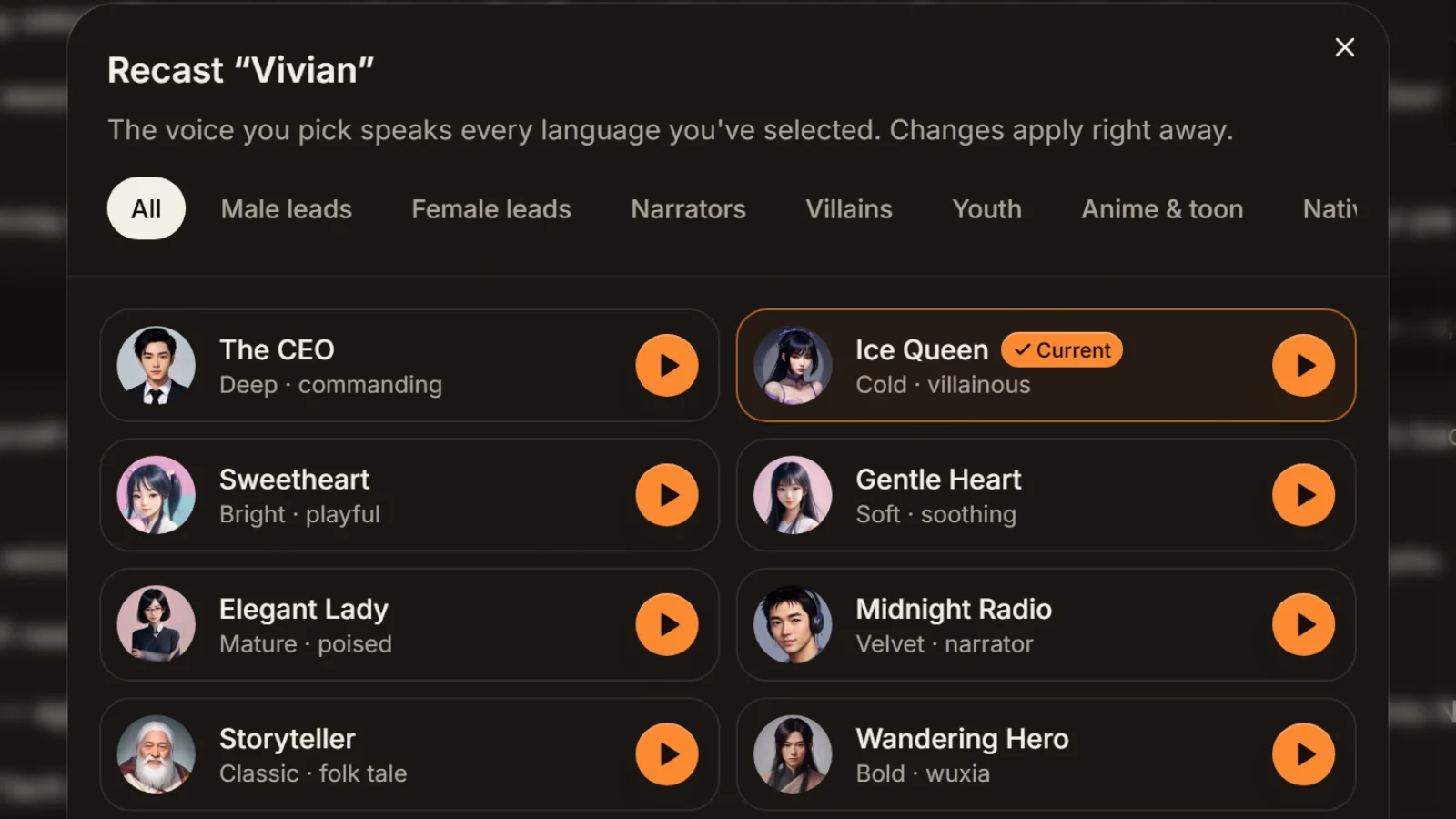
Midnight Radio
Velvet · narrator
● Narrator
Opens the rebirth with full written forms and an even pace.
NarratorsMale9 languages
To take a Chinese short drama into Brazil, Portuguese dubbing software has to do more than read lines aloud — it has to sound like Brazilians talking. Paste the script into AI Drama Voice. The AI splits the roles, tags every line's emotion and rewrites the dialogue into spoken Brazilian Portuguese — você instead of tu, 顾总 as Senhor Gu, the pet name 晚晚 as filha — then voices it with the same cast and exports a Portuguese MP3 and an SRT file timed line by line.
Updated Nov 5, 2026Fact-checked Nov 5, 2026
Brazilian Portuguese · Showdown at the engagement party
Portuguese · Script excerpt · 5 characters
NarratorCalm
Ela acordou no dia do noivado. Dessa vez, não ia ficar calada.
She woke up on the day of her engagement. This time she wasn't going to keep quiet.

Best friend · Su TianTender
Lin Wan, você tá linda hoje. Bebe só um golinho comigo, vai.
Lin Wan, you look gorgeous today. Just a little sip with me, come on.

Heroine · Lin WanCold laugh
Essa taça? Pode ficar pra você.
That glass? You can keep it for yourself.

Fiancé · Gu ChengFurious
Você ficou louca? Hoje é a nossa festa de noivado!
Have you gone crazy? This is our engagement party!
This is the real dubbing studio, already set to Portuguese. Swap in a few lines of your own and watch the AI split the roles and tag each line's emotion — this step costs no credits.
Narrator
Midnight Radio · 2 lines
5 roles · 8 lines
537 / 8,000 charsSame cast · Portuguese
The first clip is from the Brazilian Portuguese version of Sample A, Showdown at the engagement party, played by the same cast as the Chinese original; the lines are a script excerpt from the episode (not all of them fall inside these few seconds). The second is a third-party Portuguese voice for reference, transcribed as spoken, in the “previously on” style of Brazilian TV drama.
Script excerpt · Brazilian Portuguese · Showdown at the engagement party
NarratorCalm
Ela acordou no dia do noivado. Dessa vez, não ia ficar calada.
She woke up on the day of her engagement. This time she wasn't going to keep quiet.
Best friend · Su TianTender
Lin Wan, você tá linda hoje. Bebe só um golinho comigo, vai.
Lin Wan, you look gorgeous today. Just a little sip with me, come on.
Heroine · Lin WanCold laugh
Essa taça? Pode ficar pra você.
That glass? You can keep it for yourself.
Fiancé · Gu ChengFurious
Você ficou louca? Hoje é a nossa festa de noivado!
Have you gone crazy? This is our engagement party!

Father · Lin ZhenguoChoked up
Filha… me perdoa.
My girl… forgive me.
Script excerpt · Portuguese TV-drama recap voice · The letter
Recap narrator
No episódio de hoje, Marina descobre uma carta misteriosa no escritório de Ricardo. Com as mãos trêmulas, ela hesita em abrir o envelope, sabendo que seu conteúdo pode mudar tudo. Enquanto isso, Teresa confronta Paulo sobre seu encontro secreto com Clara.
In today's episode, Marina finds a mysterious letter in Ricardo's office. Hands trembling, she hesitates to open the envelope, knowing what's inside could change everything. Meanwhile, Teresa confronts Paulo about his secret meeting with Clara.
In this Portuguese dubbing software, translation, casting, voicing and subtitles happen on one screen, with no exporting between tools.
Write “Name: line”; lines without a name go to the narrator. Put the emotion in brackets at the start, like “(choked)” — the cue is never read aloud.
The AI finds the narrator and every character, picks voices by gender, age and persona, and applies the emotion you mark in brackets to each line. Swap any voice with one click.
Tip · Cast analysis is free, so adjust the casting as often as you like.
Each line goes to translation with its speaker and emotion and comes back as spoken Brazilian Portuguese, with names in one pinyin spelling and titles swapped for Portuguese forms of address, then the same cast voices it.
Download the Portuguese MP3 and SRT and line them up against the original in CapCut or any editor; if you also made Spanish or English, pack them all into one ZIP.
Portuguese pronunciation is trickier than Spanish, but the bigger job in dubbing is how Brazilians actually talk.
Portuguese · Português
Brazilian and Portuguese viewers understand each other, but the accents differ sharply and so do words and grammar. AI Drama Voice writes Brazilian Portuguese for the Brazilian market; for a show aimed at Portugal, have a native from Portugal review it.
Portuguese · Português
Portuguese has no “surname + job title” form like 顾总. Staff call the boss Senhor Gu or chefe, and formal scenes use o senhor / a senhora for the polite “you”; Brazilians often address an older woman as Dona plus her first name — respectful but warm.
Portuguese · Português
In speech Brazilians shorten está to tá and para to pra, and often say a gente for “we”. Dialogue that's too formal sounds like a news read; a measured amount of spoken shortening makes it sound like real people.
Portuguese · Português
Portuguese uses ã, õ, ç, é, ê and more, which turn into garbage if a subtitle file's encoding is wrong. AI Drama Voice exports SRT as UTF-8 with a BOM, which CapCut and other common editors read directly. Each cue is one full line with no automatic break, so split long ones on a vertical frame in your editor.
The Chinese and Portuguese versions share one cast, so each character keeps one voice. For a Portuguese-only release, you can also cast a native voice that speaks Portuguese only.
Velvet · narrator
● Narrator
Opens the rebirth with full written forms and an even pace.
Cold · villainous
● Heroine · Lin Wan
Her cold “Pode ficar pra você” is polite on the surface and pure scorn underneath.
Bright · playful
● Best friend · Su Tian
Calls her Lin Wan and ends with vai — that's the coaxing.
Deep · commanding
● Fiancé · Gu Cheng
His outburst is tagged furious: Você ficou louca? — short and hard.
Warm · grounded
● Father · Lin Zhenguo
晚晚 becomes filha, and “me perdoa” puts the pronoun first, the Brazilian way.

Portuguese · steady
● Native Portuguese voice · Thiago
A steady male voice that speaks Portuguese only, for Portuguese-only releases and narration.
Each character keeps one voice in Chinese, Portuguese and every other language, so viewers recognise the heroine whichever version they watch.
Each line goes to translation with its speaker and emotion and comes back as something a voice actor would say, kept close to the original length so timing holds.
Cold laugh, choked, furious and whisper tags apply line by line, so Portuguese crying scenes and fights still rise and fall.
Cue times come from where each dubbed line sits in the MP3, so subtitles drop straight onto your timeline.
Foreign versions reserve credits on an estimate and settle on the real translated length; the difference and any failed lines are refunded automatically.
Brazilian viewers grew up with telenovelas, so family feuds, secret origins and revenge twists are familiar ground. Test with an AI Portuguese dub first and put more money in once the numbers come back.
Tick Spanish and Portuguese in one run and one cast voices both — handy for testing South America as one region.
Many characters and choppy lines: generate a whole multi-character Portuguese episode at once instead of booking Portuguese actors one by one.
Produce an AI first pass for the client to approve lines and casting, then spend native reviewers' time on the key scenes.
People asking what Portuguese dubbing costs are usually weighing two routes: hire Portuguese voice actors, or use Portuguese dubbing software. The two are priced in completely different ways, so understand what each charges for before deciding which suits your show.
Human dubbing is usually quoted per finished minute or per word, and the price depends on how many actors you need, whether a studio and a dubbing director are involved, how many revision rounds you get, the turnaround and where the result will be used (licence scope or buyout). For the same episode, more characters and more emotional scenes mean a higher quote and a longer schedule.
Portuguese dubbing software like AI Drama Voice charges credits by the characters of your lines. Foreign versions reserve a generous estimate first, then settle on the real length of the rewritten lines once translation finishes and refund the difference; failed lines are refunded too, and cast analysis is free. Current rates are on the pricing page, and the dubbing cost calculator compares human and AI costs for a whole series.
| Point | Human Portuguese dubbing | AI Portuguese dubbing |
|---|---|---|
| Pricing | Per minute or per word, plus studio, director and licence | Credits by characters, failed lines refunded |
| Many characters | One actor per role | Roles cast automatically, one cast for all |
| Turnaround | Depends on actors' and studio schedules | Download as soon as generation finishes |
| Revisions | Usually charged per round | Fix the script and generate again, charged by characters |
| Best for | Flagship shows, brand work | Paid tests, batches of episodes, daily motion comics |
Both follow largely the same spelling rules (the 1990 Orthographic Agreement unified most of it), but they sound very different: Brazilian Portuguese has full vowels and an open rhythm, and in many regions the d in dia sounds close to “jee”; European Portuguese reduces its unstressed vowels heavily and sounds more clipped. Grammar and vocabulary differ too, so a show for Brazil should use Brazilian forms throughout.

| Point | Brazilian Portuguese | European Portuguese |
|---|---|---|
| Everyday “you” | você | tu (friends) / você (more distant) |
| Ongoing action | estou esperando | estou à espera / estou a esperar |
| Pronoun position | me perdoa | perdoa-me |
| Bus / phone / train | ônibus / celular / trem | autocarro / telemóvel / comboio |
| Spelling | econômico, fato (fact) | económico, facto |
| Chinese original | Brazilian Portuguese | Character · emotion | What changed |
|---|---|---|---|
| 姐姐,你今天真好看,陪我喝一小口嘛。 | Lin Wan, você tá linda hoje. Bebe só um golinho comigo, vai. | Su Tian · tender | “Sister” becomes her name; tá, golinho and vai are all spoken forms |
| 这杯酒?你还是留着自己喝吧。 | Essa taça? Pode ficar pra você. | Lin Wan · cold laugh | Pra for para: more casual, and colder |
| 你疯了吗? | Você ficou louca? | Gu Cheng · furious | How Brazilians ask it |
| 顾总,车已经在楼下了。 | Senhor Gu, o carro já está esperando lá embaixo. | Assistant · calm | Senhor + surname; Brazilian esperando |
| 晚晚……爸爸对不起你。 | Filha… me perdoa. | Lin Zhenguo · choked | Pet name becomes filha; pronoun first, the Brazilian habit |
Tip
Don't add notes about relationships to the script: any line without a speaker name is read out by the narrator. Let titles such as 顾总 and 爸 carry the relationship, and the Portuguese uses Senhor or filha.
Not with AI. The voice chosen for each character in the Chinese version speaks Portuguese directly, so both versions have the same voice, and later episodes reuse the same cast list. For a Portuguese-only release you can also switch characters to a native Portuguese voice. Note that AI Drama Voice does not clone voices, so it cannot reproduce a real actor's voice.
When generation finishes, choose Portuguese in the studio and download the MP3 and the SRT; with several languages ticked, download one ZIP holding an MP3 and an SRT per language. Cue times come from where each line sits in the MP3, so importing both from the same start point lines them up — see the CapCut / Jianying sync guide.
Run the episode with the most tangled relationships first and listen for natural Senhor, Dona and você, then generate the rest.
Use one pinyin spelling per character, such as Lin Wan, across the whole series; don't mix translated and transliterated names.
Start a line with “(cold laugh)” or “(choked)” for more accurate emotion tags; the cue is never read aloud.
Latin America and Brazil are often launched together: tick both in one run — see Spanish dubbing — and find every supported language on the minor-language dubbing page.
For a series you'll run for months, have a native Brazilian speaker listen through, focusing on slang, jokes and place names.
It depends on the job. For a single narration, any text-to-speech tool will do. For short dramas, pick Portuguese dubbing software that casts the roles, keeps each voice fixed, keeps it when the language changes and exports timed subtitles. AI Drama Voice is built around that workflow, and cast analysis is free to try.
Human dubbing is usually quoted per finished minute or per word, depending on the number of actors, studio, revision rounds and licence. AI Drama Voice doesn't charge per minute: it charges credits by the characters of the rewritten lines, with failed lines refunded. Rates are on the pricing page; estimate a whole series with the dubbing cost calculator.
The accents differ clearly, and so do pronouns, grammar and words: Brazilians say você, friends in Portugal say tu; Brazil says estou esperando, Portugal usually estou à espera; a bus is ônibus in Brazil and autocarro in Portugal. AI Drama Voice writes Brazilian Portuguese.
Not with AI. Each character's voice from the Chinese version speaks Portuguese directly, so both versions sound the same, and later episodes reuse the cast. AI Drama Voice does not clone voices, so it can't reproduce a real actor's voice.
When generation finishes, choose Portuguese in the studio and download the MP3 and SRT, or one ZIP for several languages. The SRT is UTF-8 with a BOM and timed line by line to the dub, ready for CapCut and other editors.
Yes. Tick Spanish and Portuguese in the same run and one cast voices both; each language exports its own MP3 and SRT.


Paste the script, confirm the cast, tick Portuguese — the same cast performs the whole episode with feeling, and the MP3 and subtitles export together.
Billed by characters generated · Failed runs refunded automatically · Alipay, WeChat Pay and cards