How to Write a Comic Drama Script: Format, Panels and Voice-Ready Lines
How to write a comic drama script comes down to one fact: the same script feeds two different people. Whoever draws the panels (or the AI image tool) needs the picture; the voice cast needs who says what, and how. So a comic drama script carries an extra layer of visual description that a live-action short drama script doesn't, with shorter lines and more inner voice and narration. This guide gives a comic drama script format with its symbols, a copyable 60-second example, and the way to split a voice-only draft out of the storyboard so it can go straight into a dubbing tool. It also states plainly which layouts the AI Drama Voice script parser reads, and which ones make voices land on the wrong character.
- Storyboard + voice draft
- 60-second example
- Matches our parser
Updated Nov 5, 2026Fact-checked Nov 5, 2026
Sample B · The sweeper who shook the sect
English · Script excerpt · 5 characters

Narrator
The Azure Cloud Sect tournament roars around the arena. Ye Chen, who swept leaves for three years, steps up with a bamboo sword.
Xiao LingSarcastic
A yard sweeper thinks he can stand against me?

YunyaoWhisper
Brother Ye, don't push it... he's the best in the inner sect.

Ye ChenCalm
Three years of sweeping. I only practiced one strike.
On this page
- 1How to write a comic drama script: one episode in six steps
- 2Comic drama script vs short drama script
- 3Comic drama script format: symbols and how our parser reads them
- 4Comic drama script example: a 60-second storyboard and voice draft
- 5Comic drama storyboard script vs voice draft: splitting one from the other
- 6Six ways a comic drama script breaks the voice track
- 7Frequently asked questions
How to write a comic drama script: one episode in six steps
This order suits AI comic dramas and motion comics: decide what the episode is about, write pictures and lines panel by panel, then split out the voice draft. For image generation and editing across the whole pipeline, see the AI comic drama workflow.
- 01
Step 1
Set the hook and the runtime
Write the episode's conflict and closing cliffhanger in one sentence, then fix the runtime. At 130–170 English words a minute, a 60-second episode holds at most 130–170 spoken words; the conversion is explained in how long is a micro drama episode.
- 02
Step 2
Write character cards
One line per character: name, age and role, look keywords (for the images) and voice keywords (for casting), for example “Shen Qinghe, 17, outer disciple, grey robe, cloth around her left hand; voice clear and stubborn”. Images and voices both follow the same card, so the character stays consistent.
- 03
Step 3
Write the panels
Each panel gets a number, a shot size and a description: “Panel 3 | Close-up | Qinghe keeps her head down, gripping her wrapped left hand.” In a comic drama the picture is generated from this text, so spell out who, the action, the expression and the key props instead of leaving it to an actor.

Whoever makes the panels only sees your description: spell out the people, the action, the expression and the props.Image: cottonbro studio / Pexels - 04
Step 4
Give each panel its lines
A panel usually carries one or two lines: dialogue, narration, inner voice or a mix. Keep lines short enough for one breath and push the overflow to the next panel. If the picture already shows it, the narrator doesn't need to say it.
- 05
Step 5
Mark the emotion
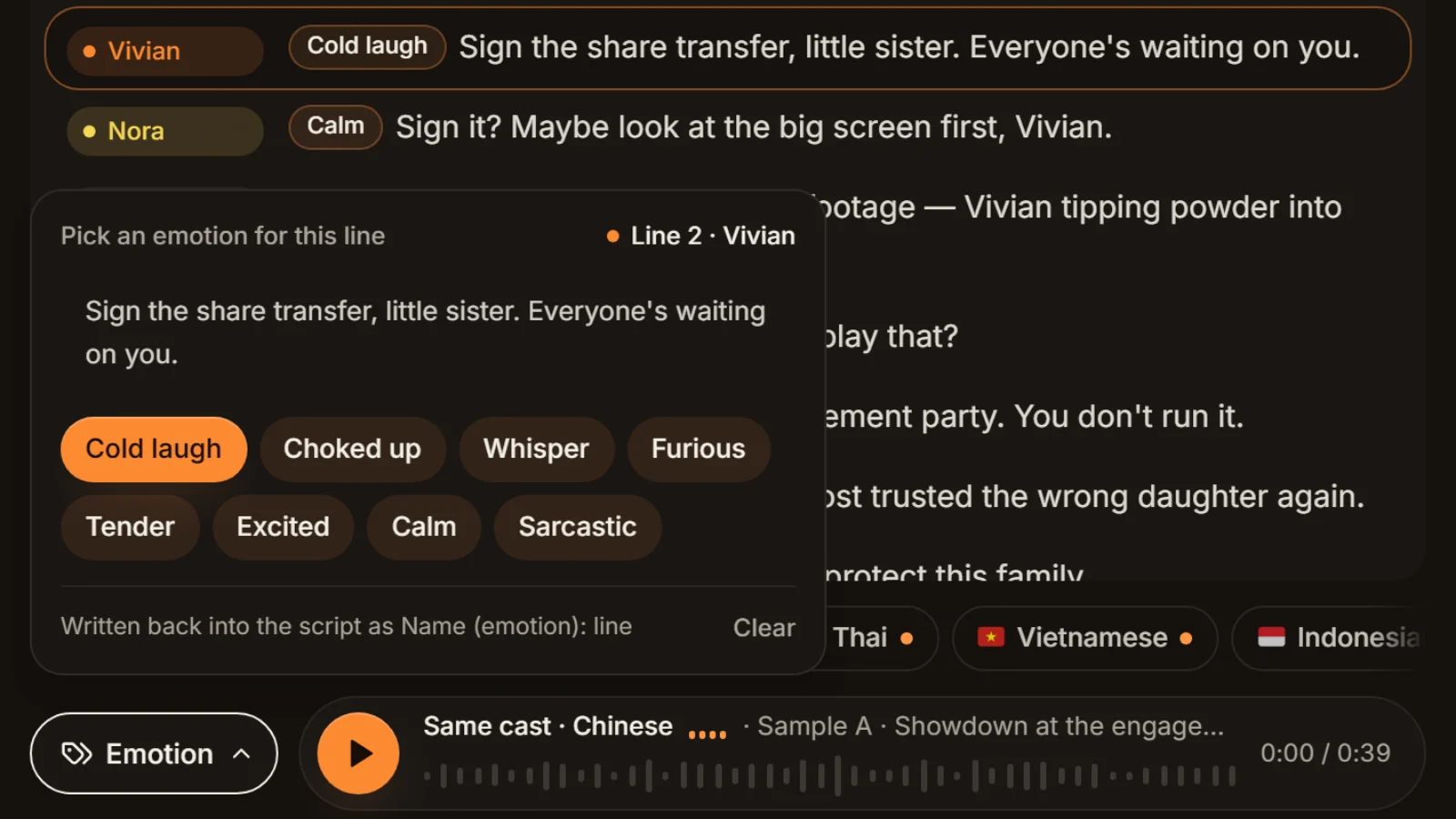
Put the emotion in brackets after the name: “Grand Elder (angry): Insolent!” Synonyms work: “coldly” maps to cold laugh, “softly” to whisper, “shocked” to excited. Give each line one emotion.
- 06
Step 6
Split out the voice draft and paste it
Delete panel numbers, shot sizes, visual descriptions and bracketed cues, keeping only dialogue, narration and inner voice: that's the voice draft. Paste it into the dubbing workshop and click Analyze cast. If the cast list matches your character cards, the format is right. This step costs no credits.
Comic drama script vs short drama script
Before working out how to write a comic drama script, see where it differs from a live-action short drama script. A live-action script is written for a director and actors; a comic drama script is written for an image tool and a voice cast. This compares only the writing; production differences are in the AI comic drama workflow.
| Writing | Comic drama script | Live-action short drama script |
|---|---|---|
| Who reads the visuals | The artist or AI image tool; the description is the picture | The director and actors, who reinterpret on set |
| How detailed the visuals are | Look, costume, expression, shot size and key props all written out | Only the action the camera can see |
| Unit of writing | The panel: one main picture each | The scene: several shots each |
| Inner voice and narration | Often used for emotion and background the picture can't carry | More of it is left to the performance |
| Sound words and text in the picture | Often drawn into the panel (BANG, signs, system screens); dubbed versions need the art changed | Mostly added in the edit |
| Sound | All voiced in post; the voice draft is the only reference | Mostly recorded on set, with ADR where needed |
Checked Nov 2026 · Summarizes common practice; teams vary.
Comic drama script format: symbols and how our parser reads them
Symbols are where comic drama scripts go wrong most often. There's no single standard comic drama script format, but you do need to know which rows reach the voice draft. The last column is what the AI Drama Voice script parser actually does (checked against the November 2026 version).
| Written as | Purpose | In the voice draft? | What AI Drama Voice does |
|---|---|---|---|
| Panel 3 | Close-up | description | Storyboard: panel, shot, picture | No | No Name: label, so the narrator reads the whole row |
| Picture: snow falls on the platform | Visual note | No | Treated as a character called Picture and read in a character voice |
| Qinghe: line | Dialogue | Yes | Qinghe's line, in Qinghe's voice |
| Qinghe (sneer): line / Qinghe: (sneer) line | Dialogue with emotion | Yes | Emotion set to cold laugh; square and 【】 brackets work too |
| Qinghe (inner voice): line | Inner voice | Yes | Qinghe's voice, with “inner voice” as a delivery note; “(inner voice, softly)” maps to whisper |
| Narrator: / Narration: / VO: / Voice-over: | Narration | Yes | Read by the narrator voice |
| [Qinghe] line | Some templates mark speakers this way | Rewrite | Not read as a speaker; the narrator reads the row, name included. Use “Qinghe: line” |
| BANG! / [SFX: cracking stone] | Sound words, effects | No | Read by the narrator; add effects in the edit |
| [Caption: End of Episode 1] | On-screen text | No | Read by the narrator |
| Panel 3 Qinghe: line | Panel number and line on one row | Rewrite | Becomes a new character called “Panel 3 Qinghe” with a different voice |
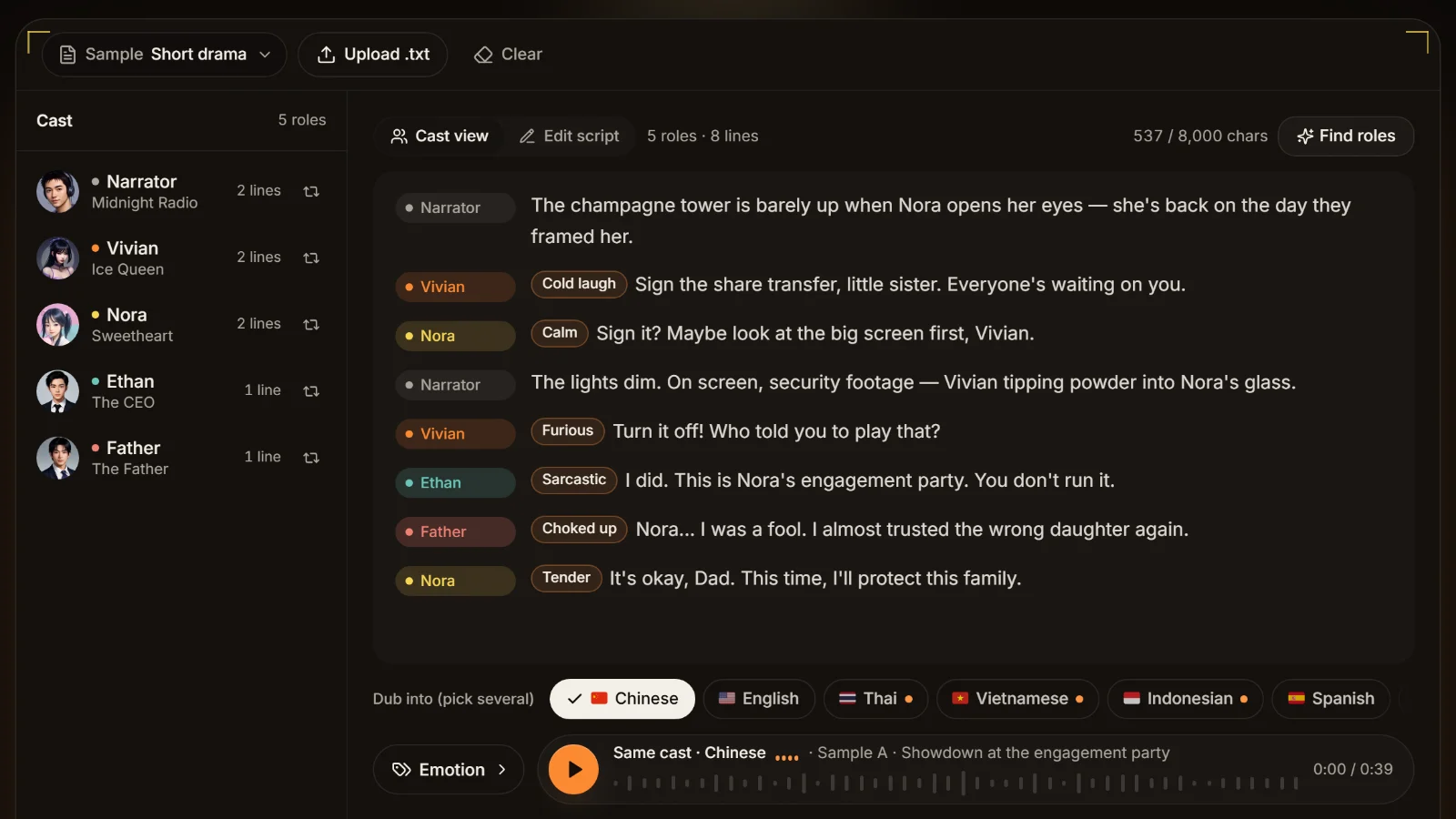
Names: one spelling for the whole series
The parser tells characters apart by the speaker name. “Shen Qinghe”, “Qinghe” and “little sister” become three people with three voices, which sounds like the wrong character talking. Copy the name from the character card onto every line. Latin-letter names are not case-sensitive, so “Qinghe” and “qinghe” count as one.
Narration vs inner voice
The narrator tells the story: time, background, cause and effect, in a voice unlike any character. Inner voice is what a character thinks but doesn't say, in the character's own voice, quieter. Comic panels have limited expression and movement, so inner voice often carries the emotion, but too much of it turns the episode into an audiobook. Two or three lines an episode is plenty.
Comic drama script example: a 60-second storyboard and voice draft
An example makes the method concrete. Below is an original xianxia (cultivation fantasy) episode written for this page: the storyboard first, then the voice draft split from it. Select the list text to copy.
Storyboard draft (for images and editing)
- Episode 1 of “Sword Bone” (about 60 seconds)
- Cast: Shen Qinghe (17, outer disciple, grey robe, cloth around her left hand); Gu Linyuan (first disciple, white robe); Grand Elder (white beard, purple robe); Disciple; Narrator
- Panel 1 | Wide | Snowy night. The bone-testing platform of Azure Cloud Sect, packed with disciples.
- Narrator: Once every three years, Azure Cloud Sect tests its disciples' bones. The test decides a whole life.
- Panel 2 | Medium | The testing stone gives off a faint grey glow. The crowd laughs.
- Grand Elder (coldly): Shen Qinghe. Common bone. By sect law, you are expelled.
- Disciple (mocking): Three years in the outer court, and still scrap iron.
- Panel 3 | Close-up | Qinghe keeps her head down, gripping her wrapped left hand.
- Qinghe (inner voice): Three years, and they still only trust that stone.
- Panel 4 | Medium | Gu Linyuan steps out of the crowd and stands in front of her.
- Gu Linyuan (calm): Elder, the stone's spirit core hasn't been replaced in three years. It can't be trusted.
- Grand Elder (angry): Insolent! The sect's first disciple, speaking up for a nobody?
- Panel 5 | Extreme close-up | Qinghe unwraps the cloth. A golden sword mark glows on her palm.
- Qinghe (sneer): A nobody? Then test me again, Elder.
- Panel 6 | Medium | Qinghe presses her left hand onto the stone.
- Narrator: She laid her hand on the stone. A heartbeat later, it cracked.
- Panel 7 | Wide | The stone splits; golden light shoots into the night sky. [SFX: cracking stone, a sword's ring]
- Narrator: That night, everyone in Azure Cloud Sect heard a sword sing.
- Panel 8 | Close-up | The Grand Elder staggers back; his whisk drops into the snow.
- Grand Elder (shocked): A golden sword mark... a born Sword Bone?
- Gu Linyuan (softly): She's been waiting for this day.
- Panel 9 | Extreme close-up | Qinghe looks up. Snow settles on her lashes.
- Qinghe (calm): No, Elder. This is only the beginning.
- [Caption: End of Episode 1]
Voice draft (paste into the dubbing tool)
- Narrator: Once every three years, Azure Cloud Sect tests its disciples' bones. The test decides a whole life.
- Grand Elder (coldly): Shen Qinghe. Common bone. By sect law, you are expelled.
- Disciple (mocking): Three years in the outer court, and still scrap iron.
- Qinghe (inner voice): Three years, and they still only trust that stone.
- Gu Linyuan (calm): Elder, the stone's spirit core hasn't been replaced in three years. It can't be trusted.
- Grand Elder (angry): Insolent! The sect's first disciple, speaking up for a nobody?
- Qinghe (sneer): A nobody? Then test me again, Elder.
- Narrator: She laid her hand on the stone. A heartbeat later, it cracked.
- Narrator: That night, everyone in Azure Cloud Sect heard a sword sing.
- Grand Elder (shocked): A golden sword mark... a born Sword Bone?
- Gu Linyuan (softly): She's been waiting for this day.
- Qinghe (calm): No, Elder. This is only the beginning.
| Storyboard pasted as is | Voice draft pasted | |
|---|---|---|
| Cast list | Narrator + 5 characters (an extra one called Cast, reading the character notes) | Narrator + 4 characters: Grand Elder, Disciple, Qinghe, Gu Linyuan |
| What the narrator reads | 3 narration lines plus the title, 9 panel rows and the caption row | Only the 3 narration lines |
| Emotion tags | Same: cold laugh (“coldly”), sarcastic (“mocking”), calm, furious (“angry”), cold laugh (“sneer”), excited (“shocked”), whisper (“softly”), calm | Same |
| Voiced text | Well over 100 extra words of notes | 12 lines, about 120 words |
Take the example into the workshop
Open the workshop's comic sample, clear the sample script, paste the voice draft above and click Analyze cast: you should see the narrator plus four characters. Cast analysis is free; generate once the voices and emotions look right.
Comic drama storyboard script vs voice draft: splitting one from the other
The storyboard for AI images and the voice draft for dubbing have different readers who need different things. The easiest way to work is to keep one storyboard sheet and filter the voice draft out of it.
| Storyboard draft | Voice draft | |
|---|---|---|
| Read by | The artist or AI image tool, and the editor | The dubbing tool or voice actors |
| Must have | Panel number, shot size, visual description, characters present | Speaker, emotion, line |
| Must not have | — | Panel numbers, shot sizes, visual descriptions, bracketed cues, image prompts |
| After a change | Regenerate the affected panels | Re-voice only the changed lines |
In practice a spreadsheet is the easiest storyboard: one row per panel, with columns for panel number, shot size, visual description, image prompt and lines. Write the lines column as “Name (emotion): line”, two rows if a panel has two lines. When it's time to dub, copy just the lines column in order and you have the voice draft; the image side only reads the first columns. Both drafts come from one sheet, so a changed line never goes out of sync.
Keep image prompts out of the lines
Prompts such as “close-up, cold tones, snowy night, golden sword mark” are for the image tool. Mixed into the lines column, the narrator will read them word for word. Give prompts their own column in the comic drama storyboard script and keep only spoken words in the lines column.
Text in the picture is not the same as dialogue
Comic panels often carry speech bubbles, sound words and signs. If a bubble repeats a spoken line, treat the voice draft as the master and use the SRT exported with the dubbing as subtitles. Sound words like BANG belong in the art, not in the voice draft. Dubbed versions also need the text in the art changed; see taking AI comic dramas overseas.
AI comic drama script: where AI helps
An LLM writing assistant can split a story into episodes, expand scenes and turn a novel passage into a storyboard sheet quickly. Consistent names, pacing and twists still need a human, and adapting a novel needs adaptation rights first. AI Drama Voice doesn't write scripts; it handles the voice step: recognizing characters, assigning voices, tagging emotion per line, and exporting MP3 and line-timed SRT.
Six ways a comic drama script breaks the voice track
These layouts are fine in a storyboard a person reads. In a voice draft they add characters, get notes read aloud or put the wrong emotion on a line.
Several names for one character
Characters can call her “little sister” in dialogue, but the speaker label stays one name all series. Two spellings in the label means two characters and two voices.
Notes written with a colon
“Picture:”, “Shot:”, “Caption:” and “Cast:” all read as characters. Keep notes in the storyboard and out of the voice draft.
Sound words on their own row
A lone “BANG!” or “WHOOSH” row is read by the narrator, which sounds odd. Draw sound words into the panel and add effects in the edit.
Unmarked inner voice
Written as ordinary dialogue, a thought sounds spoken aloud and confuses the plot. Write “Name (inner voice):”, and “(inner voice, softly)” for a quieter read.
Three or four lines in one panel
A panel held too long drags. Split heavy dialogue across two panels, or move part of it into narration over the next panel.
Stage directions as long sentences
“(backing away, gripping the sword hilt, voice shaking)” is too long; past 20 characters the row isn't read as dialogue. Keep only the tone in brackets and move the action into the panel description.
Frequently asked questions
Write by panel: one row “panel number | shot size | visual description”, followed by that panel's lines as “Name (emotion): line”, narration as “Narrator:” and thoughts as “Name (inner voice):”. Put character cards at the top with look and voice. Save a separate voice draft with only the spoken lines before dubbing.
A live-action short drama script is written for a director and actors and describes only visible action. A comic drama script is written for an image tool and a voice cast, so the description is the picture itself, with look, expression and shot size. It is organized by panel, uses more inner voice and narration, and is voiced entirely in post.
A spreadsheet works best, one row per panel, with columns for panel number, shot size, visual description, image prompt and lines. Keep one main picture and one or two lines per panel. Copy the lines column out and you have the voice draft.
Work back from the runtime. At 130–170 English words a minute, a 60-second episode needs about 100–170 voiced words; the example on this page is 12 lines and about 120 words. The storyboard is much longer once visual descriptions are added; see how long is a micro drama episode.
Three rules: one speaker and one line per row; one name per character for the whole series; and a voice draft without panel numbers, visual descriptions, bracketed cues or note rows with a colon. Put the emotion in brackets after the name and keep the note under 20 characters.
It can help split episodes, expand scenes and draft a storyboard sheet, but names, pacing and twists need human editing, and adapting a novel needs rights first. AI Drama Voice doesn't write scripts; it voices the finished voice draft with a full cast and exports MP3 and SRT.





Script done? Let the characters speak Panels on paper, voices on cue.
Paste the voice draft: the narrator and every character are recognized, emotion is tagged per line, and you export MP3 and line-timed SRT.
Billed by characters generated · Failed runs refunded automatically · Alipay, WeChat Pay and cards