How to write a short-drama recap script: hook, compress, cliffhanger
A one-minute short-drama recap script is only about 150 English words, or a little over 200 Chinese characters, yet it has to carry five things: a hook, the characters, the main plot, a twist and a cliffhanger. This guide gives each of the five parts its own method, a word count and the matching running time, then three recaps we wrote ourselves and a template you can copy, and ends with how to voice the finished script. To be clear: AI Drama Voice doesn't write scripts; it turns the script you wrote into voices.
- Five-part structure
- Words and seconds per part
- Three sample recaps
Updated Nov 5, 2026Fact-checked Nov 5, 2026
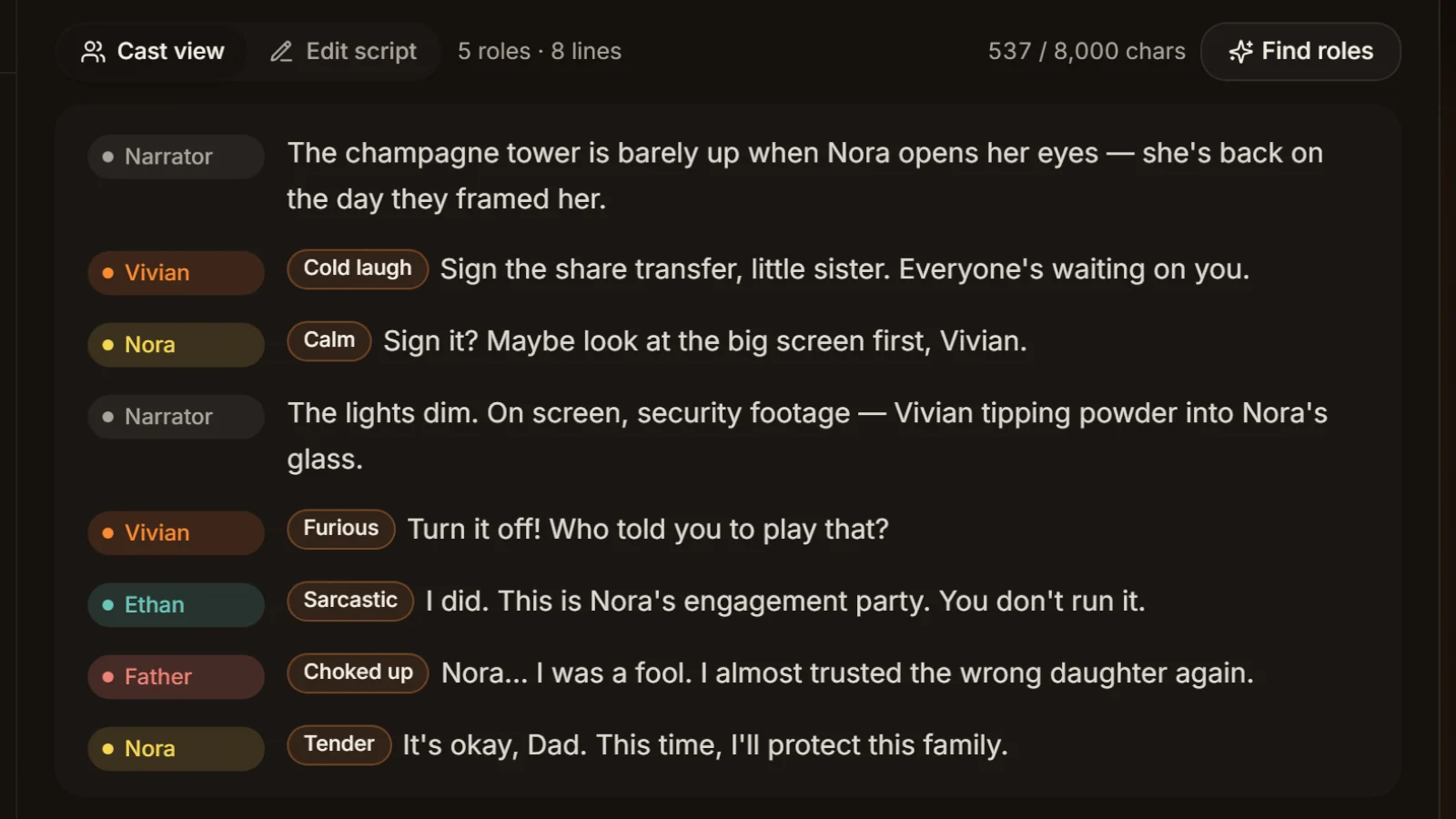
Sample A · Showdown at the engagement party
English · Script excerpt · 5 characters



Narrator
The champagne tower is barely up when Nora opens her eyes — she's back on the day they framed her.

VivianCold laugh
Sign the share transfer, little sister. Everyone's waiting on you.

NoraCalm
Sign it? Maybe look at the big screen first, Vivian.
Narrator
The lights dim. On screen, security footage — Vivian tipping powder into Nora's glass.
On this page
- 1How to write a drama recap script in five steps
- 2A recap script template: five parts and their word counts
- 3How to open a drama recap script so people stay
- 4Three sample recaps: CEO romance, rebirth, mystery
- 5Can AI write your recap script? Originality and permission
- 6Voicing the finished script: pace, format and narrator
- 7Six details that make a recap script work
- 8Frequently asked questions
How to write a drama recap script in five steps
The steps follow the order you write in. The first three decide whether a recap holds anyone's attention.
- 01
Step 1
Watch it all, then write the plot in one sentence
Finish the drama, then write its spine in one sentence: who, what happens to them, how it ends. If you can't, the plot isn't clear in your head yet; don't start drafting.
- 02
Step 2
Write the hook
The first line delivers a conflict or an outcome, in 15–20 words or under eight seconds spoken. Rewriting it ten times is normal.
Tip · Read the hook aloud. If you were scrolling, would you stop?
- 03
Step 3
Set up the characters, compress the plot
Two or three sentences on who the lead is and where they stand, then squeeze a dozen episodes into a “because… so… and then…” chain that keeps only the main line.
- 04
Step 4
Land the twist, end on a cliffhanger
Seal the twist with one quoted line or one action, and stop just before the next thing happens so people want the next video.
- 05
Step 5
Cut to length, then voice it
Estimate the running time from the word count with the script duration calculator and cut whatever runs over. Then lay out narration rows and quotes line by line and paste them into the workshop.
A recap script template: five parts and their word counts
For a one-minute recap at a standard 150 words a minute, the five parts break down roughly like this.
| Part | Job | Words (English) | Running time |
|---|---|---|---|
| Hook | Stop the scroll | 15–20 | 6–8 s |
| Setup | Who the lead is, how bad or how strong their position | 25–30 | 10–12 s |
| Plot compression | Make the main line clear | 55–65 | 22–26 s |
| Twist | The moment the situation flips | 20–28 | 8–11 s |
| Cliffhanger | Stop where curiosity peaks | 12–18 | 5–7 s |
A three-minute recap isn't every part times three. Keep the hook and cliffhanger the same length and split the compression into two or three rounds of “clash → small twist”. People stay for two extra minutes because something new keeps happening, not because every part got longer.
A template you can copy
- 1.Narrator: [The outcome or the clash], for example “The day before her wedding, she gets an invitation from her ex-husband.”
- 2.Narrator: [Who the lead is] + [where they stand], in one sentence.
- 3.Narrator: [Who the opponent is] + [what they did].
- 4.Narrator: Because [cause], [the lead's choice], and then [an even worse situation].
- 5.Name (emotion): [the single most cutting line in the drama]
- 6.Narrator: [The twist: the lead's hidden card or secret identity].
- 7.Narrator: [The cliffhanger: what happens next, and to whom?]
Why every row starts with “Narrator:”
When voicing, rows that start with “Narrator:” (or 解说: in a Chinese script) are read by one narrator in one voice, while quotes that start with “Name:” go to character voices. Write the script in that shape from the start and there's nothing to reformat before voicing.
How to open a drama recap script so people stay
The opening line is the one worth rewriting most. These five patterns work for almost any drama.
| Pattern | Idea | Example |
|---|---|---|
| Outcome first | State the ending, then rewind | Three years after the divorce, she becomes her ex-husband's new boss. |
| Status contrast | Low status and high status in one sentence | The son-in-law the whole family looks down on is the richest man's long-lost heir. |
| Open on the clash | The first line is a conflict already in progress | Halfway through the wedding, the groom announces he's marrying the bridesmaid. |
| Ask a question | An odd question that demands an answer | If you got a second chance, would you still marry the man who destroyed your family? |
| Countdown | Give the lead a deadline | She has seven days left before she's thrown out of the family for good. |
Avoid these three openings: “Today I'm recapping a drama”, “This show is so good”, “Without further ado”. They carry no information, and viewers swipe away on the first line. An opening has one job: make people ask “and then?”

Four ways to compress the plot
- Keep only the main line: side romances and minor villains go first.
- Merge characters: if three bad actors can become “her family”, don't introduce them one by one.
- Report dialogue instead of quoting it: three lines of shouting become “she loses it on the spot”.
- Bridge with time words: “three days later”, “that night”, “a year on” skip the filler scenes.
Landing the twist and the cliffhanger
Hold the line before the twist down: calm narration pushes the lead to rock bottom, and the next line plays the hidden card. Seal the twist with a quoted line if you can; the original words hit harder than a summary. End the cliffhanger just before the action. “The moment she pushes the door open” makes people want the next video more than “she pushes the door open and sees him”.
Three sample recaps: CEO romance, rebirth, mystery
All three stories are our own inventions and don't correspond to any real drama. Use them for practice, or paste them into the workshop to try voicing.
Sample one: CEO romance
- Narrator: She has cleaned his office building for three years, and today she finds out he's her fiancé.
- Narrator: Summer Xu's family lost everything. To pay off the debt she mops floors at the Gu Group by day and washes dishes in a restaurant kitchen by night.
- Narrator: And Gu Group's CEO, Gu Yanshen, is the man her grandfather promised her to as a child, a match he has always treated as a joke.
- Narrator: Until a board meeting, when his uncle waves a contract and demands the company. Everyone waits for him to give in. No one notices the cleaner in the corner put down her mop.
- Summer (calm): The signature on that contract is forged. The original is in my grandfather's safe.
- Narrator: For the first time, Gu Yanshen really looks at her. What he doesn't know is that the same safe holds a secret about his father.
Taken apart: the first line is a status-contrast, outcome-first hook; lines two and three set up both characters; line four squeezes the main plot into a single power grab; the twist goes to the heroine's one quoted line; the last line plants a new mystery.
Sample two: rebirth
- Narrator: She dies on her thirtieth birthday, and opens her eyes on the night before her university entrance exam, eighteen again.
- Narrator: Last time, Shen Nian gave her guaranteed university place to her stepsister and took the blame for the stepsister's cheating, a stain she never lived down.
- Narrator: The stepsister used that place to get into a top school, married into money, and in the end pushed Shen Nian off a rooftop.
- Narrator: Now, just like before, the stepsister comes to her in tears.
- Stepsister (choked up): Please, just help me one more time?
- Shen Nian (cold laugh): Sure. This time, you take the blame yourself.
- Narrator: The next morning, the invigilator finds a sheet of answers in the stepsister's pencil case. But Shen Nian doesn't know she isn't the only one trying to rewrite her fate.
Rebirth hooks are almost always “death plus a second chance”, so the details have to make them different: a thirtieth birthday, the night before an exam. The two quotes, one tearful and one cold, are a twist in themselves, and the last line breaks the “only I came back” premise, which gives the next video something to say.
Sample three: mystery
- Narrator: At three in the morning, delivery rider Chen Mo gets an order. The delivery address is his own flat.
- Narrator: Chen Mo lives alone with a cat, yet the order note says: “Honey, get an extra portion.”
- Narrator: He hesitates, knocks on his own door, and a voice exactly like his answers from inside.
- Voice behind the door (whisper): Who is it? Just leave it outside.
- Narrator: Chen Mo backs into the stairwell and calls building management. They tell him his door was unlocked three hours ago, by face scan. His face.
- Narrator: The door opens a crack. The person inside looks at him, and smiles.
Mystery recaps run on details, not adjectives
Skip “terrifying” and “so creepy”. The fear comes from specifics: three in the morning, a man who lives alone with a cat, a face scan that used his face.
Can AI write your recap script? Originality and permission
Let AI help with an outline or tighten a sentence, but don't post a one-click script. These tools often get the plot wrong and mix up who is who, and when many channels run the same drama through similar tools, the scripts come out nearly identical and struggle to stand out. The safer route is to watch the drama yourself, decide the main line and your own take, and use AI as an editor at most. AI Drama Voice doesn't generate scripts; it only does the voicing.
Rewriting versus reposting
| What you do | Counts as | Watch out for |
|---|---|---|
| Watch it yourself, structure it yourself, add your judgement | Original recap | The script is yours, but the footage still needs permission |
| Swap a few words in another channel's script | Reposting | May infringe the copyright in their script, and is easily flagged as duplicate content |
| Read out the official synopsis or episode summaries | Reposting | Nothing of your own in it; neither viewers nor platforms reward it |
Do you need permission to recap a short drama?
Yes. The footage in a recap belongs to the producer, so recapping someone else's drama in principle requires permission. The usual routes are recapping your own dramas, or using material the producer or platform has explicitly opened for promotion and following its rules, such as how much you may cut, whether paid promotion is allowed and whether you may post overseas. If you can't get permission, don't use long stretches of the original.

For where fair use ends and how overseas platforms handle monetisation, drama recap voiceover quotes a Chinese court white paper and YouTube's policy text; whether an AI voiceover can be used commercially is covered in can AI voiceovers be used commercially; and if you're worried about reach, see does AI voiceover get suppressed.
Note
These are common-sense pointers, not legal advice; the rights holder's terms and the platform's rules are what count.
Voicing the finished script: pace, format and narrator
How fast should a recap be read?
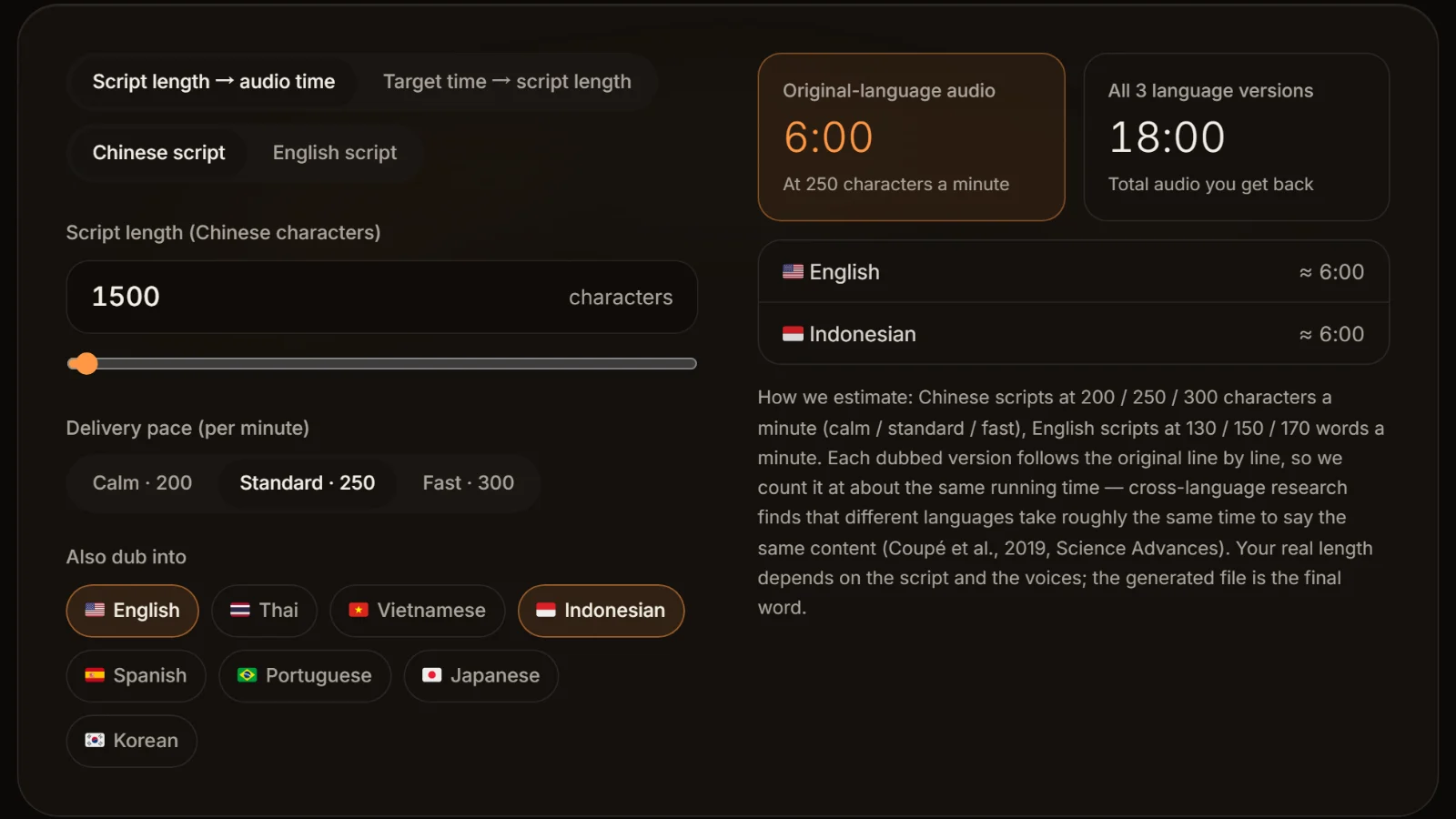
Recaps usually run faster than drama dialogue, but faster isn't always better. The duration calculator counts English scripts at 150 words a minute as standard and 170 as fast; most recaps sit between the two. Slow down for the twist and the cliffhanger: give them their own rows with a leading ellipsis and the voice usually eases off on its own.
Lay out the script like this before pasting
- Every narration sentence on its own row, starting with “Narrator:”.
- Every quoted line on its own row, as “Name (emotion): line”.
- Twist and cliffhanger lines on rows of their own.
- No editing notes like “(insert clip here)”: a row without a speaker name is read out as narration.
For choosing a narrator voice and turning the same recap into English or Thai versions, see drama recap voiceover; if you make manga recaps, see manga recap voiceover. Film recaps work with the same structure too; a feature film just has a longer main line, so split the compression part more finely.
Six details that make a recap script work
One idea per sentence
Break long sentences up, one piece of information each; both the voice and the subtitles get clearer.
Few names, used consistently
Keep names in a recap to three or four and refer to everyone else by role: “her stepsister”, “his uncle”.
Numbers beat adjectives
“Three years”, “seven days”, “3 a.m.” stick better than “ages”, “soon”, “late at night”.
Prefer the active voice
“She tears up the contract” paints a clearer picture than “the contract is torn up by her”, and is easier to say.
One twist per video
Squeeze two twists into one recap and nobody remembers the second. Save it for the next one.
Read it aloud when you're done
Anywhere you stumble reading it, the voice will stumble too.
Frequently asked questions
With a conflict or an outcome in the first line, no warm-up. Five reliable patterns: outcome first, status contrast, open on the clash, ask a question, countdown. Avoid empty openers like “Today I'm recapping a drama”.
At a standard 150 words a minute, a one-minute recap is about 130–160 English words and a three-minute recap about 400–480. Chinese scripts run about 210–270 characters a minute. Check with the script duration calculator; the voiced audio has the final say.
Use it for outlines and line edits, but watch the drama yourself, check the plot and write the main line and your opinions in your own words. One-click scripts often get the story wrong and end up nearly identical to everyone else's. AI Drama Voice doesn't write scripts; it voices them.
Yes. The footage belongs to the producer, so recapping someone else's drama in principle needs permission; the usual routes are your own dramas or material the producer or platform has opened for promotion, used within its rules. The licence terms decide.
A little faster than drama dialogue, roughly 150–170 English words or 250–300 Chinese characters a minute, slowing down for the twist and the cliffhanger. The script duration calculator lets you compare paces.
Write narration as “Narrator: …” and quotes as “Name (emotion): …”, then paste it into the workshop. The narrator keeps one voice, quotes go to character voices, and you export MP3 and SRT for editing.




Script written. Now give it a voice. Hook. Twist. Cliffhanger.
Paste the recap: one narrator voice, a character voice for every quote, MP3 and subtitles exported together.
Billed by characters generated · Failed runs refunded automatically · Alipay, WeChat Pay and cards