Multilingual dubbing software: one Chinese drama, eight languages at once
Multilingual dubbing software has one job: turn a single Chinese short drama into several foreign-language versions at once. Paste the Chinese script into AI Drama Voice once, tick the languages you need, and the same cast performs the English, Thai, Vietnamese, Indonesian, Spanish, Portuguese, Japanese and Korean versions line by line, with emotion, each exported as its own MP3 and SRT. This page puts the eight languages side by side to help you decide where to start.
- Chinese + 8 languages
- Same cast
- MP3 + SRT per language
- One ZIP for all
Updated Nov 5, 2026Fact-checked Nov 5, 2026
Sample A · Showdown at the engagement party
English · Script excerpt · 5 characters



Narrator
The champagne tower is barely up when Nora opens her eyes — she's back on the day they framed her.

VivianCold laugh
Sign the share transfer, little sister. Everyone's waiting on you.

NoraCalm
Sign it? Maybe look at the big screen first, Vivian.
Narrator
The lights dim. On screen, security footage — Vivian tipping powder into Nora's glass.
Try it: one script, another language
This is the real dubbing studio. Paste a few lines of your own, watch the AI split the roles and tag each line's emotion, then switch languages — cast analysis costs no credits.
Narrator
Midnight Radio · 2 lines
5 roles · 8 lines
537 / 8,000 charsSame cast · English
One cast, four languages
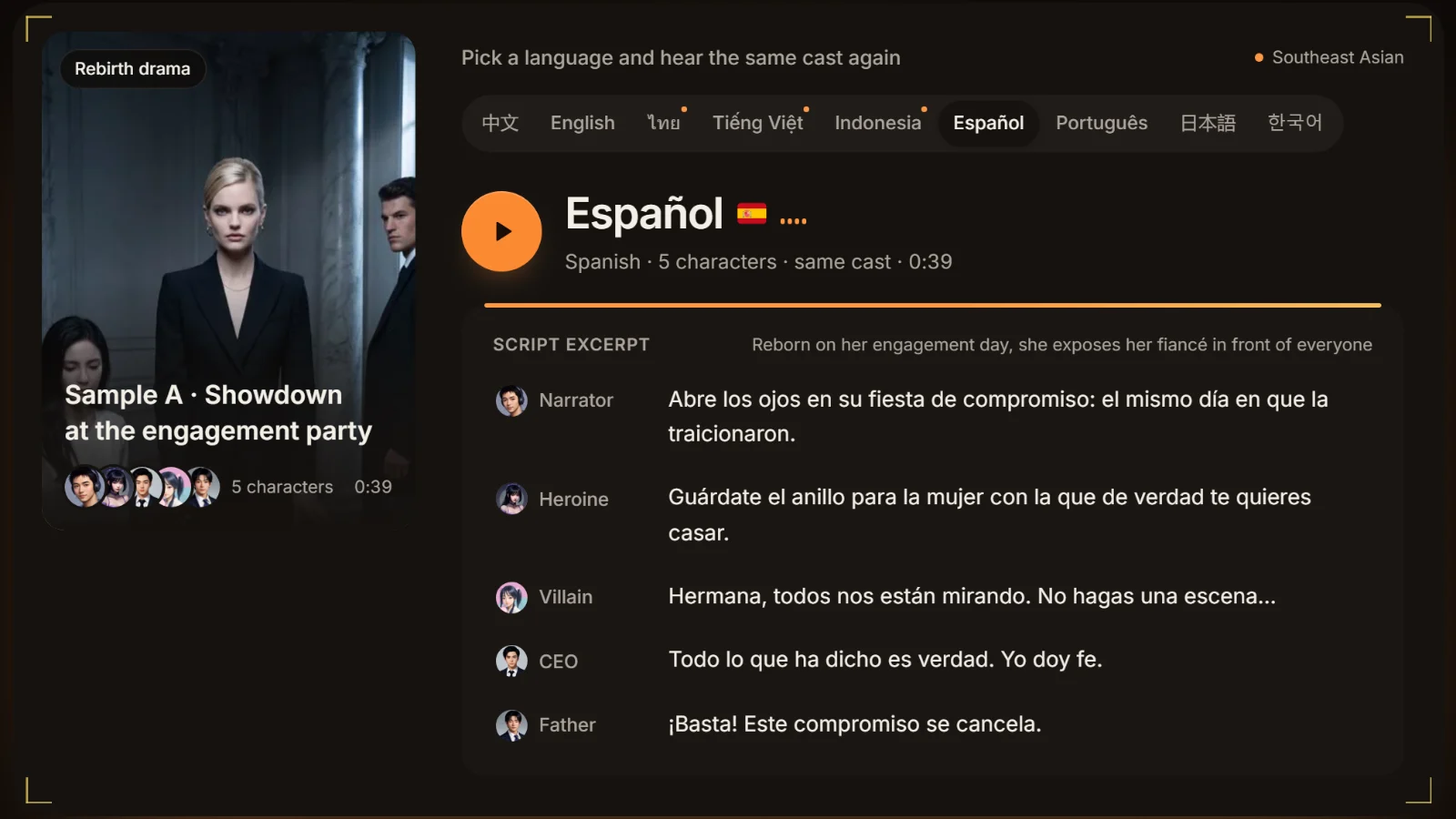
The Chinese original of Sample A, Showdown at the engagement party, and three foreign versions, all played by the same cast. Under each clip is a script excerpt from the episode (not all of it falls inside these few seconds), with the meaning in English.
Script excerpt · Chinese original · Showdown at the engagement party
NarratorCalm
重生回订婚宴那天,她决定把账一笔一笔算清。
Reborn on the day of her engagement, she decided to settle every score, one by one.
Heroine · Lin WanCold laugh
从今天起,我嫁给谁,我自己说了算。
From today on, I decide who I marry.
Script excerpt · English · Showdown at the engagement party
NarratorCalm
Reborn on the day of her engagement, she decided to settle every score, one by one.
Heroine · Lin WanCold laugh
From today on, I decide who I marry.
Script excerpt · Indonesian · Showdown at the engagement party
NarratorCalm
Terlahir kembali di hari pertunangannya, ia memutuskan untuk membalas semuanya satu per satu.
Reborn on the day of her engagement, she decided to settle every score, one by one.
Heroine · Lin WanCold laugh
Mulai hari ini, aku sendiri yang menentukan dengan siapa aku menikah.
From today on, I decide who I marry.
Script excerpt · Japanese · Showdown at the engagement party
NarratorCalm
婚約の日に生まれ変わった彼女は、すべての借りを返すと決めた。
Reborn on the day of her engagement, she decided to settle every score, one by one.
Heroine · Lin WanCold laugh
今日から、誰と結婚するかは私が決める。
From today on, I decide who I marry.
Which languages the multilingual dubbing software supports: all eight
Each language trips up in its own place. Here are the essentials for all eight, each linking to its full language page.
English · English
English: no honorifics, tone does the work
English has no polite and familiar “you”, so relationships come through titles (Mr. Gu, first names, nicknames) and tone; Chinese “sister” or pet names like 晚晚 usually become first names. Subtitles take far more characters than Chinese. See English dubbing.
- 顾总 → Mr. Gu
- A good first test language
Thai · ไทย
Thai: polite particles follow the speaker's gender
Thai has five tones; men end polite sentences with khrap (ครับ), women with kha (ค่ะ / คะ), so the same line is written differently for the hero and the heroine. Elders are phi (พี่), juniors nong (น้อง). Thai doesn't put spaces between words, so subtitle breaks must fall between words. See Thai dubbing.
- “Sister” → phi
- Never break inside a word
Vietnamese · Tiếng Việt
Vietnamese: pronouns are kinship terms
Vietnamese “I” and “you” are chosen by age and relationship — anh, chị, em, ông, bà — and lovers usually use anh and em. The northern standard has six tones, and no tone mark can be dropped. See Vietnamese dubbing.
- Boyfriend to girlfriend: anh / em
- Elders: ông / bà
Indonesian · Bahasa Indonesia
Indonesian: address by closeness, not Malay
Indonesian has no tones; the work is in address: Kak for a slightly older peer, Pak / Bu for elders and bosses; aku / kamu in fights, saya / Anda in formal scenes. Indonesian and Malay are close but not the same. See Indonesian dubbing.
- “Sister” between friends → Kak
- 顾总 → Pak Gu / Bos
Spanish · Español
Spanish: tú or usted, in Latin American Spanish
Tú for people you're close to, usted for elders and bosses; AI Drama Voice writes Latin American Spanish, with ustedes rather than vosotros. Spanish has more syllables and is spoken fast, and subtitles run clearly longer than Chinese. See Spanish dubbing.
- 顾总 → Señor Gu / jefe
- No Spain-Spanish option yet
Portuguese · Português
Portuguese: written as Brazilian Portuguese
Brazilians say você day to day, often put the pronoun before the verb (me perdoa) and shorten está to tá; subtitles with ã, ç and é need UTF-8. AI Drama Voice writes Brazilian Portuguese. See Portuguese dubbing.
- Madam → a senhora / Dona
- No European Portuguese option yet
Japanese · 日本語
Japanese: keigo, pronouns and readings
An assistant uses honorific and humble forms with the company president, lovers speak casually, and pronouns like ore, boku and watakushi are the persona. Kanji have several readings, so names are the first thing to go wrong. See Japanese dubbing.
- 顾总 → 顧社長
- Listen to the names first
Korean · 한국어
Korean: jondaemal and banmal
Honorifics (-seumnida / -yo) for elders and bosses, banmal for friends and lovers; women say oppa and eonni, men say hyeong and nuna. Modern Chinese names are written in Hangul by their Mandarin sound. See Korean dubbing.
- 顾总 → daepyonim
- 林晚 → 린완
From Chinese to foreign-language dubbing: one drama, several languages at once
No translator first, and no redoing the work for each language.
- 01
Paste one Chinese episode
Write “Name: line”; lines without a name go to the narrator. Put emotions in brackets at the start of a line — the cue is never read aloud.
- 02
Confirm the cast
The AI finds the narrator and every character, picks voices by gender, age and persona, and applies the emotion you mark in brackets to each line. This step is free and can be redone as often as you like.
Tip · The cast list is shared by every language, so you only set it once.
- 03
Tick your languages
Tick one or all eight. Each foreign version is first rewritten into local, spoken language, then voiced by the same cast.
- 04
Export per language
Download an MP3 and an SRT for each language, or every language in one ZIP; file names carry the language code, so nothing gets mixed up in the editor.
Why use AI Drama Voice as multilingual dubbing software
One cast, nine languages
Each character uses the same voice in Chinese and all eight foreign languages, so viewers recognise the heroine and the CEO in any version.
Rewritten line by line
Each line goes to translation with its speaker and emotion, so titles, honorifics and pronouns follow the relationships instead of being read from a word-for-word translation.
Emotion follows the line
Cold laugh, choked, furious and whisper tags apply line by line in every language, so a fight is a fight in all of them.
Every language in one ZIP
An MP3 and an SRT per language, or all of them in one ZIP, with cue times taken from where each line sits in the audio.
Failed lines refunded
Settled on the real length of the rewritten lines, failed lines refunded automatically, and cast analysis free.
Choosing multilingual dubbing software: the table, where to start, cost and speed
Multilingual dubbing software mostly comes in two kinds. Text-to-speech tools make you translate the lines first and then voice them one by one; video-translation tools take a finished video, transcribe it and re-voice it. For a Chinese short drama, the first means doing your own translation and casting, and the second usually offers one or two voices that can't tell the characters apart. AI Drama Voice takes a third route: start from the Chinese script, cast it, and generate several languages in one run. It does not translate videos, lip-sync or clone voices; for a vertical video, import the MP3 and SRT into CapCut or Jianying.
The eight languages at a glance
| Language | Our variety | Hardest part to dub | Subtitles vs Chinese | Full page |
|---|---|---|---|---|
| English | General English | No honorifics; titles and tone carry it | Much longer | English dubbing |
| Thai | Thai | Polite particles by speaker gender | Longer, no spaces between words | Thai dubbing |
| Vietnamese | Vietnamese | Pronouns by age and relationship | Longer, many tone marks | Vietnamese dubbing |
| Indonesian | Indonesian | Kak / Pak / Bu and other titles | Much longer | Indonesian dubbing |
| Spanish | Latin American | Tú or usted | Much longer | Spanish dubbing |
| Portuguese | Brazilian | Você, Senhor, Dona | Much longer | Portuguese dubbing |
| Japanese | Japanese | Keigo levels and pronouns | Longer (lots of kana) | Japanese dubbing |
| Korean | Korean | Switching honorific and casual speech | Slightly longer | Korean dubbing |
Languages we don't support
Only the eight languages above plus the Chinese original are supported today. These often-requested languages are not, so you'd need another tool for them:
- Right-to-left languages such as Arabic, Persian and Hebrew
- South Asian languages such as Hindi, Urdu and Bengali
- French, German, Italian, Russian and Turkish
- Malay, Tagalog, Burmese and Khmer
- Cantonese and other Chinese dialects, and separate regional varieties such as European Portuguese or Spain Spanish
Which language should a drama start with?
There's no universal answer; it depends on the platform and region you're aiming for. A few common approaches:
- No market chosen yet: start with English — the widest reach and the easiest to get reviewed.
- Southeast Asia: Thai, Vietnamese and Indonesian in one run — see the Southeast Asian short-drama market.
- Latin America and Brazil: Spanish and Portuguese together, voiced by one cast.
- Anime-style motion comics, school and romance stories: Japanese and Korean first.
- Whichever you choose, run one episode end to end and check titles and names before the batch.
Why are foreign-language dubs slower?
A foreign version has an extra translation step, so it is always slower than Chinese alone. In AI Drama Voice each foreign version goes through three stages: the lines go to a large language model in batches to be rewritten, each with its speaker and emotion; each line is then queued as its own voice-generation task; finally your browser joins the episode into an MP3 and builds the SRT. Tick eight languages and there are eight sets of translation and voice tasks. Lines that fail are retried automatically, and any that still fail are refunded.
- Run one language on one episode first, then add the others.
- Split a very long episode in two; queuing and export both go faster.
- A new run only does lines that have no audio yet: languages already voiced are not redone, only new languages or failed lines.
What does multilingual dubbing cost?
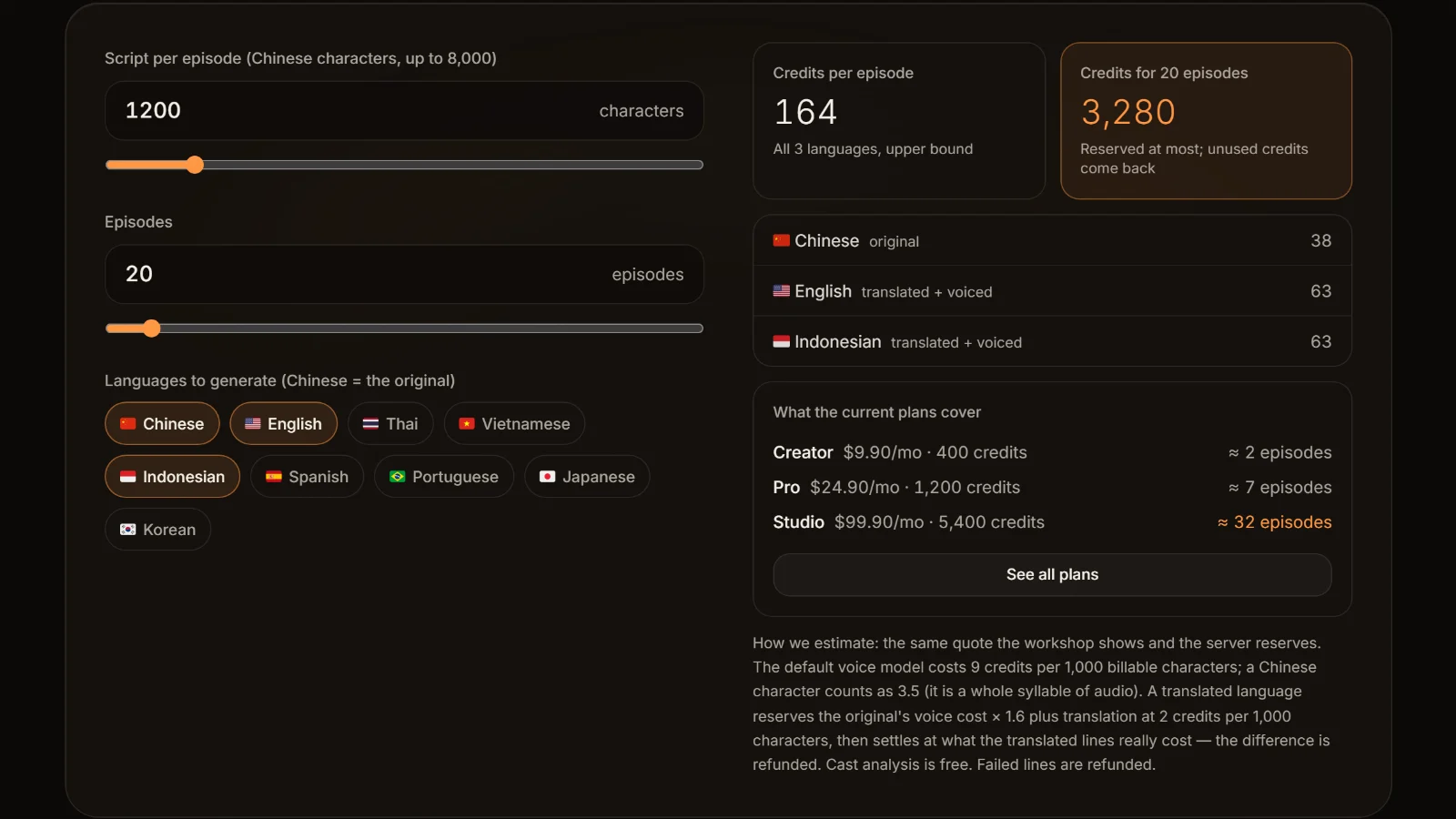
Human dubbing in less common languages is usually quoted by language, minutes and number of actors, and rarer languages are harder to staff. AI Drama Voice charges credits by the characters of your lines: a foreign version covers translation and voicing, reserves an estimate first and settles on the real length of the rewritten lines, refunding the difference; cast analysis is free. Rates are on the pricing page, and the dubbing cost calculator estimates a whole series.
Five tips for multilingual versions
Get one language right first
Dub one episode in the language you're surest of, check the cast, titles and names, then add the others.
Put titles in the lines
Lines that say 顾总, 姐姐 or 爸 let each language swap in Señor, eonni or Pak; don't add notes about relationships — lines without a speaker name are read by the narrator.
Keep names consistent
Settle how each character is written in each language in episode one and don't change it later, so subtitles and audio agree.
Batch by region
Southeast Asia (Thai, Vietnamese, Indonesian), the Americas (English, Spanish, Portuguese), East Asia (Japanese, Korean): one run and one ZIP each.
Native review for lead languages
Have a native speaker listen through the languages you're pushing hardest, focusing on titles, slang and jokes; test the others first.
Frequently asked questions
It depends where you start. If you already have translated lines and just need them read, any text-to-speech tool will do. Starting from a Chinese drama script with many characters and several languages, choose a tool that casts the roles, keeps each voice across languages and exports timed subtitles. AI Drama Voice covers Chinese plus eight languages, and cast analysis is free to try.
A foreign version adds translation: the lines are rewritten in batches, then voiced line by line, then joined into an episode. More languages mean more tasks. Running one language first and splitting very long episodes cuts the wait noticeably.
AI Drama Voice charges credits by the characters of your lines; a foreign version covers translation and voicing, reserves first and settles on the real rewritten length, refunding the difference. Failed lines are refunded and cast analysis is free. Rates are on the pricing page.
It depends on your region and platform. No direction yet: English. Southeast Asia: Thai, Vietnamese and Indonesian together. Latin America: Spanish and Portuguese together. Anime-style motion comics: Japanese and Korean first.
No. Paste the Chinese script and tick the languages; each line is rewritten into spoken language and voiced by the same cast, with titles and honorifics set by relationship.
Not at the moment. AI Drama Voice supports the Chinese original plus eight languages: English, Thai, Vietnamese, Indonesian, Spanish (Latin America), Portuguese (Brazil), Japanese and Korean.




One Chinese drama, eight languages at once One cast. Eight languages.
Paste the script, confirm the cast, tick your languages — the same cast performs every version, and the MP3 and subtitles export per language.
Billed by characters generated · Failed runs refunded automatically · Alipay, WeChat Pay and cards