How Long Is a Micro Drama Episode? Words per Episode and Runtime
How long is a micro drama episode, and how much script does one take? There is no official word count. The figure quoted most often in the Chinese industry is one to two minutes per episode, 500–900 Chinese characters of script, of which only 200–300 characters are spoken dialogue. This guide lists where those numbers come from, converts them into dialogue and script length for one, two and three minute episodes (with English word counts too), explains which parts of a script are actually voiced, and ends with a calculator you can use right away.
- 1 / 2 / 3 minute table
- Every figure sourced
- Built-in length calculator
Updated Nov 5, 2026Fact-checked Nov 5, 2026
Sample A · Showdown at the engagement party
English · Script excerpt · 5 characters



Narrator
The champagne tower is barely up when Nora opens her eyes — she's back on the day they framed her.

VivianCold laugh
Sign the share transfer, little sister. Everyone's waiting on you.

NoraCalm
Sign it? Maybe look at the big screen first, Vivian.
Narrator
The lights dim. On screen, security footage — Vivian tipping powder into Nora's glass.
Try it: how long will your script run?
Enter the spoken word count (only what gets read aloud) and get a voice-over length at calm, standard or fast pace, or enter a target length to see how many words to write.
Delivery pace (per minute)
Original-language audio
6:00
At 250 characters a minute
All 3 language versions
18:00
Total audio you get back
- English≈ 6:00
- Indonesian≈ 6:00
How we estimate: Chinese scripts at 200 / 250 / 300 characters a minute (calm / standard / fast), English scripts at 130 / 150 / 170 words a minute. Each dubbed version follows the original line by line, so we count it at about the same running time — cross-language research finds that different languages take roughly the same time to say the same content (Coupé et al., 2019, Science Advances). Your real length depends on the script and the voices; the generated file is the final word.
On this page
How many words per episode: five steps back from the runtime
Rather than memorizing a magic number, start from the runtime you want and work backwards. After these five steps you know how much dialogue the episode needs and how long the full script will be.
- 01
Step 1
Pick the episode runtime
Regulation only sets a ceiling: in China a micro drama episode must be shorter than twenty minutes. Paid vertical dramas are usually written at one to two minutes an episode; recaps and novel promos can run longer. Choose a target for your platform and genre, for example 90 seconds.
- 02
Step 2
Subtract the silent shots
Every episode has time without speech: an opening establishing shot, the pause before a twist, reaction shots, the freeze frame on the cliffhanger. Estimate those seconds from your storyboard and take them off the target. What is left is the time dialogue has to fill.
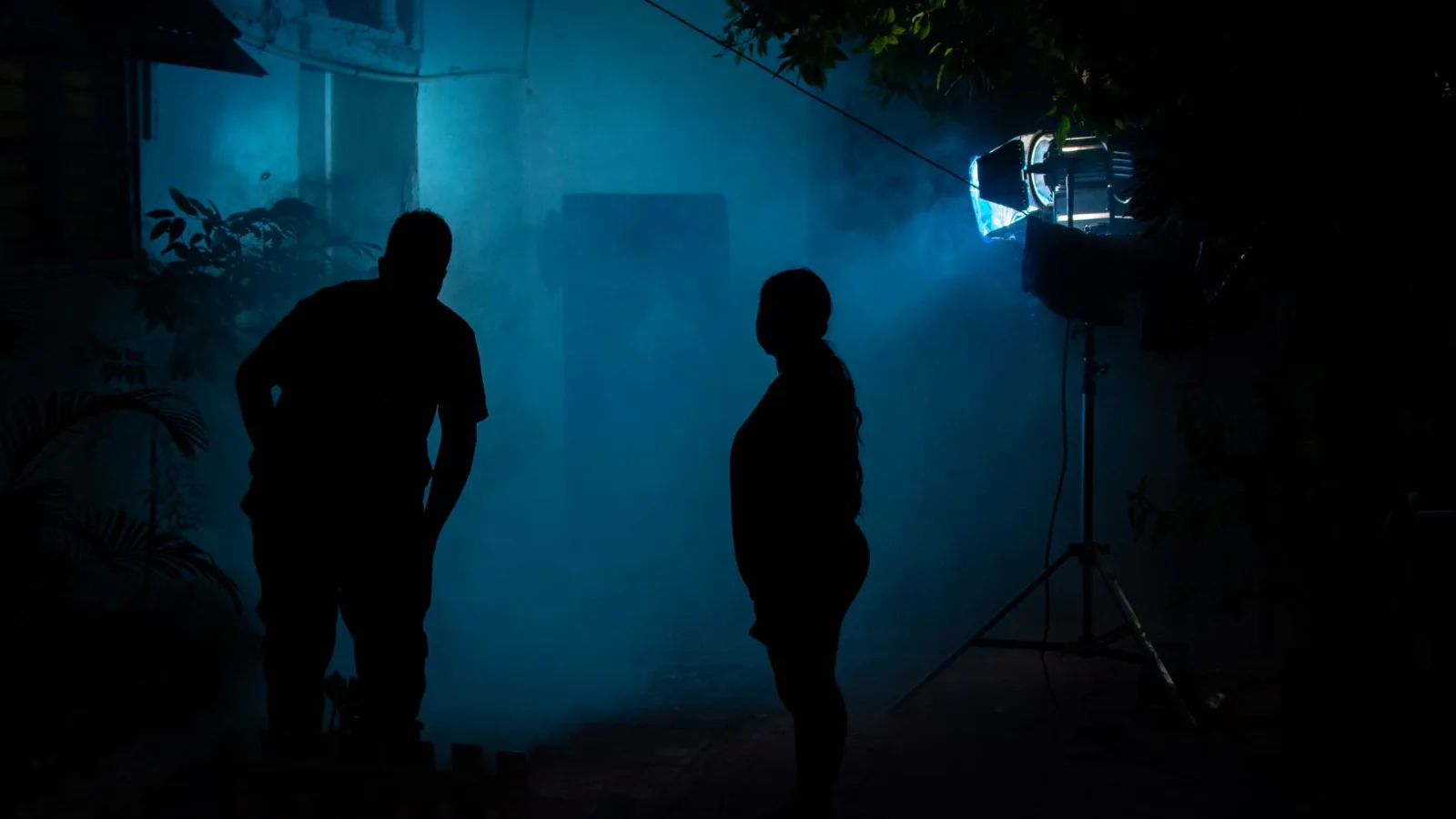
Establishing shots, pauses and reaction shots carry no dialogue: take them off the target length first.Image: Luis Morales Torres / Pexels - 03
Step 3
Convert speaking time to words
Our calculator uses 130 (calm), 150 (standard) and 170 (fast) words a minute for English, and 200 / 250 / 300 characters a minute for Chinese. Sixty seconds of speech at standard pace is about 150 English words. Switch the calculator above to target length to get the number directly.
Tip · Estimate scene by scene: fights and payoff scenes at fast pace, crying scenes and confessions at calm pace.
- 04
Step 4
Add action lines to get the full script
Scene headings, cast lines and action descriptions are not read aloud, but they take up the page. Based on the two practitioner articles quoted below, a full script runs about two to three times the spoken dialogue, so an episode with 150 spoken words usually lands at 300–450 words on paper.
- 05
Step 5
Generate a sample and calibrate
An estimate is only a budget. Paste one episode into the dubbing workshop, generate it, and check the end time of the last cue in the exported SRT: that is the real length with those voices and emotions. Calibrate later episodes against the first one.
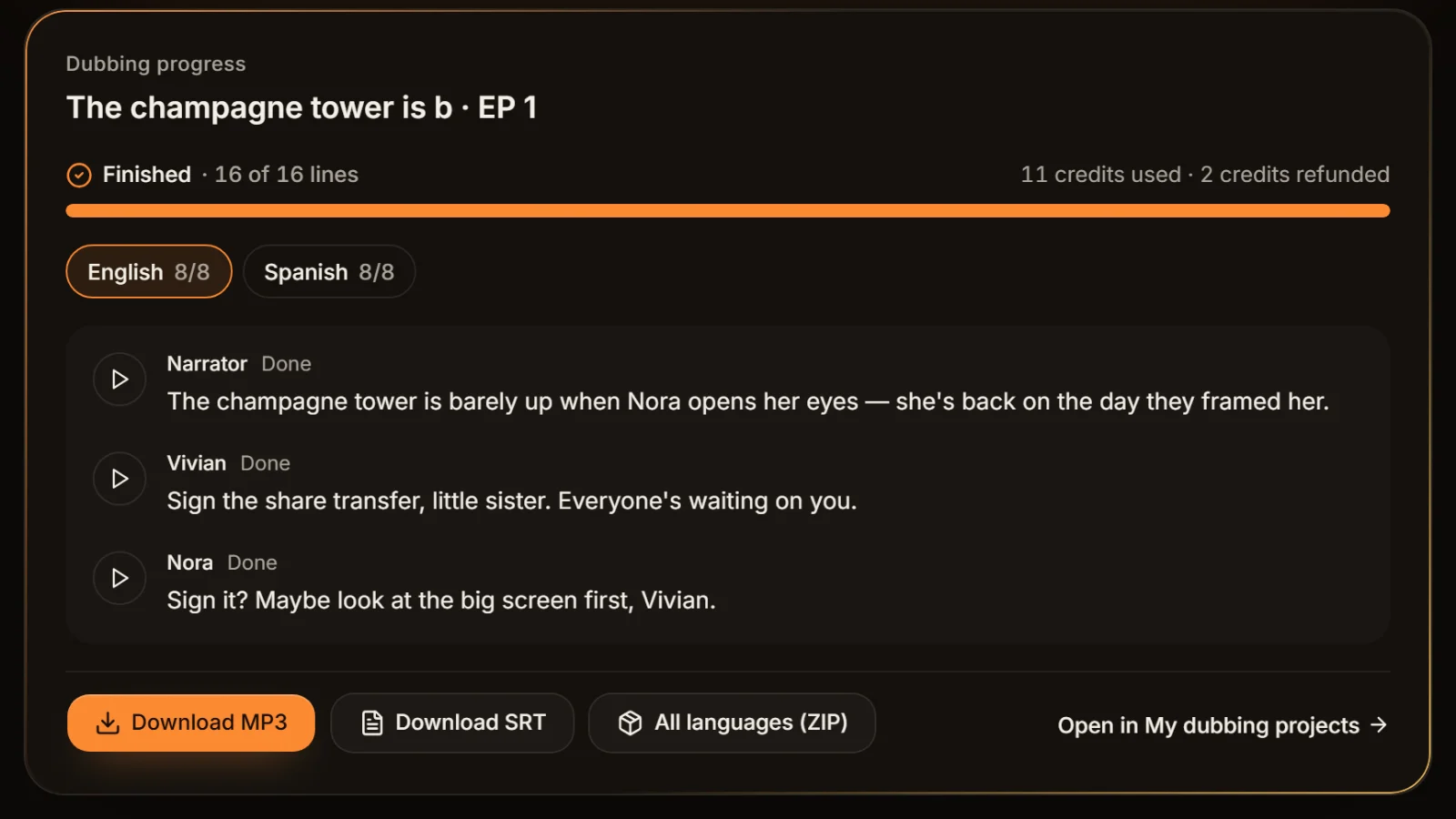
After generating, download the SRT: the end time of the last cue is the episode's real voice-over length with these voices and emotions.Product screenshot
How long is a micro drama episode: figures you can trace
There are plenty of claims online about episode length and word counts. Below are only the ones with a source we could open. Checked November 2026.
Regulation sets a time ceiling, not a word count
| Document | What it says about episode length | Status |
|---|---|---|
| NRTA General Office notice on micro drama management (Guang Dian Ban Fa [2022] No. 345) | Episodes from a few dozen seconds to about 15 minutes, with a clear theme and a continuous, complete storyline | Issued 14 November 2022 |
| Micro-Drama Development Measures (NRTA Order No. 16) | Episodes shorter than twenty minutes, with a clear main thread, a continuous complete plot and prominent characters | Published 31 July 2026, in force from 1 September 2026 |
Originals on the NRTA website: 2022 notice, 2026 Measures. Neither sets a word count.
Rules of thumb: 500–900 characters a script, 200–300 spoken
| Source | Episode length | Word count claim |
|---|---|---|
| China Writers Online, Li Huayan, 12 July 2024 | Micro drama: 1–2 minutes | About 500 Chinese characters per episode |
| China Youth Daily, 3 January 2024 | — | Mini-program dramas: 500–700 characters per episode, two plot beats and one twist |
| Hailuoshe blog, 19 July 2026 | 1 to 2 minutes | 200–300 characters of usable dialogue; the full script is usually 600–700 on paper; keep each line under 15 characters |
| Zhihu column, Xuanyuan Script Studio, 4 June 2026 | 90 seconds to 2 minutes | About 200–300 characters of dialogue, 600–900 including action lines |
Originals (Chinese): China Writers Online, China Youth Daily, Hailuoshe, Zhihu.
Rules of thumb, not a standard
These come from a novelist, a reporter and two script teams working in different genres. They are fine for planning, but not a submission requirement: platforms and studios set their own, so follow theirs.

Words for a one, two and three minute episode
The table converts runtimes with our calculator's pace settings, assuming someone speaks for the whole episode. Full script length uses the two-to-three-times ratio from the articles above. A real episode has silent shots, so scale dialogue down to match your storyboard.
| Episode length | English dialogue (calm / standard / fast) | Chinese dialogue (calm / standard / fast) | Full script (dialogue × 2–3) |
|---|---|---|---|
| 1 minute | 130 / 150 / 170 words | 200 / 250 / 300 characters | about 2–3× the dialogue |
| 2 minutes | 260 / 300 / 340 words | 400 / 500 / 600 characters | about 2–3× the dialogue |
| 3 minutes | 390 / 450 / 510 words | 600 / 750 / 900 characters | about 2–3× the dialogue |
Pace settings match the calculator; see words per minute for voice-over.
Put the two tables side by side and a useful gap appears. The rules of thumb give a one to two minute episode only 200–300 characters of dialogue, yet at standard pace 250 characters take one minute to say. In other words, a two-minute vertical episode spends roughly half its time talking and half on pictures, pauses and reactions. Leave that half in the script and the pacing breathes.
Micro drama vs short series vs TV episode: script per episode
The same China Writers Online article gives figures for two longer formats. Per minute, the script density is similar; the difference is mostly runtime.
| Item | Vertical micro drama | 10–15 minute short series | 45 minute TV episode |
|---|---|---|---|
| Episode length (as stated) | 1–2 minutes | 10–15 minutes | 45 minutes |
| Script per episode (as stated, Chinese characters) | about 500 | about 3,500 | about 15,000 |
| Script per minute (our arithmetic) | about 250–500 | about 233–350 | about 333 |
Checked Nov 2026 · The third row divides the stated word count by the stated runtime; it is not a figure from the article.
Sources:China Writers Online: Li Huayan on writing micro dramas (2024-07-12, Chinese)
Do action lines count? Which words get voiced
When people talk about micro drama script word count they mean two different numbers: the whole script, and the words that are read aloud. Only the second sets the voice-over length.
A full script contains scene headings, a cast line, action lines, dialogue, narration and bracketed sound or caption cues. A voice reads only three of these: character dialogue, narration and inner voice. Here is a short original excerpt that shows the gap.
- 1-3 NIGHT INT. FU FAMILY STUDY
- Cast: Wanning, Fu Chen
- Wanning walks in and sets a folder on the desk.
- Wanning (calm): The divorce papers. I've signed them.
- Fu Chen doesn't look up. His pen stops mid-air.
- Fu Chen (sneer): This trick again?
- Wanning: It's not a trick. It's a notice.
- She heads for the door and stops for a second.
- Wanning (inner voice): Three years. I never have to wait up for him again.
- [SFX: door closes]
- Narrator: The moment the door shut, the pen in Fu Chen's hand snapped.
| Count | This excerpt | Note |
|---|---|---|
| Whole excerpt | about 90 words | everything on the page |
| Words that get voiced | about 40 words | the text of 3 dialogue lines, 1 inner-voice line and 1 narration line, without names or brackets |
| Voice-over length at standard pace | about 16 seconds | 40 ÷ 150 × 60 |
That is why it pays to save a separate voice-over version before dubbing: delete scene headings, the cast line, action lines and bracketed cues, and keep only dialogue, narration and inner voice. Anything you leave in gets read. In the workshop a row without a Name: label is read by the narrator, and a row such as “Cast: Wanning, Fu Chen” is treated as a character called Cast. The layout is covered in the short drama script format guide; to count lines per character, use the script line counter.
Narration-heavy scripts are different
Novel adaptations, comic dramas and novel promo videos often carry more than half their text as narration, and almost every word is read aloud, so script length and voiced length end up close. Estimate those as fully voiced instead of using the two-to-three-times ratio. How comic drama scripts differ is covered in how to write a comic drama script.
Six habits for planning a whole series
Once the episode length is settled, the workload and the voice-over volume for the series follow. These six come from the figures and the dubbing workflow above.
Budget on spoken words
Schedules, quotes and voice-over time should use the words that are read aloud, not the full script. The two can differ by two to three times.
Work out a series total first
100 episodes at 500–900 Chinese characters is 50,000–90,000 characters of script, of which 20,000–30,000 are dialogue. That is the amount of audio you will have to review.
Keep each line to one breath
The Hailuoshe blog suggests keeping a line under 15 Chinese characters. Short lines carry emotion better and fit on screen as one subtitle.
Leave silence in every episode
The pause before a twist and the freeze on the cliffhanger are part of the rhythm. Dialogue that fills the whole runtime usually sounds rushed.
For dubbed versions, watch subtitle length
Dubbed lines follow the original line by line, so runtime stays close to the source. Subtitle length is what changes; see minor-language dubbing for how languages differ.
Calibrate on episode one
After the first episode is voiced, divide the SRT's total time by the spoken word count. That is this series' own words-per-minute; write the rest to it.
Frequently asked questions
The common rule of thumb is one to two minutes per episode, 500–900 Chinese characters of script and 200–300 characters of dialogue; in English that is roughly 150–300 spoken words. These are practitioner figures, not a standard. Set the runtime first and work back with the calculator.
Paid vertical dramas most often run one to two minutes an episode. Chinese regulation only sets a ceiling: the Micro-Drama Development Measures (in force from 1 September 2026) define micro dramas as having episodes shorter than twenty minutes; a 2022 notice described them as a few dozen seconds to about 15 minutes.
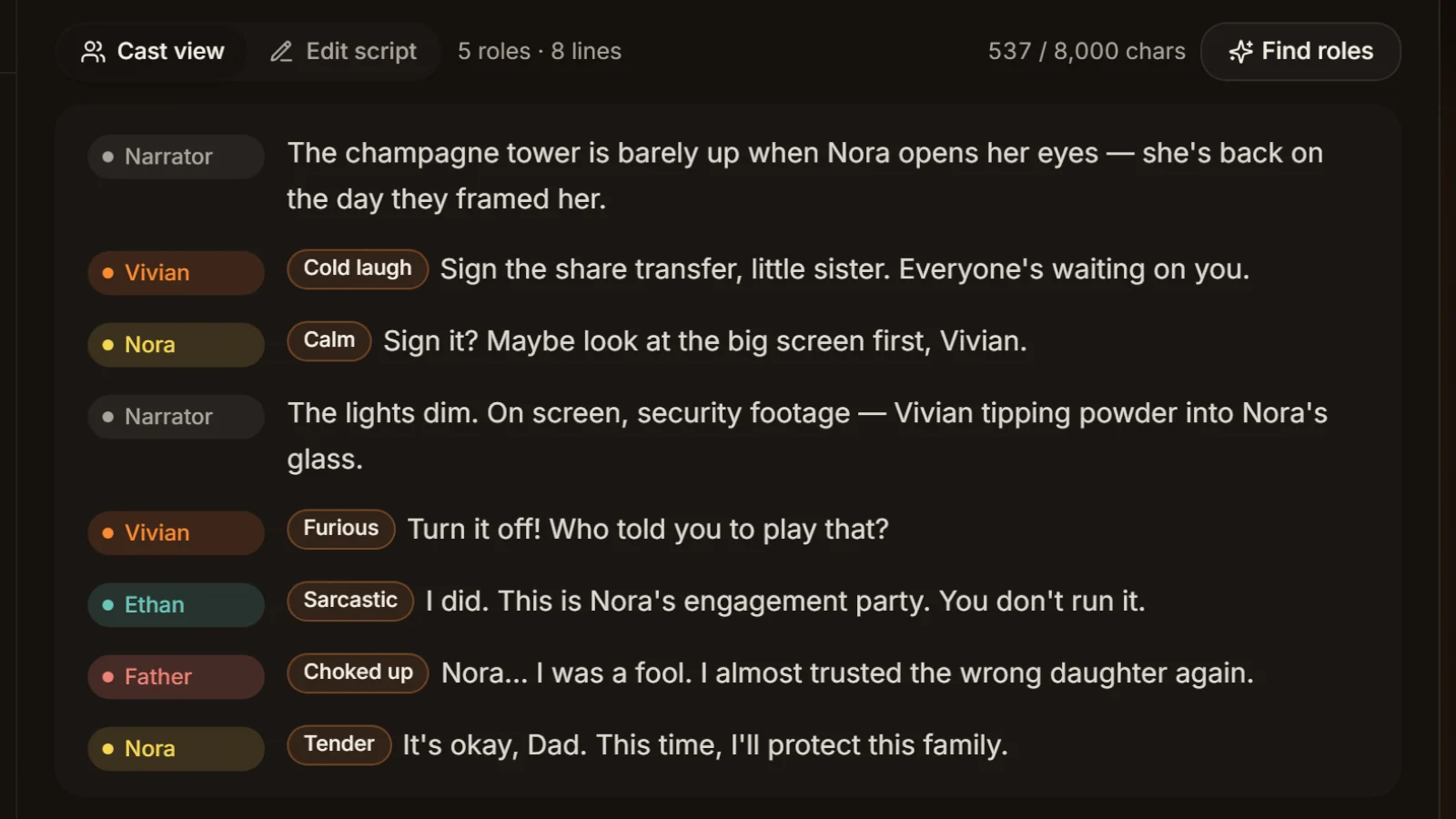
It depends on line length. With 200–300 characters of dialogue at 10–15 characters a line, an episode has roughly 14 to 30 lines. For reference, the drama sample built into the workshop, an engagement-party scene, has 8 lines: 2 narration and 6 from four characters.
The script total does; the voiced count does not. Scene headings, cast lines, action lines and bracketed cues are for the director and editor and are never read. Count only dialogue, narration and inner voice for timing, and delete the rest before dubbing so it is not read by the narrator.
At 500–900 Chinese characters an episode, about 50,000–90,000 characters; the voiced dialogue at 200–300 an episode is about 20,000–30,000. Narration-heavy novel promos and comic adaptations get much closer to fully voiced.
It depends on short lines, emotion and voice: lots of short lines and pauses run longer, arguments run faster. The reliable method is to voice one episode, read the end time of the last SRT cue and calibrate. Dubbing is charged by script length; see pricing.




Finished an episode? Hear how long it runs Write it, hear it, time it.
Paste the script and get the cast list for free; after generating, calibrate your episode length against the SRT timings.
Billed by characters generated · Failed runs refunded automatically · Alipay, WeChat Pay and cards