Script Line Counter: Lines, Words and Share per Character
This script line counter takes one step: paste a script, and it finds each speaker from lines written like "Name: line", then lists every character's line count, word count and share of the script, with an estimate of how long their part takes to voice at slow, standard and fast speaking rates. Narration, dialogue and inner voice (OS) are counted separately; the results show as a table and a bar chart and export to CSV. Use it for casting, voice-actor quotes and recording schedules. It all runs in your browser, so the script is never uploaded.
- Per-character counts
- Narration / dialogue / OS
- Three speaking rates
- CSV export
Updated Nov 5, 2026Fact-checked Nov 5, 2026
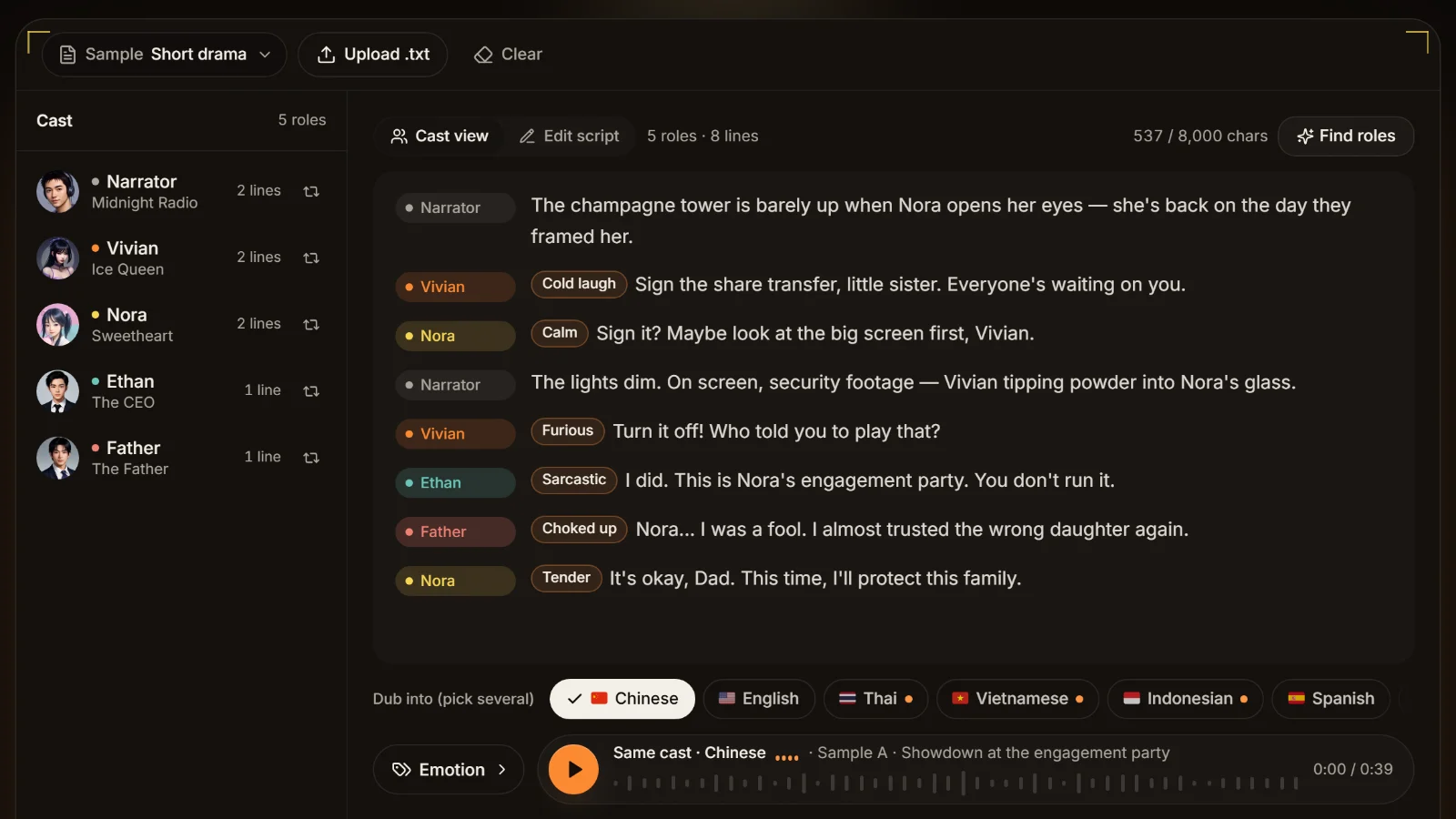
Sample A · Showdown at the engagement party
English · Script excerpt · 5 characters



Narrator
The champagne tower is barely up when Nora opens her eyes — she's back on the day they framed her.

VivianCold laugh
Sign the share transfer, little sister. Everyone's waiting on you.

NoraCalm
Sign it? Maybe look at the big screen first, Vivian.
Narrator
The lights dim. On screen, security footage — Vivian tipping powder into Nora's glass.
Script line counter: paste a script, see who carries it
Paste one episode or several. The counter lists lines, words, share and estimated time at three speaking rates for each character. If one character appears under two names (say "Nora" and "Nor"), merge them by hand into one row.
How to use the script line counter in four steps
No need to tidy the script into a spreadsheet or strip the action lines first. Paste it as it is, count, then go back and fix the script.
- 01
Paste the script
Paste one or more episodes into the box; copying straight from Word or Google Docs is fine, or open a .txt or .docx file. Speakers written as "Nora: line", "Nora (cold laugh): line" or "【Nora】line" are recognised, and lines starting "Narrator:" or with no speaker name at all go to narration.
Tip · For the layout and a copyable template, see the short-drama script format guide.
- 02
Check the cast list
Look at which characters were found. If one person goes by several names in the script ("Nora", "Nor", "Miss Lin"), the count splits them into separate rows; merge them by hand so their share is right.
- 03
Read each character's share
The table lists lines, words, share of the script and estimated time at slow, standard and fast rates for every character. Narration, dialogue and inner voice are shown apart, and the bar chart makes the lead obvious at a glance.
- 04
Export the CSV
Export a CSV and open it in Excel, Numbers or Google Sheets. That file is your per-character breakdown, ready to send to a voice actor, director or producer as the basis for a quote or a schedule.
Counting rules: what the script line counter includes
The count covers words that will actually be spoken. This table shows how common script lines are counted; if a result looks off, check the script against it first.
| In the script | Counted as | Note |
|---|---|---|
| Nora: You finally came. | Nora · dialogue | The standard form |
| Nora (cold laugh): You finally came. | Nora · dialogue | The emotion after the name isn't counted |
| 【Nora】You finally came. | Nora · dialogue | The bracketed-name form common in Chinese scripts |
| Nora (OS): So it was you. | Nora · inner voice | Counted apart from dialogue |
| Narrator: Three years later, the Lins were broke. | Narration | Lines that start with "Narrator:" |
| She finally understood. | Narration | A line with no speaker name |
| △ Nora pushes the door open. | Not counted | An action line, not dialogue |
| INT. LIN HOUSE - DAY | Not counted | Scene headings and lines like "Location:" or "Characters:" are skipped |
| Nora: Stay back! (steps away) I'm calling the police! | Nora · dialogue | Bracketed notes inside a line aren't counted |
Why inner voice gets its own count
In Chinese short-drama scripts, OS marks a character's unspoken thoughts. (English screenplays usually write V.O. for this, and O.S. means "off screen", so watch the convention when scripts cross languages.) Inner voice is normally voiced by the same actor, but recorded differently: softer, closer, sometimes with a little reverb added later. Counting it apart tells the actor to prepare two registers, and with AI dubbing it shows you which lines to check for the right mood.
Agree on the counting rules first
Two people can count the same script and get different totals: one includes names, punctuation and action lines, the other only the dialogue. This counter counts spoken lines only, so it will come out lower than your word processor's count. Before you ask a voice actor for a quote, agree on what counts: narration or not, inner voice or not, and for Chinese, punctuation or not. The figure at the top of the AI Drama Voice dubbing workshop is the whole pasted script minus whitespace, names and punctuation included; that is how it measures an episode's length, not a line count.
Example: counting lines per character in a dinner scene
Here is a short revenge-drama scene we wrote for this page, 12 lines with one action line. Paste it into the tool above and compare.
- Narrator: The Shen family dinner happens once a year.
- △ Zhiyi pushes the door open. Every pair of chopsticks stops.
- Mother: Zhiyi? What are you doing here?
- Zhiyi (cold laugh): Do I need permission to come home?
- Weiwei: Don't take it the wrong way. Mom is just surprised.
- Zhiyi (OS): The fire three years ago started at this very table.
- Father: Sit down. We are all family here.
- Zhiyi: Family? Was it family who rewrote the will, too?
- Weiwei (choked up): Dad, look at her. Five minutes back and she is already after me.
- Narrator: No one noticed someone was still standing outside the door.
- Gu Yan: Miss Shen is right. The will was changed.
- Zhiyi: Mr. Gu. So you are finally talking.
| Character | Lines | Of which OS | Words | Share | At standard rate |
|---|---|---|---|---|---|
| Zhiyi | 4 | 1 | 33 | 34.7% | about 13 s |
| Weiwei | 2 | — | 23 | 24.2% | about 9 s |
| Narrator | 2 | — | 18 | 18.9% | about 7 s |
| Gu Yan | 1 | — | 8 | 8.4% | about 3 s |
| Father | 1 | — | 7 | 7.4% | about 3 s |
| Mother | 1 | — | 6 | 6.3% | about 2 s |
| Total | 11 | 1 | 95 | 100% | about 38 s |
What the table tells you
- Zhiyi carries about a third of the words plus the only inner-voice line. She is the scene's anchor voice: cast her first and keep the same voice in every episode.
- Narration opens and closes the scene. The narrator works as a storyteller and needs a voice clearly different from the lead's.
- Mother and Father have one line each, but they are in the same room, so they can't share a voice. Small parts still need separate cast entries.
- Gu Yan arrives last with a single line that sets up the next episode. Whatever voice he gets now is the one he keeps.
- In the Chinese original Weiwei has under a fifth of the text; in English she has nearly a quarter, because her lines translate longer. Count the language you are actually recording.
Why count lines per character: casting, quotes, schedules
A per-character count isn't a vanity number. Three jobs that cost money or time all start with knowing who says how much.
Casting: protect the lead voices
The two or three biggest parts shape how a whole series sounds, so they deserve the most time when you choose voices; a passer-by with one line can come from a ready-made voice. For how to choose, see how to cast voices for a short drama. On a running series, counting lines across episodes also shows which characters recur and must keep the same voice.
Quotes: voice actors often price by role or by length
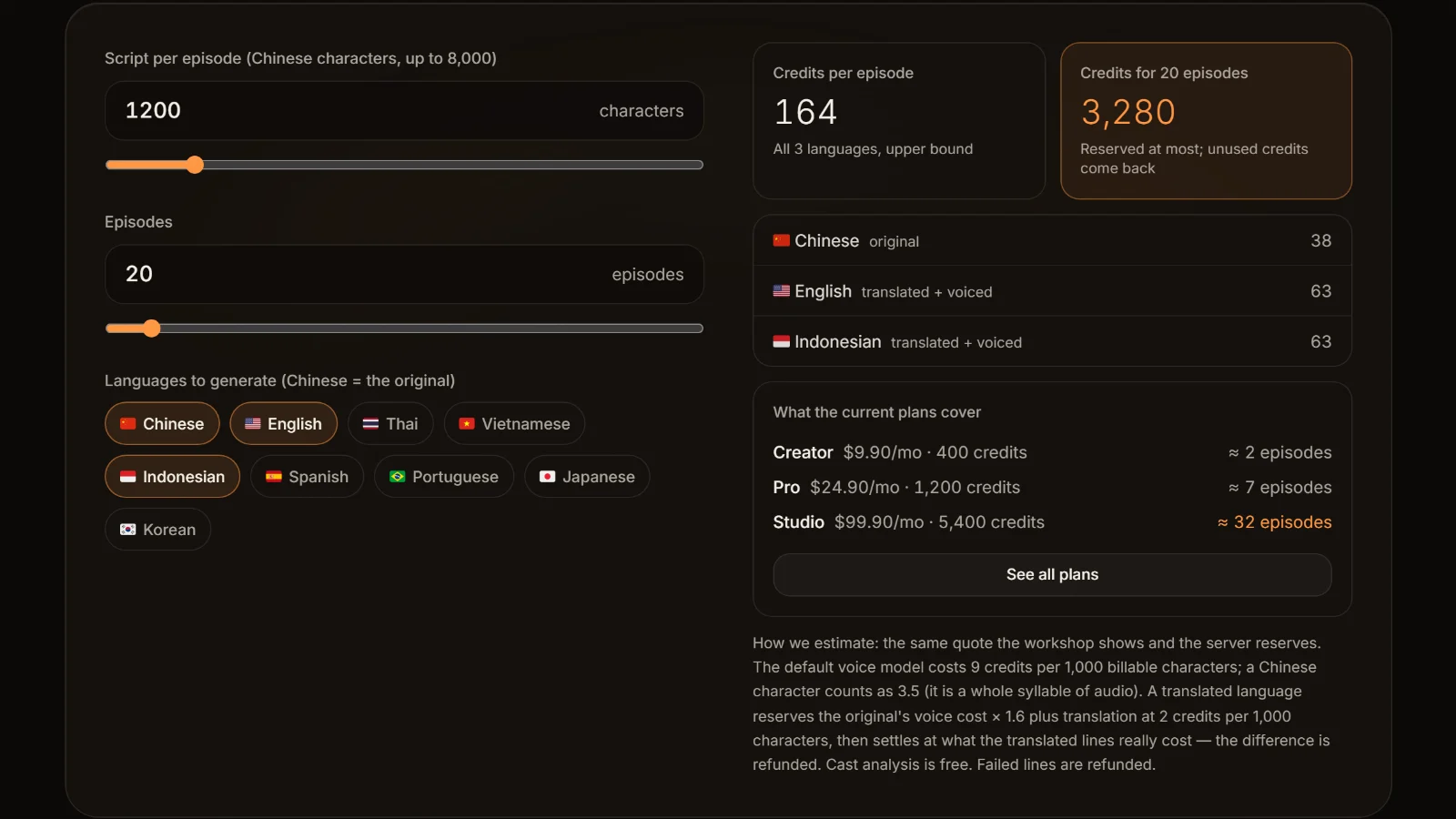
Human voice-over is quoted in many ways: by word count, by finished minute, by role or by line. Whichever it is, you need the per-character breakdown first: a per-role quote needs the number of roles and how big each is, a per-word quote needs each actor's words. The five pricing models and a quote template are in the dubbing cost calculator. For AI dubbing, AI Drama Voice charges credits by the text of the lines, so the number of characters doesn't change the cost; see pricing.
Schedules: book sessions by actor
Human dubbing is usually recorded actor by actor, and a session's length roughly follows that actor's share of the script. The estimated time in the table is finished audio; real sessions add read-throughs, retakes and pickups, so leave slack. In narration-heavy formats such as story recaps, the narrator often has the most work and can be booked first.

Six habits that make the line count accurate
Most wrong counts come from inconsistent scripts, not the counter. These six habits are also what lets AI dubbing assign the right voices.
One name per character
Write "Nora" every time in the speaker slot; nicknames belong inside the lines. Two spellings become two characters in the count, and two voices in a dub.
Mark inner voice and off-screen voices
Write inner monologue as "Nora (OS):" and note phone or radio voices after the name. The counter can then split them, and the actor knows how to record them.
Keep action on its own line
Start action lines with △ (or keep them fully in brackets) instead of mixing them into dialogue. Long stage directions in the middle of a line are best moved out.
Switch to colons before dubbing
The AI Drama Voice dubbing workshop finds speakers by "Name: line". A "【Nora】line" row is read as narration there, and an action line with no name is read aloud by the narrator. Fix or delete those rows before pasting into the workshop.
Count several episodes together
One episode shows who leads that episode. Paste ten together to see which characters run through the series and which only pass through.
Count the language you record
English scripts in "Nora: line" form are counted in words. Translation keeps every line with its speaker, so line counts stay the same, but word shares shift, as the example above shows.
Frequently asked questions
Paste the script into the script line counter on this page. It finds speakers written as "Name: line", "Name (emotion): line" or "【Name】line" and lists each character's lines, words, share and estimated voice time. Merge any character who appears under two names.
No. The counter counts Chinese characters and English words in the spoken lines only; punctuation, bracketed emotions and action lines are left out. Voice actors count differently (some include punctuation or skip narration), so agree on the rule before you compare quotes.
Yes, as its own group. Lines starting "Narrator:" and lines with no speaker name go to narration, shown apart from dialogue and inner voice. In recap and story-narration scripts, narration is often the biggest part.
Export the CSV and open it in Excel, Numbers or Google Sheets, then save it as a spreadsheet. If Chinese text shows as gibberish in Excel, import it through Data → From Text/CSV and choose UTF-8.
With human voice actors, yes: quotes are often per role, per word or per line, so a bigger part costs more. With AI Drama Voice's AI dubbing, credits follow the text of the lines and the number of characters makes no difference; see pricing.
Paste plain text, including text copied from Word or online docs, or open a .txt or .docx file. Speakers can be written "Name: line", "Name (emotion): line" or "【Name】line", with half- or full-width colons; "Narrator:" and unnamed lines count as narration, and lines starting with △ are action.




You know who says what. Now hear it. Every role, counted and cast.
Paste an episode and AI finds every character, assigns voices and tags each line's emotion, then exports the MP3 and SRT per episode. Cast analysis is free.
Billed by characters generated · Failed runs refunded automatically · Alipay, WeChat Pay and cards