
Midnight Radio
Velvet · narrator
● Narrator · mystery, apocalypse, horror
Deep and velvety; tag the eerie lines whisper and the tension builds.
NarratorsMale9 languages
A manga recap voiceover is not the same as voicing a comic panel by panel. In a recap, the narrator does most of the talking, and only the key moments are quoted in the characters' own words. Paste your recap script into AI Drama Voice: rows written as “Narrator: …” all go to one narrator voice, rows written as “Name: …” go to separate character voices, and any line can carry an emotion. Export an MP3 and a line-timed SRT, and voice the same recap in English or Japanese for an overseas channel.
Updated Nov 5, 2026Fact-checked Nov 5, 2026
Sample B · The sweeper who shook the sect
English · Script excerpt · 5 characters

Narrator
The Azure Cloud Sect tournament roars around the arena. Ye Chen, who swept leaves for three years, steps up with a bamboo sword.
Xiao LingSarcastic
A yard sweeper thinks he can stand against me?

YunyaoWhisper
Brother Ye, don't push it... he's the best in the inner sect.

Ye ChenCalm
Three years of sweeping. I only practiced one strike.
The studio opens on a Chinese-comic sample with a narrator and four characters. Replace it with your own recap, narration rows starting with “Narrator:”, and see how narration and quoted lines are split apart. This step costs no credits.
The four formats get mixed up, but each is voiced differently. Work out which one you're making before you decide how to write the script and how many voices it needs.
| Format | Input | Voice structure | Deliverable | Page |
|---|---|---|---|---|
| Manga recap | Your own recap script plus a few original lines | One narrator throughout, with occasional character quotes | Recap MP3 + SRT, cut over manga panels | This page |
| Audio comic | Every panel's dialogue and narration | Every character voiced, panel by panel | A fully voiced chapter over motion-comic visuals | Audio comic dubbing |
| Comic drama | A script written to storyboards | Multi-character acting, like a short drama | Per-episode audio + subtitles over AI visuals | AI comic dubbing |
| Short-drama recap | A recap script over live-action drama clips | One narrator, faster pace | Recap MP3 + SRT over drama footage | Drama recap voiceover |
Recaps and audio comics are the easiest to confuse. An audio comic is acted: whoever speaks in a panel speaks in their own voice, and the narrator only links scenes. A recap is told: the narrator stands outside the story, summarises, adds opinions, skips dozens of panels in a sentence and quotes the characters only at the most intense moments. That's why a manga recap voiceover lives or dies on one narrator voice people can listen to for a long time; character voices are the seasoning.

The whole trick of a manga recap voiceover is writing narration and quotes on separate rows. The workshop handles the rest.
Step 1
Start every narration row with “Narrator:”. When you quote a character, give the quote its own row as “Name: line”. Keep quotes rare; two or three of the strongest lines per video is plenty.
Step 2
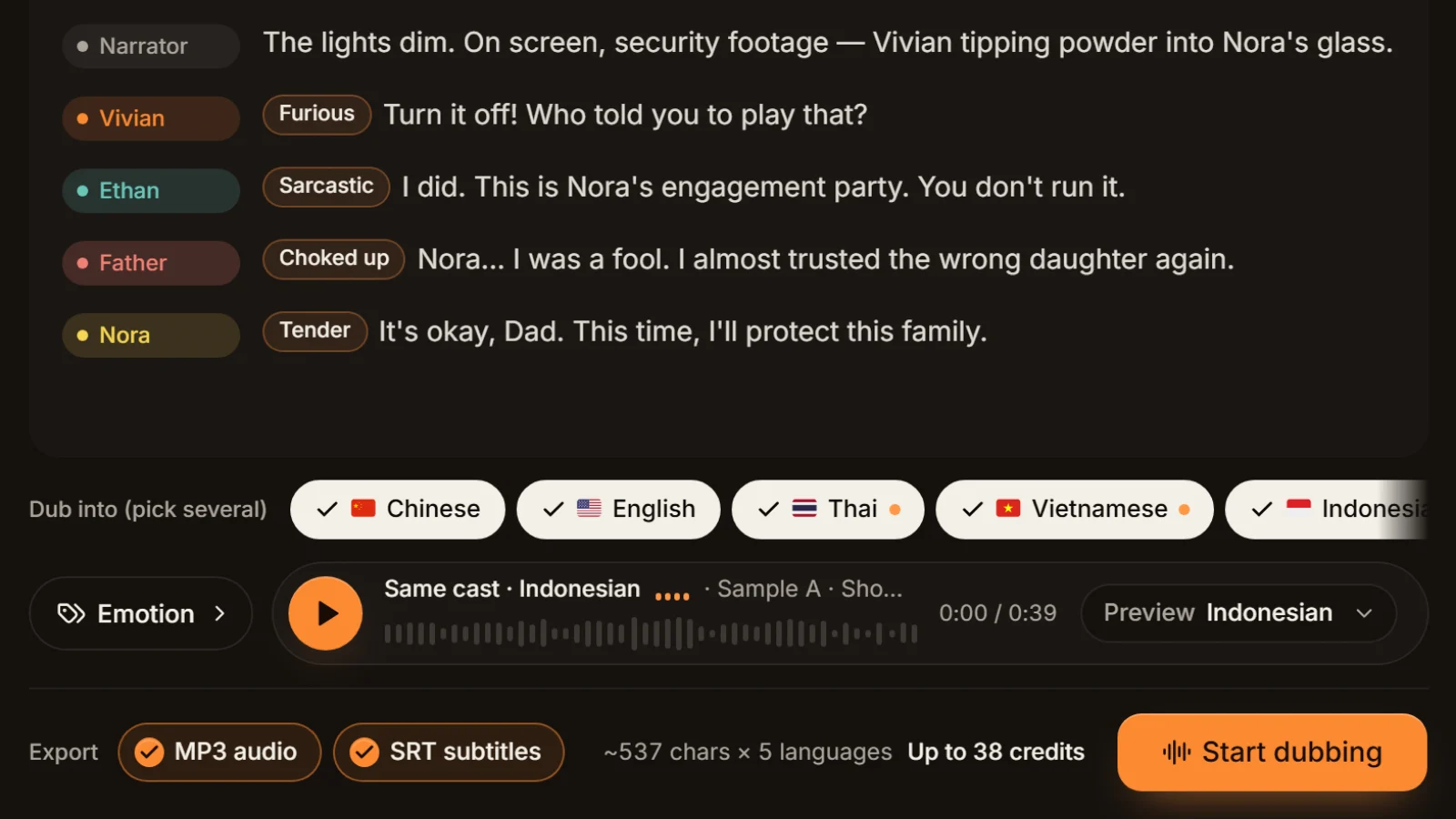
Paste the script into the workshop and run Find roles. The cast list shows the narrator and every character separately, with a line count for each. The analysis is free.
Step 3
The narrator voice is your channel's face; pick one and stick with it. Cast the quoted characters by persona, for example Ice Queen for the villainess and Young Hero for the lead.
Tip · Give each character the same name in every episode so the cast list recognises them as one person.
Step 4
Narration is mostly calm, reveals work as a whisper, and quotes get whatever the scene needs: cold laugh, furious, choked up. Tick the languages you want and generate; failed lines are refunded automatically.
Step 5
Download the MP3 and the line-timed SRT, then cut the manga panels over them in CapCut with pans, zooms and keyframes. AI Drama Voice delivers the voice and subtitles; the picture edit happens in your editor.
The first four make good narrators; the last four suit quoted character lines. Click a portrait to listen. Every voice speaks Chinese and eight other languages.
Velvet · narrator
● Narrator · mystery, apocalypse, horror
Deep and velvety; tag the eerie lines whisper and the tension builds.
Clear · energetic
● Narrator · action, shonen-style stories
Clear and driving, made for scripts packed with “and then he finally awakens” moments.

Mature · poised
● Narrator · romance, palace intrigue
Mature and poised; steady through love triangles and schemes, easy to listen to for a long time.
Classic · folk tale
● Narrator · historical, cultivation, Chinese comics
A classic storyteller's cadence, ideal for openings like “Long ago, beneath the Azure Mountains…”.

Cold · villainous
● Quotes · the villainess
Cold with an edge; her cold-laugh line is where it pays off.
Deep · commanding
● Quotes · the male lead, the big boss
Deep and commanding; one “You think you're worthy?” is enough.
Bright · playful
● Quotes · the heroine, the junior disciple
Bright and youthful, clearly distinct from a low narrator voice.
Over-the-top · comic
● Quotes · the villain in a comedy manga
Exaggerated and comic, for recaps with a goofy tone.
Half of a good recap is the script. Here is a common five-part structure, each part with its own way of writing. The sample is an apocalypse manga we made up; it doesn't match any real title.
| Part | Job | Sample |
|---|---|---|
| Hook | Open with the most absurd premise | Narrator: Day three of the apocalypse. One convenience store in the whole city still has its lights on, and the zombies can't get through its door. |
| Setup | Who the hero is and where he stands | Narrator: Lin Ye was just a college kid on the night shift. Now the store is packed with people hiding from the dead. |
| Escalation | Trouble walks in | Narrator: Among them is an armed squad, and on the very first night their leader, Zhao Lie, eyes the keys behind the counter. |
| Quotes | One or two original lines push the clash to its peak | Zhao Lie (cold laugh): A shop clerk wants to be in charge? / Lin Ye (calm): I opened that door. I decide who comes in. |
| Cliffhanger | Stop just before the next thing happens | Narrator: But that night, the security camera catches someone opening the store's door, from the inside. |
Paste that sample into the workshop and it becomes three roles: Narrator, Zhao Lie and Lin Ye. All five narration lines share the narrator voice, and the two quotes go to Zhao Lie and Lin Ye. There's no fixed ratio, but once quotes pile up, the video stops sounding like a recap and starts sounding like a full dub.

Make the reveal breathe
Put the reveal on a row of its own, tag the line before it calm and the reveal itself whisper. Lines already have a short gap between them, and the drop in delivery does more than a comma in the middle of a sentence.
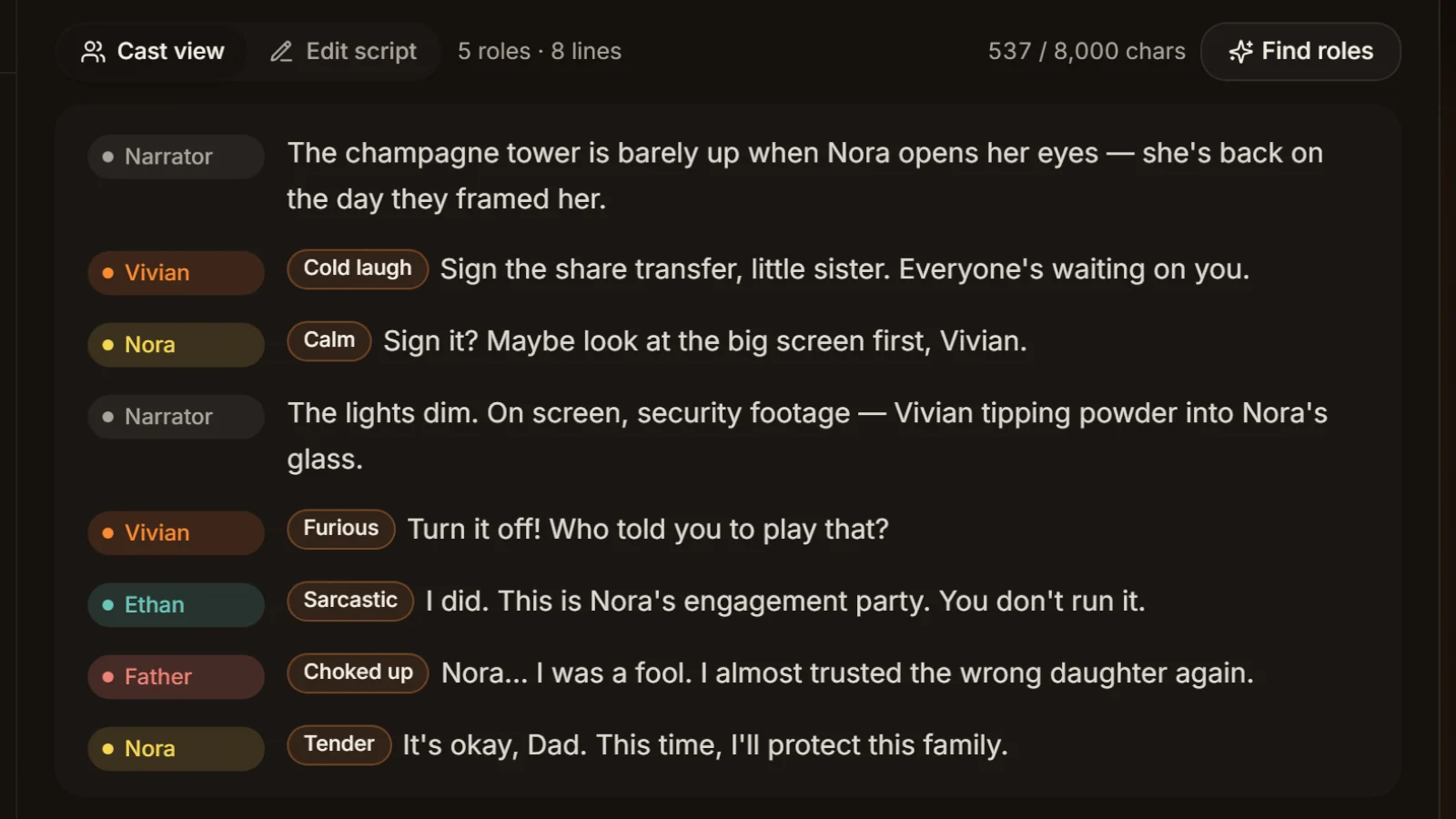
Tick English and Japanese, and every narration row and quote is rewritten into natural spoken language, keeping its speaker and emotion, then voiced by the same cast. Each language has its own things to watch.
English · English
English recaps are usually told in the simple present (“Lin Ye locks the door…”), which makes the story feel like it's happening now. Write Chinese names in pinyin and keep one form throughout; don't drift between “Lin Ye” and “Ye”.
Japanese · 日本語
A Japanese recap can be narrated in the polite です・ます style or the plain だ・である style; choose one and keep it. The personality lives in the quotes: a forceful male character tends to say 俺 (ore) for “I”, a villainous young lady might say わたくし (watakushi).
Every “Narrator:” row uses the same voice, so line fifty sounds like line one.
Rows written as “Name:” go to character voices; no switching voices line by line.
Calm narration, a whispered reveal, a villain's cold laugh: one tag per line.
Each cue's timing comes from where its line sits in the MP3, so it lines up in CapCut straight away.
Tick English, Japanese and more; the narrator voice stays the same, and each language gets its own MP3 and SRT.
The panels, layouts and dialogue in a manga recap belong to the original creator or publisher. Your recap script is yours, but that doesn't give you the right to use the artwork. Before you start, check three things:
Whether the voice itself can be used commercially, say for sponsored or promoted posts, is covered in can AI voiceovers be used commercially; adding the AI label is covered in how to label AI-generated content.
Note
These are common-sense pointers, not legal advice. Whether and how a specific title can be recapped depends on the rights holder's written terms.
Credits are charged by the characters in the lines: a longer recap uses more, and each extra language adds translation and voicing. Cast analysis is free and failed lines are refunded automatically. Put the length and languages into the dubbing cost calculator for an estimate; plans are on the pricing page.
Use the same narrator voice for the life of the channel, even when you change genres. Viewers remember a channel by its voice.
Quote the two or three lines that move the plot; retell everything else in narration.
Calm on the line before, whisper on the reveal; the drop grabs harder than turning the volume up.
Cultivation and fantasy comics are full of rare characters and multi-reading characters in names, sects and techniques. Check those lines first after generating; fixes are in AI voice polyphonic characters.
Get the voice first, then edit: let the length of each SRT cue decide how long a panel stays on screen.
It depends on the genre: a low narrator like Midnight Radio for mystery and apocalypse, Young Hero for action, Elegant Lady for romance, Storyteller for historical and Chinese comics. Pick one and keep it so the channel is recognisable. Listen first in the voice library.
Roughly two kinds: general text-to-speech tools, fine for scripts that are pure narration; and script-based multi-character tools like AI Drama Voice, which voice the narrator and the quoted characters separately and also produce foreign-language versions and SRT.
It comes down to the artwork: use your own original comic, or a title the platform or rights holder has opened for promotion, and follow its rules. Write the recap yourself rather than copying someone else's. The rights holder's terms are what count.
Yes. Rows written as “Narrator:” share the narrator voice, rows written as “Name:” go to character voices, and you can recast each in the cast list.
Yes. Tick English, and Japanese or others if you like; narration and quotes are rewritten line by line into natural spoken language and voiced by the same cast, with an MP3 and SRT for each language.
It depends on the script length and the number of languages: credits are charged by characters, and foreign versions add translation. The dubbing cost calculator estimates it from those two numbers; cast analysis is free and failed lines are refunded.
Paste the recap, confirm the cast, tick the languages. MP3 and subtitles export together; the picture is CapCut's job.
Billed by characters generated · Failed runs refunded automatically · Alipay, WeChat Pay and cards