Rewritten for English ears
Lines aren't translated word for word. They're rewritten the way native speakers talk: long, tangled sentences get shorter, references only Chinese viewers get are swapped, and the conflict and twists stay intact.
Taking a Chinese drama overseas usually starts with an English version. This short drama English dubbing software starts from the script: AI rewrites the lines the way English speakers actually talk, the original cast performs them again in English, and you export English MP3 and SRT. Not a robot reading a word-for-word translation.
Pay per character · Failed runs refunded · Alipay / WeChat Pay accepted
Sample C · Poisoned wine in the cold palace
English · Script excerpt · 4 characters
NarratorCalm
The cold palace door had not opened in three years. Tonight, the Noble Consort walked in carrying a jug of wine.

Noble Consort · Liu RuyanSarcastic
A gift from His Majesty, sister. Drink up.

Deposed consort · Shen QingciCold laugh
And your baby, is it really in there?

The EmperorFurious
Silence, all of you!
An excerpt from Poisoned wine in the cold palace; play the Chinese original and the English version. Court forms of address have no direct English match, so we turned them into what viewers instantly get: sister and His Majesty.
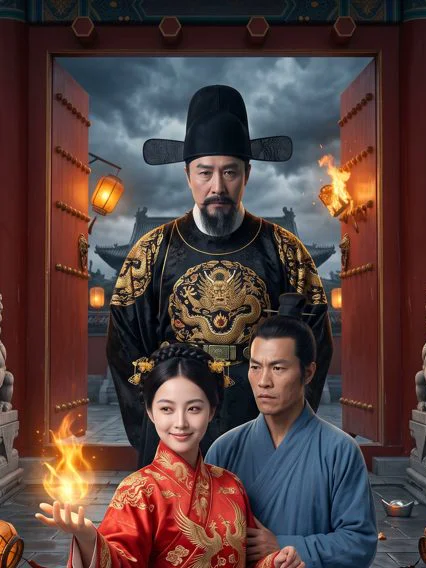 Palace intrigue
A deposed consort exposes a fake pregnancy just as the emperor walks in.
38s
Sample C · Poisoned wine in the cold palace
🇺🇸 English38s
Script excerpt
The cold palace door had not opened in three years. Tonight, the Noble Consort walked in carrying a jug of wine.
A gift from His Majesty, sister. Drink up.
And your baby, is it really in there?
Silence, all of you!
Cast of this episode
NarratorDeposed consort · Shen QingciNoble Consort · Liu Ruyan Maid · Xiao HeThe Emperor
An office romance, an urban "system" story and a radio reunion: English multi-voice clips with the transcript as spoken and a scene summary.
Office romance · 4 voices
16s
Transcript
Scene
Oat milk hits the floor as the new CEO, Lu Jingshen, greets the office; a colleague whispers to Lin Xiaoman, who only wonders whether she still has a desk.
These are example multi-character English clips. Their lines differ from the Poisoned wine in the cold palace excerpt above: not the same scene and not the same cast.
There are plenty of English voice tools, but most translate a finished video or read everything in one voice. We start from the script and perform it character by character.
Lines aren't translated word for word. They're rewritten the way native speakers talk: long, tangled sentences get shorter, references only Chinese viewers get are swapped, and the conflict and twists stay intact.
The CEO, the heroine and the villain from the Chinese version keep their voices in English. Viewers switching between versions recognize the same cast.
Cold laughs, sobs, shouts and whispers: every line's emotion tag carries into the English version, so the payoffs and twists still land.
The English SRT has one cue per line, timed exactly to the dub, so it imports into CapCut without re-timing.
English is usually the first stop overseas. These four teams use it most.
A Chinese catalogue heading to English-language drama platforms: dub English first to test the numbers. One episode per run, dozens in a queue.
With the script and voice-free footage you can re-voice in English from the script, rewritten the English way, which is cleaner than translating a finished video.
One creative, Chinese and English versions: the English MP3 and SRT go straight into the editor, and a new audio track makes a new ad.
Paste a translated English script and dub it directly. Write it as "Name (emotion): line" for the most accurate casting.
Go from Chinese script to English dub directly, with no need to finish a Chinese cut and translate it afterwards.
Paste the whole episode. AI identifies characters, narration and each line's emotion, and builds the cast for the Chinese version first.
Tick English as a target and check each character's voice and each line's emotion tag. English voices include American Lily and Brian and British Arthur, so cast by role.
During the run AI rewrites each line in English, keeping speaker and emotion, then voices it. Export English MP3, SRT subtitles or a ZIP of every language, and make the vertical cut in CapCut.
We deliver audio and subtitles, not video. For a vertical cut, drop the English MP3 and SRT into CapCut and they line up in minutes.
The English version and the Chinese original each get a file, every character in script order, ready for the audio track.
One cue per line, starting and ending exactly where that line's audio does, UTF-8 encoded. No manual re-timing after import.
Picked several languages? Each one's MP3 and SRT download together in one ZIP, the easiest hand-off to an editor.
Create a 9:16 project and import the footage for the episode.
Drag the English MP3 onto the audio track, starting at 0 seconds.
Import the matching SRT with the subtitle import; the cues fall into place on the timeline.
Preview line by line, adjust subtitle position and size, then export.
Picture and final export happen in your own editor: we don't render video or lip-sync. If the original footage has Chinese voices baked in, use a voice-free version or the music-and-effects track.
SRT example (format only, timings illustrative)
A lot of a Chinese drama's punch lives in the language itself. Translate it literally and the punch is gone. These are the spots we focus on.
The problem
Classic Chinese drama put-downs, fate-defying vows and internet slang either make no sense in literal English or lose all their impact, and viewers can't tell why the moment should feel satisfying.
How we handle it
AI looks for English lines that do the same job in context: a brutal put-down becomes a put-down English viewers know, slang becomes a close equivalent, and when nothing fits it rewrites rather than forcing a translation.
你算什么东西? → Who do you think you are?
The problem
Imperial self-references, sect seniority terms and "young master" have no ready-made English words. Transliterations confuse viewers, and turning everything into "you" erases rank.
How we handle it
We settle on one set of English titles for each rank, such as His Majesty, Senior Brother and Young Master, and keep it consistent across the series. You can always change them to your preferred translations in the lines.
陛下 → His Majesty · 师兄 → Senior Brother · 少爷 → Young Master
The problem
English often needs more syllables to say the same thing, so squeezing it into the original timing sounds rushed. Other lines end up too short and the voice stops before the shot does.
How we handle it
The rewrite keeps English lines close to the original timing, and lines that have to hit a cut can be trimmed further so the pacing never drags.
The problem
A long English subtitle line covers half a phone screen, and breaking after a preposition or an article makes it hard to read.
How we handle it
The exported SRT has one cue per line, timed to the dub, with no automatic line breaks. The rewrite keeps lines short; split a very long sentence in the script, or break it by hand in CapCut.
This is script-first English dubbing software for short dramas: paste a Chinese script, AI casts the characters, assigns voices and tags emotions, rewrites every line in English with speaker and emotion kept, and the same cast voices it. You get an English MP3 per episode, line-timed SRT subtitles and a ZIP, billed per character, with failed lines refunded automatically.
Choosing short drama English dubbing software, proofreading the translation, and billing.
If you have the Chinese script, choose a script-first tool that casts characters, keeps the emotion and exports time-coded subtitles. If you only have a finished video and need lip-sync, a video-translation tool fits better. This short drama English dubbing software does the former, exporting English MP3 and line-timed SRT.
No. We work from scripts and don't process a video's original audio or lip-sync. Provide the Chinese script (the dialogue text); AI rewrites it in English and re-voices it, and you lay the English MP3 and SRT over voice-free footage.
Yes. Every character uses the same voice in Chinese and English, just in another language. For a series, pick the same voices from one cast sheet every episode.
Everyday dialogue is usually ready to use. Before a flagship release, have someone fluent in English read the subtitles once, focusing on names, titles and wordplay.
Credits are charged on the characters of the English text you generate, separately from the Chinese original, and failed runs are refunded automatically. See the pricing page for plans.
Yes. English voices include American-accented Lily and Brian and British-accented Arthur, so cast by role, for example British for a butler or an aristocrat and American for younger characters.
No. We deliver English MP3, line-timed SRT subtitles and a ZIP, not rendered video. Create a 9:16 project in CapCut, import the footage, put the MP3 on the audio track and import the SRT; the timings line up on their own.
Names default to pinyin, and titles become what English viewers know, such as His Majesty, Senior Brother or Young Master, consistently across the series. To use your own translations, write them into the Chinese script before generating.
Up to 8,000 characters per run; split long scripts by episode. New episodes in the same series keep the characters already cast, so the English version always sounds like one cast.
No. Swap that character's voice in the cast list and only their lines are re-voiced. Failed lines re-run in one click, with their credits refunded automatically.
Still have a question? Open a ticket


Paste one Chinese episode, analyse the cast for free, then generate the English version. Pay per character; failed lines are refunded automatically.