Chinese Polyphonic Character Checker for Voiceover Scripts
This Chinese polyphonic character checker does one job before you dub: paste a script and every common polyphonic character (a character with more than one pronunciation, also called a heteronym) is highlighted, with its possible readings and example words beside it. Words that trip up short-drama and period-drama lines get their own colour, and numbers and English abbreviations are flagged as a separate group. It marks what might be misread; it does not decide which reading a line needs, and it cannot predict which one an AI voice will choose. Confirming readings and rewriting lines is up to you. The script is processed in your browser and never uploaded.
- Highlights polyphones
- Readings and examples
- Drama-specific traps
- Nothing uploaded
Updated Nov 5, 2026Fact-checked Nov 5, 2026
Sample B · The sweeper who shook the sect
English · Script excerpt · 5 characters

Narrator
The Azure Cloud Sect tournament roars around the arena. Ye Chen, who swept leaves for three years, steps up with a bamboo sword.
Xiao LingSarcastic
A yard sweeper thinks he can stand against me?

YunyaoWhisper
Brother Ye, don't push it... he's the best in the inner sect.
Ye ChenCalm
Three years of sweeping. I only practiced one strike.
Polyphonic character checker: paste a script, see the risky characters
Paste an episode or a voiceover script. Each highlighted character lists its possible readings and example words; high-risk short-drama and period-drama words get a second colour, and numbers and abbreviations are flagged apart. Export the annotated text for a reviewer or a human voice actor.
How to use the polyphonic character checker before dubbing
Checking an episode takes far less time than fixing it line by line after generation. The order: see everything, confirm one by one, then change only the lines that are really at risk.
- 01
Paste the script
Paste an episode or a voiceover script. Speaker names and emotion brackets can stay; they don't affect the check.
- 02
Read the three kinds of highlight
Ordinary polyphones get one colour, high-risk short-drama and period-drama words get another, and numbers and English abbreviations are grouped apart. Start with the last two; they go wrong most often.
- 03
Confirm each reading
Use the listed readings and examples to decide which one the line needs. In 这件事你得听我的 ("you have to listen to me") 得 reads děi; in 说得对 ("well said") it reads de. Same character, different meaning.
- 04
Rewrite the line, or export the annotations
For AI dubbing, rewrite risky lines into a wording that can't be misread. For a human voice actor or reviewer, export the annotated text so they can read or listen against it.
What the polyphonic character checker can and can't do
A Chinese polyphonic character checker finds; it does not judge. Knowing where it stops keeps you from expecting the wrong thing.
| It can | It can't |
|---|---|
| Highlight the common polyphonic characters so you can go through them one by one | Decide which reading this particular line needs |
| List each character's possible readings with example words | Predict which reading an AI voice will pick |
| Colour high-risk short-drama and period-drama words separately | Tell you how invented names, techniques or places should sound |
| Flag numbers and English abbreviations as their own group | Rewrite lines for you or pass results to the dubbing step |
Why it can't pick the reading for you
Which reading a polyphone takes depends on what it means in the sentence, and meaning comes from context, sometimes from the plot. 陆总这人,最好面子 ("Mr Lu cares about face more than anything") splits as 最 / 好面子 with 好 read hào, but it can also be mis-split as 最好 / 面子 with hǎo. A person gets it at once; a tool or a model can split it wrong. So the checker leaves the judgement to you: it finds the candidates, and you make sure each one is right.

Why it can't predict the AI voice either
AI Drama Voice uses one fixed voice model, and users cannot switch it. How that model reads a polyphone is decided by the model from the whole sentence, so the same character may come out right in one line and wrong in another. A highlight doesn't mean the line will be misread; it means the line is worth listening to closely after generation. Why AI voices misread Chinese in the first place is covered in how to fix AI voice polyphone errors.
Where the readings come from
Readings come from the Unicode Han Database (Unihan 18.0), fields kTGHZ2013 (the 2013 Table of General Standard Chinese Characters dictionary) and kXHC1983 (the Contemporary Chinese Dictionary), used under the Unicode License v3; the fields are described in Unicode Standard Annex #38. Archaic and dialect-only readings are left out. Example words and the high-risk word list are compiled by our editors. Special readings your production agrees on, such as a character's name, are yours to decide.
Polyphones that trip up short-drama scripts, by genre
The words the checker colours as high-risk are the list in how to fix AI voice polyphone errors. The characters below are common short-drama polyphones beyond that list, which the checker highlights as ordinary polyphones. We wrote every example in the style of typical short-drama dialogue, and each row comes with a safer rewrite: for AI dubbing, swap in the right-hand wording and the polyphone is gone.
Rich-family and urban dramas
| Char | Line | Read here | Often misread as | Safer rewrite |
|---|---|---|---|---|
| 少 | 少爷,老夫人让您回去一趟。(Young master, the old madam wants you home.) | shào | shǎo | 大公子,老夫人让您回去一趟。 |
| 好 | 陆总这人,最好面子。(Mr Lu cares about face above all.) | hào | hǎo | 陆总这人,最爱面子。 |
| 得 | 这件事,你得听我的。(On this, you have to listen to me.) | děi | de | 这件事,你必须听我的。 |
| 冲 | 有什么火,冲我来!(Angry? Take it out on me!) | chòng | chōng | 有什么火,朝我来! |
| 背 | 这个锅,我不背。(I'm not taking the blame for this.) | bēi | bèi | 这个锅,我不扛。 |
| 处 | 我们相处了整整三年。(We were together for three whole years.) | chǔ | chù | 我们在一起整整三年。 |
| 空 | 明晚有空吗?(Are you free tomorrow night?) | kòng | kōng | 明晚有时间吗? |
| 似 | 他像疯了似的冲进会议室。(He stormed into the meeting room like a madman.) | shì | sì | 他像疯了一样冲进会议室。 |
| 剥 | 董事会要剥夺你的继承权。(The board wants to strip your inheritance.) | bō | bāo | 董事会要收回你的继承权。 |
| 了 | 我受够了,这日子过不了了。(I'm done. I can't live like this.) | liǎo | le | 我受够了,这日子没法过了。 |
| 间 | 是她在背后挑拨离间。(She's the one turning us against each other.) | jiàn | jiān | 是她在背后挑拨我们。 |
Period, palace and xianxia dramas
| Char | Line | Read here | Often misread as | Safer rewrite |
|---|---|---|---|---|
| 将 | 末将领命!(Your general obeys!) | jiàng | jiāng | 属下领命! |
| 相 | 相爷,宫里来人了。(Chancellor, a messenger from the palace.) | xiàng | xiāng | 大人,宫里来人了。 |
| 臭 | 乳臭未干的小子,也敢放肆?(A wet-behind-the-ears boy dares defy me?) | xiù | chòu | 毛头小子,也敢放肆? |
| 舍 | 寒舍简陋,还望公子莫嫌。(My humble home is plain; forgive it, sir.) | shè | shě | 家中简陋,还望公子莫嫌。 |
| 宁 | 我宁死也不嫁!(I'd rather die than marry!) | nìng | níng | 我死也不嫁! |
| 塞 | 守住北境要塞!(Hold the northern fortress!) | sài | sāi | 守住北境关口! |
| 盛 | 去给王爷盛碗汤。(Ladle a bowl of soup for His Highness.) | chéng | shèng | 去给王爷端碗汤。 |
| 削 | 她削发为尼,从此不问红尘。(She shaved her head and left the world.) | xuē | xiāo | 她剃度出家,从此不问红尘。 |
| 都 | 回到帝都那天,满城飞雪。(The day I returned to the capital, snow filled the city.) | dū | dōu | 回到京城那天,满城飞雪。 |
| 正 | 正月十五,宫中设宴。(On the fifteenth of the first month, the palace holds a feast.) | zhēng | zhèng | 元宵那天,宫中设宴。 |
| 喝 | 他大喝一声:“住手!”(He roared: "Stop!") | hè | hē | 他大吼一声:“住手!” |
Mystery and revenge dramas
| Char | Line | Read here | Often misread as | Safer rewrite |
|---|---|---|---|---|
| 供 | 他已经招供了。(He has already confessed.) | gòng | gōng | 他已经全都交代了。 |
| 卷 | 把十年前的卷宗找出来。(Pull the case file from ten years ago.) | juàn | juǎn | 把十年前的档案找出来。 |
| 吓 | 你这是在恐吓我?(Are you threatening me?) | hè | xià | 你这是在威胁我? |
| 丧 | 你简直丧心病狂!(You've lost your mind!) | sàng | sāng | 你简直疯了! |
| 横 | 他三年前横死街头。(He died a violent death in the street three years ago.) | hèng | héng | 他三年前惨死街头。 |
Surnames: the reading follows the character
| Char | Usual reading as a surname | Often misread as | Example |
|---|---|---|---|
| 华 | Huà | huá | 华总 (President Hua), 华家 (the Hua family) |
| 任 | Rén | rèn | 任经理 (Manager Ren) |
| 燕 | Yān | yàn | 燕家大小姐 (the eldest Yan daughter) |
| 盖 | Gě | gài | 盖先生 (Mr Ge) |
| 柏 | Bǎi | bó | 柏总 (President Bai) |
| 乐 | Depends on the character: Lè or Yuè | — | 乐瑶, 林乐 |
Numbers and English abbreviations
| Written | Possible readings | Write it as |
|---|---|---|
| 2个亿 (200 million) | 二个亿 / 两个亿 | 两个亿 |
| 1208房 (room 1208) | digit by digit / as one thousand two hundred and eight | 一二零八房 |
| 11:30 | half past eleven / eleven to thirty (a score) | 十一点半 |
| 50% | fifty percent / fifty plus a percent sign | 百分之五十 |
| VIP 包厢 (VIP room) | letter by letter / as one word | 贵宾包厢, or its own line |
After the check: fixing lines for an AI voice versus a human
The same annotations are used in completely different ways depending on who reads the script.
For AI dubbing: rewrite the line, don't add pinyin
AI Drama Voice has no pronunciation dictionary and no per-character reading setting. Brackets in the middle of a line are treated as part of the line: write 少(shào)爷 and "shào" is spoken aloud and lands in the subtitles. Only the bracket right after a speaker's name, as in 沈知意(冷笑):, is read as an emotion cue. So the reliable fix for AI dubbing is different wording: use the safer rewrites above, or give a short line more context. A rewritten line is still correct Chinese, so the subtitles need no clean-up afterwards and foreign-language translations aren't thrown off.
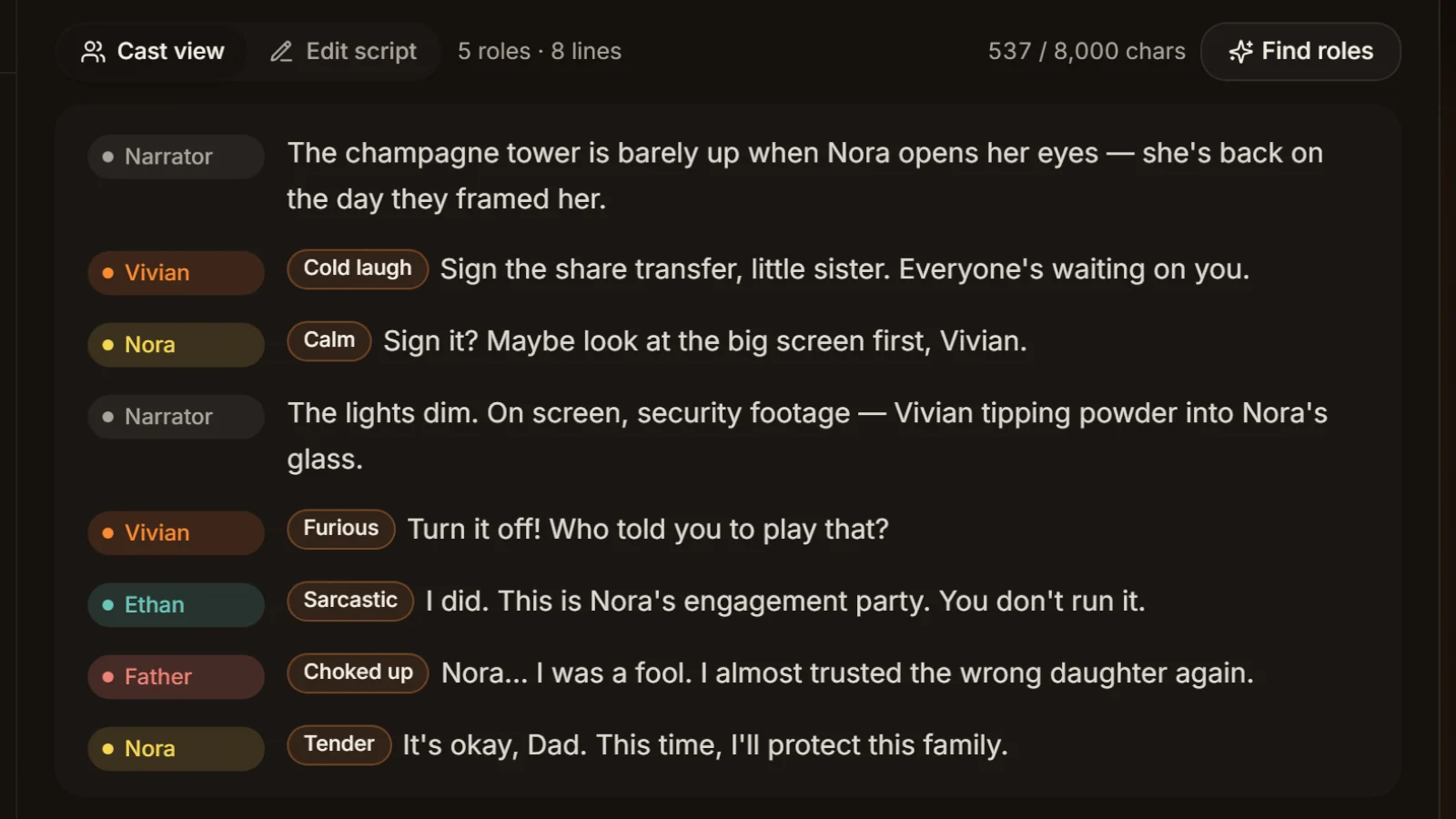
After generation: listen to the highlighted lines
For titles and names you couldn't rewrite, play back each highlighted line after generation. If one really is wrong, paste just those lines as a new script, keep the speaker names identical, set the character back to the same voice in the cast list, and regenerate only those lines; then swap them in your editor. The replacement steps are in the CapCut sync guide.
For a human actor or reviewer: export the annotated script
People can read annotations. Export the result with readings marked and send it to the voice actor to read from, or to the reviewer to listen against; it beats explaining it on a call. Keep that file for humans only: pasted back into the dubbing workshop, the bracketed readings would be spoken too.
Be careful with homophone swaps
Swapping in a same-sound character (writing 可务 for 可恶) can make an AI voice read correctly, but the subtitles then show a wrong character and translations go astray. The trade-offs between the three fixes are compared in how to fix AI voice polyphone errors.
Five misreadings a polyphone check won't catch
The checker only knows that a character has several readings. These problems are just as common, and only a listener catches them.
Neutral tone
东西 read dōngxi means "thing"; dōngxī means "east and west". 大意 read dàyi means "careless"; dàyì means "main idea". The characters alone don't reveal which one is meant.
Wrong phrasing
A long line without punctuation may pause in the wrong place and change the meaning. A comma where the pause belongs works better than any annotation.
Invented names
Xianxia techniques, sects and places are usually made up by the author, so no dictionary has a correct reading. Pick one and put it on the series' pronunciation sheet.
Rare characters
罡 or 魑魅魍魉 are not polyphones, but they can still come out wrong or mumbled. Swap in a common word if you can; if not, listen closely after generation.
Names in the foreign-language versions
Chinese polyphones don't exist in the English or Thai versions, but transliterated names must stay consistent. Even with the same cast dubbing every language, spot-check a few names.
Frequently asked questions
Paste the script into the Chinese polyphonic character checker on this page. Common polyphones are highlighted automatically, high-risk short-drama and period-drama words get their own colour, and numbers and abbreviations are grouped apart. Check the last two groups first, then confirm the rest against the listed readings.
No. Which reading a polyphone takes depends on its meaning in the sentence. The tool finds the characters that might be misread and lists each reading with examples; you decide which one applies. It also can't predict what an AI voice will say.
In AI Drama Voice, the reliable fix is to rewrite the line, using wording without the polyphone or giving a short line more context, then regenerate only those lines. Don't put bracketed pinyin in the middle of a line; it gets read aloud. More options are compared in how to fix AI voice polyphone errors.
Titles and idioms: 将 in 末将 reads jiàng, 相 in 相爷 reads xiàng, 臭 in 乳臭未干 reads xiù, 舍 in 寒舍 reads shè, 削 in 削发为尼 reads xuē and 正 in 正月 reads zhēng. The trap list on this page has more lines and safer rewrites by genre.
They are flagged as a separate group, but the tool doesn't decide how to read them, because that depends on the voice model. The safest fix is to write them as the Chinese words you want spoken: 两个亿, 一二零八房, 十一点半.
No. The checker runs in your browser; the script is not sent to a server, no AI is called and no sign-in is needed.




Check the readings, then start dubbing Fix the line before the take.
Paste the checked script into the dubbing workshop and AI casts every role and tags each line's emotion. Cast analysis is free; generate the episode when you're happy.
Billed by characters generated · Failed runs refunded automatically · Alipay, WeChat Pay and cards