AI Comic Drama Localization: Translation, Dubbing and Subtitles for Overseas Release
AI comic drama localization differs from taking a live-action short drama overseas in one big way: the pictures are generated and every voice is added in post, so there are no actors, schedules or lip movements to match. A new language version means changing three things: the voice track, the subtitles and the text drawn into the panels. This guide walks through six steps from rights to delivery, gives market signals and subtitle specs for eight languages (all sourced, checked November 2026), and is clear that AI Drama Voice handles only the dubbing and SRT subtitles. It does not draw images or render video.
- 6-step workflow
- 8 languages compared
- Sourced figures
Updated Nov 5, 2026Fact-checked Nov 5, 2026
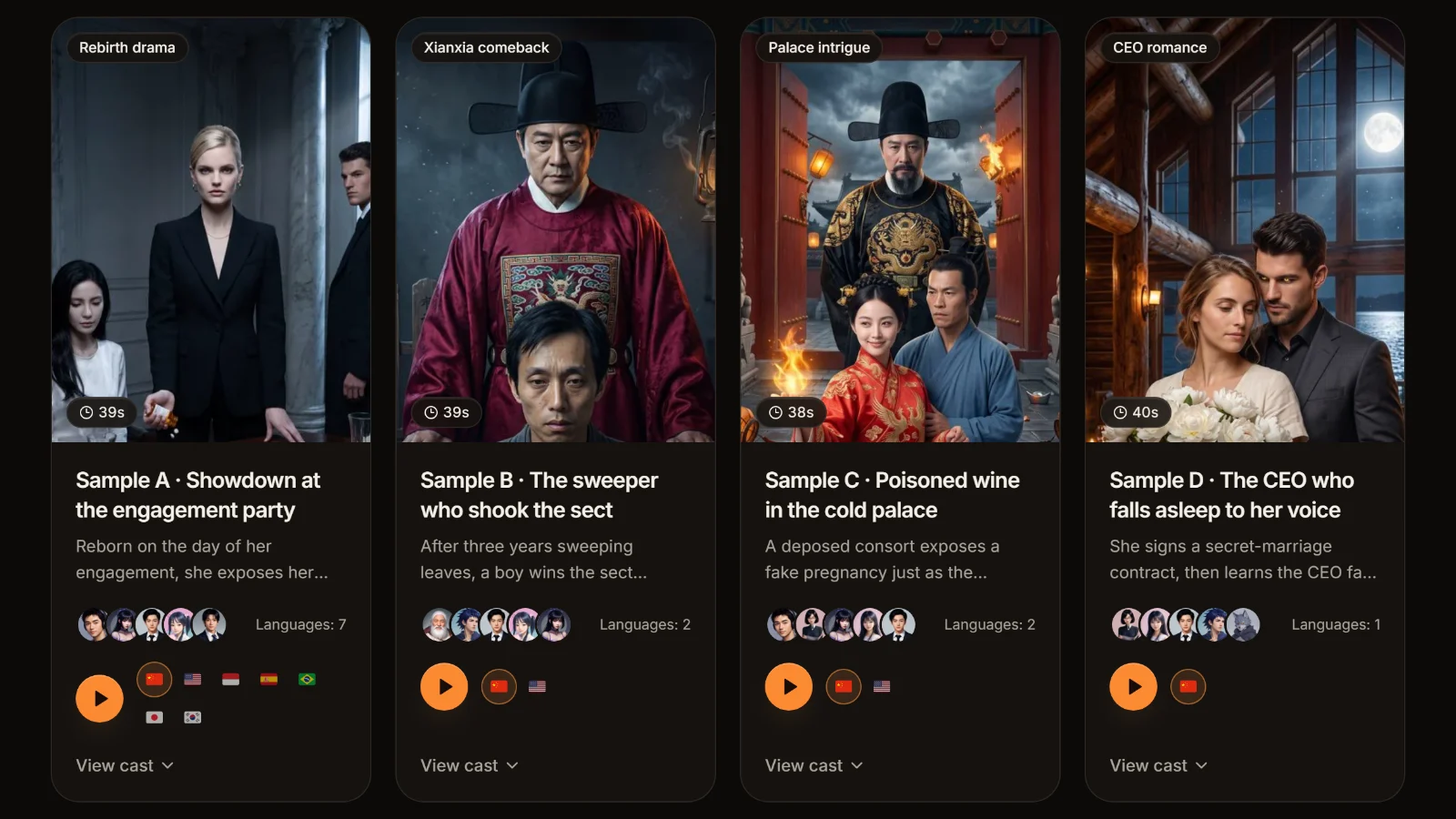
Sample B · The sweeper who shook the sect
English · Script excerpt · 5 characters


Narrator
The Azure Cloud Sect tournament roars around the arena. Ye Chen, who swept leaves for three years, steps up with a bamboo sword.

Xiao LingSarcastic
A yard sweeper thinks he can stand against me?

YunyaoWhisper
Brother Ye, don't push it... he's the best in the inner sect.

Ye ChenCalm
Three years of sweeping. I only practiced one strike.
On this page
How to localize an AI comic drama: six steps
The steps of AI comic drama localization are ordered by dependency: without the rights nothing ships, and dubbing before names are fixed means re-dubbing every time a name changes.
- 01
Step 1
Check the rights cover overseas and other languages
For a comic adapted from a novel, check the contract for overseas distribution, translation and adaptation rights, with territory, term and exclusivity spelled out. For original scripts, confirm that art assets, fonts and music can be used commercially in the target region.
- 02
Step 2
Pick the first language
Run one language through the whole pipeline before copying it to the next. The table below lists the market signals we could source for eight languages; Southeast Asian detail is in the Southeast Asia short drama market guide, and language order in minor-language dubbing.

Manhattan at night: in DataEye's September figures the US held about 28% of the overseas market.Image: Ino Pascual / Pexels - 03
Step 3
Fix a names and titles sheet
Before generating, list each character's name and every form of address (Master, Senior Brother, Elder, CEO, Young Master) in the target language. Keep pinyin names or switch to local ones, but pick one approach for the whole series.
- 04
Step 4
Deal with the text in the art
Speech bubbles, sound words, signs and system panels are drawn into the panels, and no dubbing tool can reach them. Keeping a text-free version of every panel is easiest; where text is baked in, retouch or regenerate it in the target language, or cover it with a subtitle box.
- 05
Step 5
Dub and subtitle
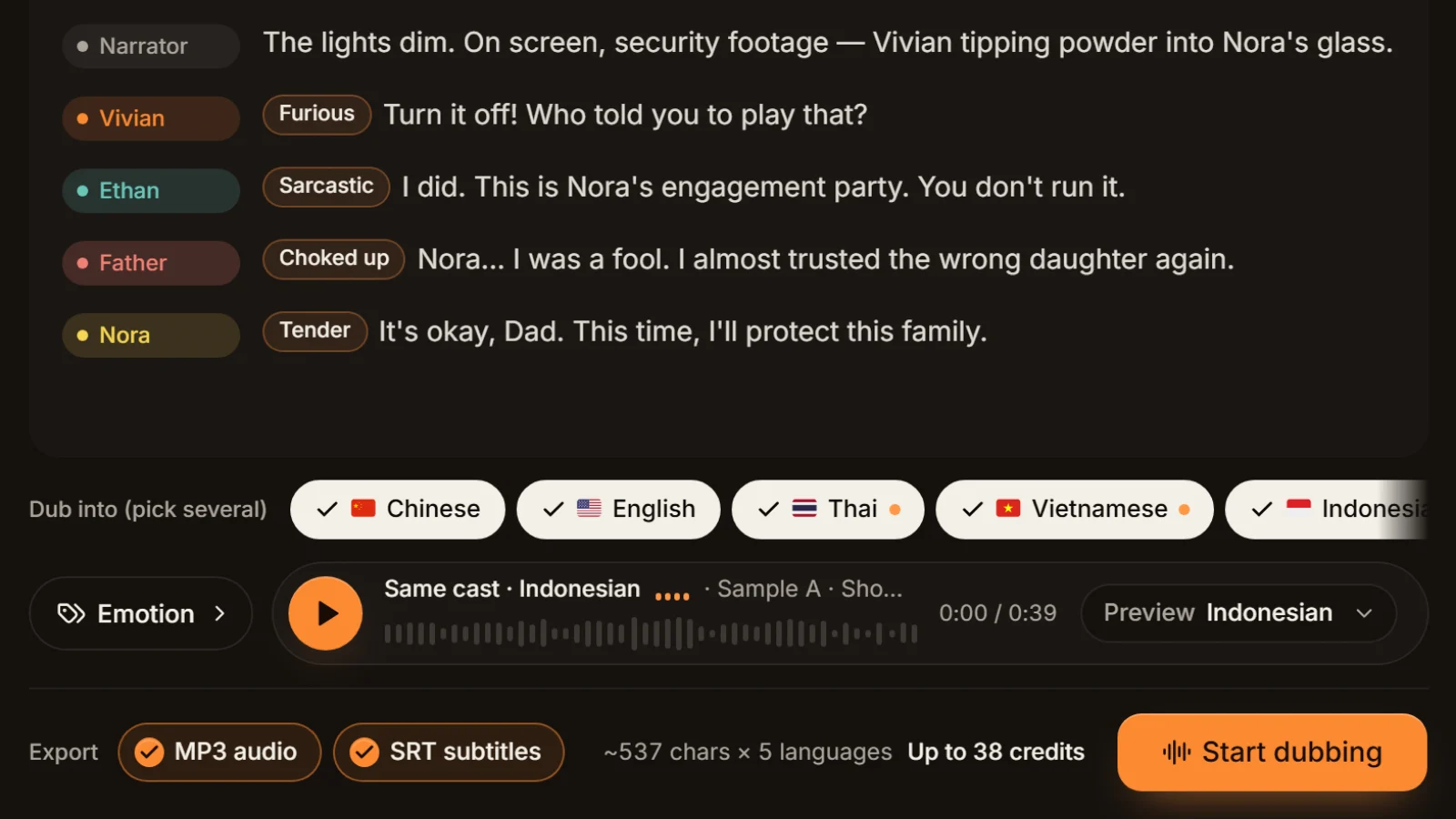
Paste the Chinese voice draft into the dubbing workshop and tick the target languages. Each line is translated into natural local speech and voiced by the same cast; every language exports an MP3 and a line-timed SRT, or a ZIP of all of them. More on comic dubbing in AI comic dubbing.
- 06
Step 6
Deliver per platform and label it
Swap in the dubbed audio and subtitles in your editor and export to each platform's spec. YouTube Shorts run up to three minutes in a square or vertical frame; TikTok accepts uploads up to 60 minutes; drama apps follow your contract. TikTok and YouTube both ask for labels on realistic AI content.
Which language first: signals and subtitle specs for 8 languages
Which language comes first in AI comic drama localization? The table only states what has a source; “not found” means we found no figure we could cite. Subtitle specs come from Netflix's timed text style guides; vertical platforms may differ, so treat them as an upper limit. Thai, Vietnamese and Indonesian specs are in the Southeast Asia short drama market guide.
| Language | Market signal (sourced) | Subtitle reference (Netflix) | Localization note |
|---|---|---|---|
| English | DataEye, September: US about 28% of the overseas market, UK about 4.3%, Australia about 4.08% (Cailian Press) | 42 characters a line, up to 20 characters a second for adult programs, 2 lines max | Keep pinyin names or use English ones; choose one for the whole series |
| Japanese | DataEye, September: Japan about 6.7% (Cailian Press) | Up to 13 full-width characters a line (horizontal), up to 4 characters a second, 2 lines max | The guide says to transliterate character names unless official translations exist; honorifics follow relationships |
| Korean | DataEye, September: Korea about 4.09% (Cailian Press) | 16 characters a line, up to 12 characters a second for adult programs, 2 lines max | Formal and casual speech levels mark rank and closeness |
| Spanish (Latin America) | No separate Latin American Spanish figure found | 42 characters a line, up to 17 characters a second for adult programs, 2 lines max | tú vs usted marks closeness |
| Portuguese (Brazil) | On free platforms, popular genres in Brazil are gangsters and zombies (DataEye Research, 21st Century Business Herald) | 42 characters a line, up to 17 characters a second for adult programs, 2 lines max | Genre and character fit matter more than literal translation |
| Thai | Thailand has the highest in-app purchase revenue in ASEAN and is the only ASEAN country in the global top ten (DataEye, 21st Century Business Herald) | See the Southeast Asia guide | Sentence-final ค่ะ / ครับ mark gender and politeness |
| Vietnamese | Users in Indonesia, the Philippines and Vietnam mostly watch for free in standalone drama apps (DataEye, 21st Century Business Herald) | See the Southeast Asia guide | anh / chị / em encode the relationship itself |
| Indonesian | Indonesia: 411 million downloads in the first three quarters of 2026, 56.77% of ASEAN (DataEye, 21st Century Business Herald) | See the Southeast Asia guide | Kak / Pak / Bu mark seniority |
Checked Nov 2026 · Market figures cover micro dramas as a whole, not AI comic dramas separately; shares are DataEye estimates.
Sources:Cailian Press: AI short dramas overseas run faster but earn no more (2026-10-23, Chinese)21st Century Business Herald: the second half of AI short dramas going overseas (2026-10-23, Chinese)Netflix English Timed Text Style GuideNetflix Japanese Timed Text Style GuideNetflix Korean Timed Text Style GuideNetflix Spanish (Latin America & Spain) Timed Text Style GuideNetflix Portuguese (Brazil) Timed Text Style Guide
Translating AI comic dramas: names, titles and text in the art
In AI comic drama localization, comic and live-action translation share the dialogue but differ in the picture: comic panels carry text, and the genres are full of cultivation and fantasy titles. The general checklist is in short drama localization; this covers what is specific to comics.
Names: pinyin or local names
The AI Drama Voice translation step keeps each name consistent across the series, transliterating Chinese names in pinyin unless the target language has a usual form. You can't yet pin a fixed translation for a given name, so teams that want local names should check every name after episode one and have a native speaker standardize them in the subtitles if needed. For reference, Netflix's Japanese guide says to transliterate character names unless official translations are provided.
Cultivation and fantasy titles: common renderings
| Chinese | English | Japanese | Korean |
|---|---|---|---|
| 师尊 / 师父 | Master | 師匠 | 사부님 |
| 师兄 | Senior Brother | 兄弟子 | 사형 |
| 长老 | Elder | 長老 | 장로 |
| 宗主 | Sect Leader | 宗主 | 종주 |
| 陛下 | Your Majesty | 陛下 | 폐하 |
These are renderings common in web-novel and anime translation; a native reviewer has the final say. When translating, AI Drama Voice adapts titles and honorifics to the relationship implied by the dialogue rather than translating kinship terms word for word. Stating relationships at the top of the script, such as “Qinghe is Gu Linyuan's junior sister”, makes the forms of address more accurate.
Text in the art: the step unique to comics
- Speech bubbles: most target languages run longer than Chinese, so leave room; the simplest route is a bubble-free version with all dialogue in subtitles.
- Sound words: Chinese sound effects left in place read as untranslated; redraw or remove them and use audio effects instead.
- Signs, letters and system panels: retouch the ones the plot needs into the target language; decorative ones can stay.
- Titles and credits: remake them per language, and keep the localized title identical to the one used on the platform listing.
Genre: changing the premise is harder than changing the language
The 21st Century Business Herald report of 23 October 2026 describes a common practice: keep the script's core and only change the character setup per country, for example turning an emperor and a palace maid into a werewolf and a maid. DataEye Research's Liu Zun is quoted saying going overseas is not just translating subtitles but a deep re-translation of payoffs, values, religion and racial taboos. For a comic drama, a new premise means new artwork, far costlier than new voices, so decide early whether you are making a translated version or an adapted one.
Platforms and revenue: figures you can trace
Coverage of AI comic dramas going overseas is plentiful and inconsistent. Below are only the parts of two October 2026 reports we could match to the original text. Checked November 2026.
Platforms: live-action apps still lead, AI dramas are moving in fast
- DataEye estimates overseas micro drama apps earned more than 2.1 billion US dollars in in-app purchases across iOS and Android in January–September 2026, with more than 2.2 billion downloads; DramaBox, ReelShort and NetShort took the top three by revenue (Cailian Press).
- VibeShort and StoryReel, both focused on AI dramas and launched in the first half of 2026, have entered the top 15 by revenue (Cailian Press).
- By September 2026 ByteDance's PineDrama passed 100 million global downloads with a free-to-watch model (Cailian Press).
- DataEye Research's Liu Zun said AI dramas rose from under 5% of ReelShort's new releases in the first half of 2026 to 90% in September (21st Century Business Herald).

Risk: most titles don't earn back their cost
The same 21st Century Business Herald article cites DataEye data that 93% of AI comic dramas get fewer than a million plays a month and only 1.3% break even, with revenue per play falling sharply (the report doesn't say whether these figures are domestic or overseas). In the Cailian Press piece, practitioners also say the volume-driven phase for overseas AI comics is closing. Budget on the assumption that most titles won't pay back, then add languages to the ones that do.
Rights are the cost most often missed
Yang Xun, a partner at Llinks Law Offices, warns in the 21st Century Business Herald report that many script purchases cover only domestic adaptation rights, without global distribution or multilingual adaptation; even with a new title and new lines, a matching core of character relationships and plot can still infringe.
Chinese rules also apply to work made in China for overseas release
NRTA Order No. 16, the Micro-Drama Development Measures, took effect on 1 September 2026. Article 34 requires micro dramas generated or made with AI to carry a notice in a prominent place in every episode; Article 52 says micro dramas shot in China for overseas broadcast fall under the Measures' filing and review provisions. How this applies to AI comic dramas is for the regulator to interpret; get professional advice before committing to a project.
Sources: Cailian Press (2026-10-23), 21st Century Business Herald (2026-10-23), Micro-Drama Development Measures. For schemes that charge upfront under the name of an “overseas contest” or “project investment”, see the scam section in taking short dramas global.
Six practical tips for AI comic drama localization
These six are specific to comics and complement the general advice for live-action dramas.
Keep text-free panels from day one
Put bubbles and sound words on their own layer, or export an extra text-free image per panel. Every future language then skips regeneration.
Fix the names sheet before batch generation
After episode one, copy each character's foreign-language name and titles into a sheet, review it, then generate the rest so episode 10 doesn't switch names.
Match the narrator to the art style
Cultivation fantasy suits a storyteller's narration; urban stories suit a calm radio-style narrator. Keep the same narrator voice in every language; it is how viewers recognize the series.
Let subtitles make room for bubbles
English, Spanish and Portuguese lines can reach 42 characters, which wraps to two lines on a vertical screen. Place subtitles away from bubbles and faces.
Have a native speaker hear episode one
Listen for names, titles and jokes. Set the rules on episode one and check later episodes against them, rather than reviewing every episode from scratch.
Label AI on every platform
Both pictures and voices are AI-generated, so declare it on upload; versions released in China also follow the labeling measures. See how to label AI-generated content.
Frequently asked questions
Six steps: confirm the rights cover overseas and other languages, pick a first language, fix a names and titles sheet, handle the text in the art, dub and subtitle, then deliver per platform with AI labels. The artwork stays; most of the work is localization and in-art text.
Yes where the plot depends on it: bubbles, letters and system panels. Sound words are better redrawn or removed and replaced with audio effects. The easiest route is to keep a text-free version of each panel and leave dialogue to the dubbing and subtitles.
It depends on what you want to test. DataEye's September figures, as reported by Cailian Press, put the US at about 28% of the overseas micro drama market and Japan, the UK, Korea and Australia at about 4–7% each, so English reaches furthest. Southeast Asia has big download numbers but different payment patterns. Run a few episodes in one language first.
Reports name overseas micro drama apps such as DramaBox, ReelShort, NetShort and PineDrama, plus AI-focused VibeShort and StoryReel (Cailian Press, 2026-10-23); TikTok and YouTube are the main distribution and discovery channels. The reports don't count “comic drama platforms” separately, so check each platform's partnership terms before listing.
Paste the Chinese voice draft into AI Drama Voice and tick the target languages: each line is translated into natural local speech and voiced by the same cast, and every episode and language exports an MP3 and a line-timed SRT to swap into your edit. Pricing is by script length; see pricing.
Yes, and they are often missed. A lawyer quoted by 21st Century Business Herald notes many scripts are bought with domestic adaptation rights only, without global distribution or multilingual adaptation; renaming characters and rewriting lines doesn't help if the core plot matches. Put territories, languages and term in the contract.





Keep the panels, change the language Same panels. A new language.
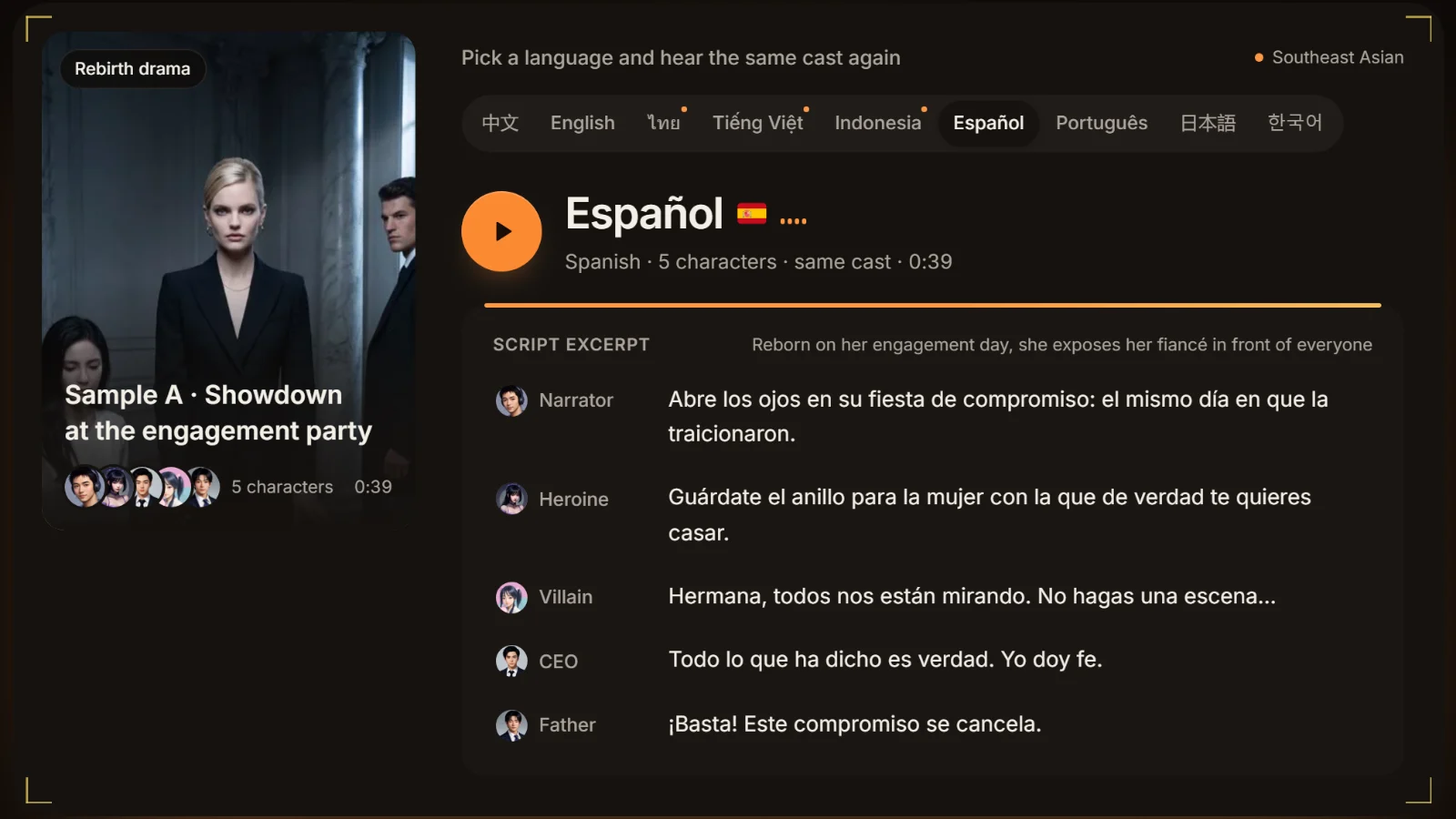
Dub Chinese comic drama lines into eight languages with one cast, exporting MP3 and SRT for each language.
Billed by characters generated · Failed runs refunded automatically · Alipay, WeChat Pay and cards