Short Drama Script Format: Template and Voice-Ready Layout
There is no official standard for short drama script format, but vertical-drama teams in China have settled on a shared layout: scripts are organised by scene, every scene heading states time and place, △ marks action, dialogue is written as Name: line, and narration, OS and VO each have their own mark. This guide walks through every element and symbol, gives you a template you can copy, and shows how to turn a shooting script into a dubbing script so an AI tool can tell characters, narration and emotions apart. It is written for teams who write in English and for teams handling Chinese scripts.
- Elements + symbols
- Shooting and dubbing templates
- Narration, OS and VO
Updated Nov 5, 2026Fact-checked Nov 5, 2026
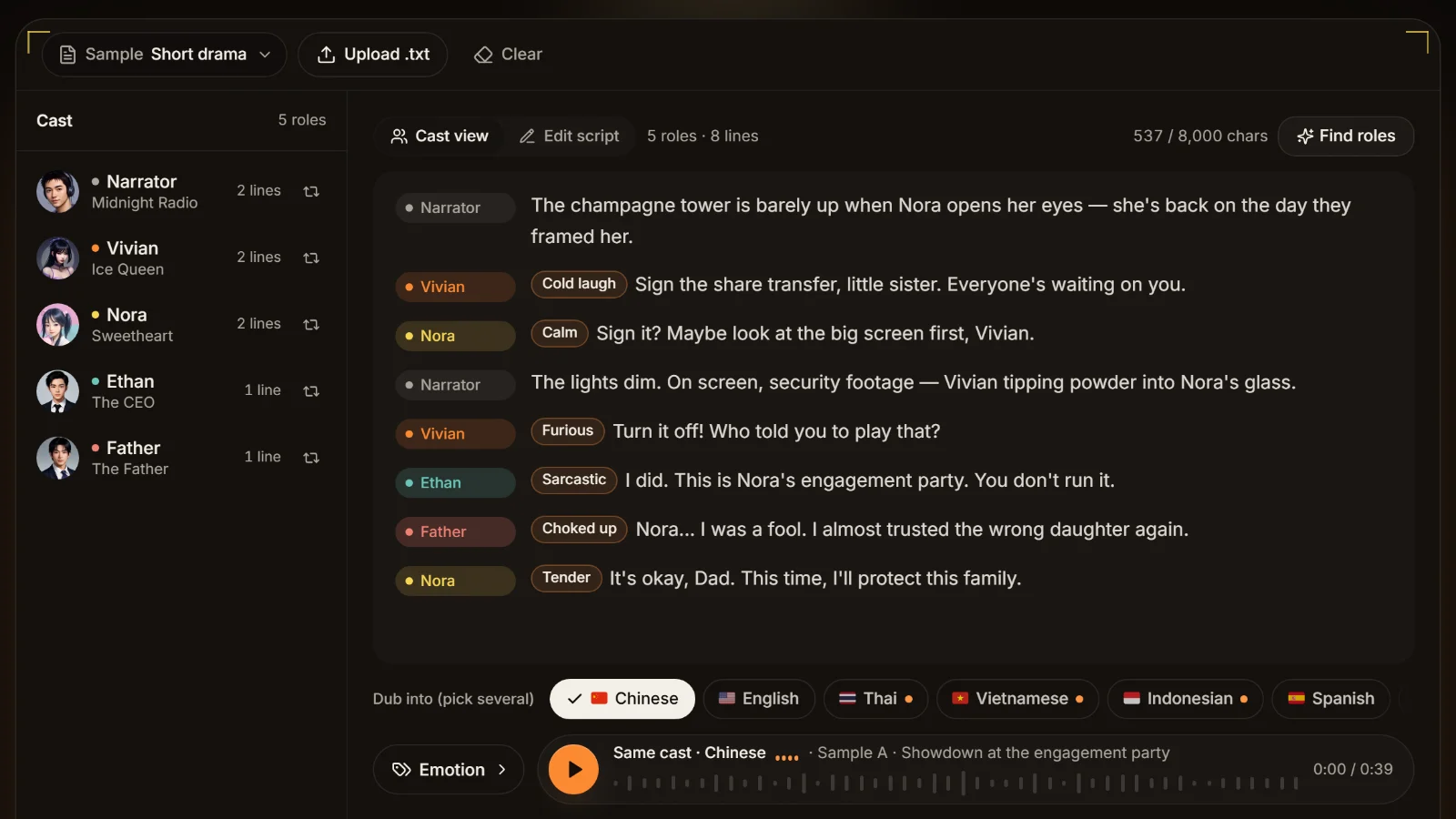
Sample A · Showdown at the engagement party
English · Script excerpt · 5 characters


Narrator
The champagne tower is barely up when Nora opens her eyes — she's back on the day they framed her.

VivianCold laugh
Sign the share transfer, little sister. Everyone's waiting on you.

NoraCalm
Sign it? Maybe look at the big screen first, Vivian.
Narrator
The lights dim. On screen, security footage — Vivian tipping powder into Nora's glass.
On this page
- 1How to write a short drama script: 7 steps
- 2Short drama script format requirements, element by element
- 3Short drama script symbols: △, brackets, OS and VO
- 4The dubbing script: making short drama script format machine-readable
- 5A short drama script format template you can copy
- 66 formatting habits for short drama scripts
- 7Frequently asked questions
How to write a short drama script: 7 steps
Follow this order from the top of an episode to a version you can paste straight into a dubbing tool, and the layout stays clean.
- 01
Step 1
Title, episode number and logline
Open each episode with the title and Episode N, then one or two sentences on this episode's hook and twist. The logline is never filmed or voiced; it is for the director, editor and whoever reviews the dub.
- 02
Step 2
List the characters
Before episode 1, add a character list: name, age, role, relationship to the lead and a one-line personality. It drives the voice casting and tells translators how characters address each other.
Tip · The spelling in the character list is the only spelling. Every dialogue line uses it.
- 03
Step 3
Write by scene, heading first
Start each scene with a heading: episode-scene number, day or night, interior or exterior, location, for example 1-2 NIGHT INT. SU FAMILY BALLROOM. Number scenes in order so revisions are easy to find.
- 04
Step 4
List who is in the scene
Under the heading, list only the characters who appear: Cast: Nora, Vivian, Ethan. It helps scheduling and lets the dub reviewer check every voice.
- 05
Step 5
Write △ action and dialogue
Action and description go on their own rows, starting with △. Dialogue is Name: line, one line per row. Tone or delivery notes go in brackets after the name, for example Nora (coldly):.
- 06
Step 6
Mark narration, OS, VO and on-screen text
Narration is Narrator:, inner monologue is Name (OS):, phone or radio voices are Name (VO):, and text that appears on screen is [Caption: Three days earlier].
- 07
Step 7
Save a separate dubbing version
Delete scene headings, cast rows, △ action and every bracketed screen note, keeping only spoken lines and narration. That file is the one you paste into a dubbing tool.
Short drama script format requirements, element by element
This table covers almost everything that appears in a vertical-drama script. Teams adjust details, but one drama should use one convention throughout.
| Element | How to write it | Example |
|---|---|---|
| Episode | Title, Episode N | The Engagement Party Strikes Back, Episode 1 |
| Scene heading | Ep-scene DAY/NIGHT INT./EXT. location | 1-2 NIGHT INT. SU FAMILY BALLROOM |
| Cast in scene | Cast: name, name | Cast: Nora, Vivian, Ethan |
| Action / picture | Starts with △, own row | △ Nora sets down her glass and looks up at the screen. |
| Dialogue | Name: line | Vivian: Just sign it, little sister. |
| Delivery note | Name (note): line | Nora (coldly): Sign it? |
| Narration | Narrator: text | Narrator: She had waited a whole lifetime for this day. |
| Inner monologue | Name (OS): text | Nora (OS): Not this time. |
| Off-screen voice | Name (VO): text | Ethan (VO): She won't sign. |
| On-screen text | [Caption: text] | [Caption: Three days earlier] |
| Flashback | [Flashback] … [End flashback] | [Flashback] A hospital corridor in the rain. [End flashback] |
| Sound effect | [SFX: text] | [SFX: glass shatters] |
How vertical dramas differ from film scripts
A vertical short-drama episode usually runs a minute or two, with short scenes and fast cuts, so the format is more fragmented than a feature screenplay: five or six scenes per episode, a few lines each. Lines must be short and sayable, and action describes only what the camera sees.
Short drama script symbols: △, brackets, OS and VO
The symbols in short drama script format are few, but each has a fixed meaning. Misuse one and the director or the voice reads it as something else.
| Symbol | Meaning | Example |
|---|---|---|
| △ | Action, picture, what the camera shows | △ Ethan walks in. The room goes quiet. |
| ( ) or () | After a name: tone, gesture, delivery note | Vivian (panicking): Turn it off! |
| [ ] or 【】 | Non-dialogue: on-screen text, flashback, SFX, transitions | [Transition: fade to black] |
| … | A pause, a line trailing off | Father: Nora… I was a fool. |
| — | An interruption or a sudden turn | Vivian: I only— |
| OS | Inner monologue: the character is on screen but not speaking aloud | Nora (OS): So it was you. |
| VO | Off-screen voice: the speaker is not in the picture | Narrator (VO): Three years later. |
How to write narration
Narration sits on its own row as Narrator: text. It sets time, background and the build-up before a twist, and is normally one steady voice across the whole series, kept apart from character dialogue. For dramas adapted from first-person novels you can write Nora (narrating):, but use one form per drama. Choosing a narrator voice and style is covered in narration voiceover.
OS vs VO
In Chinese short-drama scripts, OS most often marks inner monologue: the character is in the shot but the line is never said aloud. VO marks an off-screen voice: the speaker isn't in the picture, as with a phone call, a broadcast, a memory or narration. English screenplays use them slightly differently: O.S. means the character is in the scene but out of frame, and V.O. means the voice is not part of the scene at all. Both conventions are common; pick one and state it at the top of the script.
Writing a phone call
Write each end separately. The person on screen is Name: line as usual; the person on the other end, not in the picture, is Ethan (VO, on the phone): line, with a △ row saying who is calling whom, for example △ Nora answers; the screen reads Ethan. If both ends are shown, write two scenes joined by a [Transition]. The slightly tinny phone sound is normally added in the edit.
The dubbing script: making short drama script format machine-readable
A shooting script is written for people; a dubbing script is written for a voice tool. Here is how AI Drama Voice actually reads each form.
| In the script | What AI Drama Voice does with it |
|---|---|
| Nora: line | Nora's line, in Nora's voice |
| Nora (sneering): line, or Nora: (sneering) line | Nora's line, tagged cold laugh |
| Nora (teeth clenched): line | Not one of the 8 emotion tags; passed to the voice model as a delivery note |
| Narrator: / Narration: / VO: text | Narration, in the narrator's voice |
| Any row without a speaker name | Read aloud as narration |
| △ Nora pushes the door open. | Also read aloud as narration; remove it from the dubbing version |
| 1-2 NIGHT INT. SU FAMILY BALLROOM | Read aloud; remove it |
| Cast: Nora, Vivian | Treated as a character called Cast speaking; remove it |
| Nora (OS): text | Nora's voice; OS is passed as a note. For a more inward sound write Nora (OS, softly): |
| Brackets mid-line, e.g. I (pause) won't go | The bracket is spoken and appears in the subtitle |
Writing emotion notes
You don't need the exact tag name. Common synonyms in English and Chinese are recognised: sneer or scoff maps to cold laugh, sobbing or tearful to choked up, softly or quietly to whisper, angry or shouting to furious, gently or warmly to tender, shocked or thrilled to excited, flat or steady to calm, and mocking or teasing to sarcastic. Keep the note under 20 characters. A longer bracket stops the row from being recognised as dialogue, and the whole row, name and bracket included, is read out as narration.
Three hard rules for the dubbing version
- 1.One speaker, one line per row. Nora: Go. Ethan: I'm not leaving. on a single row gives both lines to Nora.
- 2.One name per character for the whole series. Nora and Nor are two characters and get two different voices.
- 3.Write numbers and abbreviations as they are said, and deal with misread Chinese characters early; see fixing AI voiceover mispronunciation.
A short drama script format template you can copy
Both templates hold the same scene: first the shooting version, then the dubbing version. Select the list text, copy it, and save it in Word, Google Docs or a plain text file.
Template 1: shooting script
- The Engagement Party Strikes Back, Episode 1
- Logline: At her engagement party, Nora is reborn and exposes her sister Vivian's plot in front of everyone.
- Characters: Nora (lead, 24, the younger Su daughter); Vivian (Nora's older sister); Ethan (male lead, CEO of the Lu Group); Father (head of the Su family)
- 1-1 NIGHT INT. SU FAMILY BALLROOM
- Cast: Nora, Vivian, Ethan, Father, guests
- △ The champagne tower glitters. Nora's eyes snap open; the glass in her hand trembles.
- Narrator: The day of the engagement party. She was back.
- Nora (OS): This time, I'm not drinking it.
- Vivian (smiling): The share transfer just needs your signature, little sister.
- △ Nora takes the papers without looking and sets them aside.
- Nora (calm): Before I sign, you might want to look at the big screen.
- [SFX: projector starts]
- △ The screen lights up: security footage of Vivian tipping powder into a glass.
- Vivian (panicking): Turn it off! Who put that on?
- Ethan (coldly): I did.
- Father (choked): Nora… I was a fool.
- [Caption: Ethan Lu, CEO of the Lu Group]
Template 2: dubbing script
- Narrator: The day of the engagement party. She was back.
- Nora (OS, softly): This time, I'm not drinking it.
- Vivian (smiling): The share transfer just needs your signature, little sister.
- Nora (calm): Before I sign, you might want to look at the big screen.
- Vivian (panicking): Turn it off! Who put that on?
- Ethan (coldly): I did.
- Father (choked): Nora… I was a fool.
Shooting to dubbing in three moves
Delete scene headings, cast rows and every △ and bracketed screen row; add a tone such as softly to OS lines; check every name is spelled the same throughout. Then paste it into the workshop and click Analyze cast to check the cast list. Analysis is free.
6 formatting habits for short drama scripts
Character list before episode 1
Name, age, role, relationship and personality on one row each. Cast voices from it; how to keep leads and supporting roles distinct is in how to cast short-drama voices.
Number scenes in sequence
Number by episode and scene (1-1, 1-2, 2-1) so any revision, reshoot or re-dub can be located in one sentence.
Action shows only what's visible
After △, write what the camera can film, not “she feels heartbroken”. If the audience should hear a thought, write it as OS.
Keep bracket notes short
(coldly) works better than (coldly tossing the file onto the table). Move the action to a △ row and keep only the tone in brackets.
Write lines people can say
Long literary sentences sound read, not spoken. Keep a line to what fits in one breath and split long speeches.
Estimate length before you lock
Dialogue volume per episode varies a lot. Before locking, estimate the running time from the word count with the script duration calculator and cut if it runs long.
Frequently asked questions
Both templates on this page, shooting and dubbing, can be selected and copied straight into Word, Google Docs or a text file. Save the dubbing version as .txt and paste or upload it into the workshop.
The person on screen is Name: line as usual; the caller who isn't in the picture is Name (VO, on the phone): line, plus a △ row saying who is calling whom. The phone sound effect is usually added in the edit.
Narration gets its own row written Narrator: text. Some teams use (VO) instead; just use one form per drama. When dubbing, rows starting with Narrator: get a separate narrator voice.
In Chinese short-drama scripts, OS usually means inner monologue (the character is on screen but silent) and VO means an off-screen voice such as a phone call, broadcast, memory or narration. Agree on one convention within the team.
Save a dubbing version: drop scene headings, cast rows and △ action, keep Name: line and Narrator: text, put emotions in brackets after the name, and use one line per row with consistent names.
There is no mandatory industry-wide standard; platforms and studios set their own submission rules, so follow theirs when you submit. The layout here is the most widely shared one among vertical-drama teams and is easy for any team to read.




Get the format right and the dub goes fast Format once, cast in seconds.
Paste your dubbing script into the workshop for automatic casting and per-line emotion, then voice the episode when it looks right.
Billed by characters generated · Failed runs refunded automatically · Alipay, WeChat Pay and cards