Does AI Voiceover Get Throttled? Platform Rules and a Checklist
Does AI voiceover get throttled? Going by the rules platforms publish today, using an AI voice is not in itself a reason for reduced reach. What does carry stated penalties is missing an AI label, reposting material without adding anything new, and mass-producing videos from a template. Douyin says AI-assisted creation brings “no special traffic advantage”, and both TikTok and YouTube say that labeling AI content does not affect distribution. Below are the rule texts from Douyin, WeChat Channels, Bilibili, Kuaishou, TikTok and YouTube with links, the difference between being asked to label and being down-ranked, and a pre-publish checklist. Nothing here guarantees reach, and it is not legal advice.
- Six platforms' rule text
- Every line linked and dated
- 8-point pre-publish check
Updated Nov 5, 2026Fact-checked Nov 5, 2026
Sample A · Showdown at the engagement party
English · Script excerpt · 5 characters



Narrator
The champagne tower is barely up when Nora opens her eyes — she's back on the day they framed her.

VivianCold laugh
Sign the share transfer, little sister. Everyone's waiting on you.

NoraCalm
Sign it? Maybe look at the big screen first, Vivian.
Narrator
The lights dim. On screen, security footage — Vivian tipping powder into Nora's glass.
On this page
An 8-point checklist before posting with an AI voice
Whether an AI-voiced video reaches people depends far more on what you post than on which tool you used. Each of these eight points maps to a published platform or regulatory rule. Run through them in order before you post.
- 01
Step 1
Script, source novel, visuals and music are licensed
WeChat Channels' operating rules (6.5) say content with infringing material may be stopped or have its promotion and distribution restricted. TikTok's guidelines ask you to post only content you created or have the right to share. A voice tool's license covers the voice only; see can you use AI voiceover commercially.
- 02
Step 2
Pick the “contains AI-generated content” label
On 12 May 2026 China's Cyberspace Administration required platforms to make every short-video publisher pick one of six mandatory labels, including “contains AI-generated content”. If the voice is AI, pick that one, not “no label needed”.
- 03
Step 3
Tick the platform's AI disclosure
Douyin: Advanced settings → creator self-declaration → content generated by AI. Bilibili: creator statement → “this video uses AI synthesis”. TikTok: the AI-generated content setting under More options. YouTube: the altered or synthetic content disclosure when you upload. Menus change; follow the current interface.
- 04
Step 4
Viewers can hear or see a notice
An audio notice at the start, a caption or an on-screen badge; the options are in how to label AI-generated content. For micro dramas in China, Article 34 of the Micro-Drama Development Measures also requires a notice in a prominent place in every AI-made episode.
- 05
Step 5
Keep the implicit label in the audio file
AI Drama Voice writes an AIGC implicit label into each exported MP3's file metadata. Platforms that read it add a notice; Douyin shows “work contains AI-generated content”. Don't strip the metadata: China's AI content labeling measures forbid deleting or hiding labels.
- 06
Step 6
Add your own creative work
TikTok's rule is that videos with unoriginal or reused material without anything new are not eligible for the For You feed. An original script, freshly edited visuals and your own commentary are the new part. Re-posting someone else's video with a new AI voice is not.

What earns a place in the feed is something new: your own script, fresh editing and your own take.Image: Ayyeee Ayyeee / Pexels - 07
Step 7
Don't mass-produce from one template
YouTube won't monetize AI content made with generic or unoriginal templates that gives the impression of mass production without the creator's own insight. Douyin likewise says it does not encourage using AI's low cost to churn out low-quality content. Make each video's story and angle genuinely different.
- 08
Step 8
Don't impersonate real people
Douyin's rules forbid using generative AI to infringe portrait or intellectual-property rights; TikTok does not allow AI content that is misleading on matters of public importance or harmful to individuals, labeled or not. Use the tool's preset voices and never market a voice as a celebrity sound-alike.
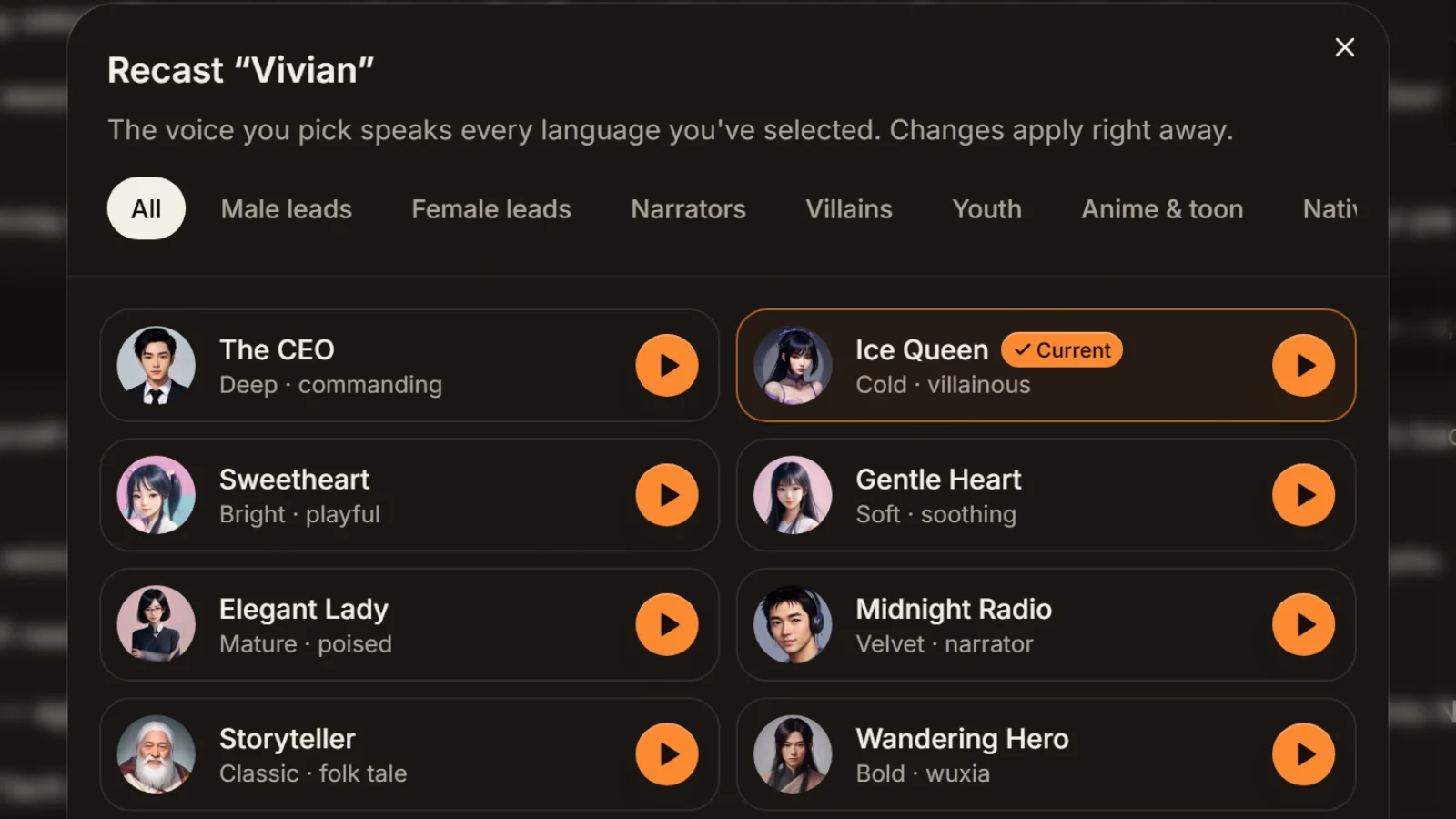
Every workshop voice is a preset voice you can audition; cast with these rather than imitating a recognizable real person.Product screenshot
What Douyin, WeChat Channels, Bilibili and Kuaishou say
Does AI voiceover get throttled on Chinese platforms? Each cell below quotes or paraphrases a published document, translated from Chinese. We could not open Bilibili's and Kuaishou's announcements on an official page this time, so their cells follow a Beijing Daily report of 1 September 2025.
| Rule | Douyin | WeChat Channels | Bilibili | Kuaishou |
|---|---|---|---|---|
| Is labeling required | Creators publishing AI content must add a visible label with Douyin's labeling tool; audio is in scope (announcement, 1 Sep 2025) | Non-real audio or video generated or synthesized with generative AI must be labeled prominently (operating rules 6.4) | Uploaders can self-declare in the upload flow (Bilibili announcement, as reported) | Self-declaration is live; creators are encouraged to label AI content accurately (Kuaishou announcement, as reported) |
| Where to declare | Advanced settings → creator self-declaration → content generated by AI | Users must declare AI-generated content when publishing (WeChat announcement, as reported by Xinhua) | Creator statement → this video uses AI synthesis | Self-declaration feature (location per app) |
| Does the platform label it for you | Suspected AI: “suspected use of AI generation, judge with care”; implicit label found: “work contains AI-generated content” | The platform may add explicit and implicit labels | Undeclared AI content gets a label under community rules | Content that is clearly AI or detected as suspected AI gets a prominent notice |
| Wording on reach or traffic | AI-assisted creation brings “no special traffic advantage”; churning out low-quality content on AI's low cost “is not encouraged” (platform rules, 8 May 2023) | Content with infringing material may be stopped or have its promotion and distribution restricted (6.5) | No public clause on AI content and recommendations found | No public clause on AI content and recommendations found |
| If you don't label or break rules | False, infringing or vulgar traffic-bait AI content is handled under law and platform rules | Missing labels, or using such content for improper marketing, may be penalized | Users may not tamper with or hide labels | Violations and malicious labeling are handled under community rules |
Checked Nov 2026 · “Not found” means no public clause turned up in this check, not that the platform has no internal rule. Rules change; the official page wins.
Sources:Douyin Trust Center: AI content labeling announcement (2025-09-01, Chinese)Douyin: platform rules and industry initiative on AI-generated content (2023-05-08, Chinese)WeChat Channels operating rules (Chinese)Xinhua: platforms publish rules as AI labeling measures take effect (2025-09-09, Chinese)Beijing Daily: Tencent, Douyin, Kuaishou, Bilibili announce AI labeling (2025-09-01, Chinese)
What TikTok and YouTube say about AI voiceover
For dubbed versions posted to TikTok and YouTube the wording is blunter: the label itself doesn't affect distribution, originality does. This is also where questions about AI voice YouTube monetization get their answer.
| Rule | TikTok | YouTube |
|---|---|---|
| Is labeling required | Creators must label all AI-generated content that contains realistic images, audio and video; “AI-generated speech” is given as an example of significant AI editing | Creators must disclose realistic AI-generated or altered content; cloning your own voice for voice-overs and clearly unrealistic animation don't need disclosure |
| Does labeling reduce reach | Turning on the AI-generated content setting won't affect distribution as long as the video follows the Community Guidelines | Disclosing AI content alone won't limit a video's audience or its eligibility to earn money |
| What isn't recommended or monetized | Content with unoriginal or reused material without anything new is ineligible for the For You feed | AI content made from generic or unoriginal templates that looks mass-produced can't be monetized; content that only reads other people's text counts as reused content |
| If you don't label | Unlabeled content may be removed, restricted or labeled by TikTok | Creators who consistently don't disclose may get a label applied or penalties, including removal or suspension from the Partner Program |
Checked Nov 2026 · Cells paraphrase the English originals.
Sources:TikTok Support: About AI-generated contentTikTok Community Guidelines: Integrity and Authenticity (version effective 2026-09-24)YouTube Help: Disclosing altered or synthetic contentYouTube Help: Channel monetization policies (inauthentic content update, 2025-07-15)
Labeling and throttling are two different things
Most worries about whether AI voiceover gets throttled mix up two separate questions: what you are obliged to disclose, and how the recommendation system distributes your video.
Labeling is an obligation, not a penalty
China's AI content labeling measures took effect on 1 September 2025 and ask publishers to declare AI-generated content; since May 2026 short-video uploads there also pass through a mandatory label step. Elsewhere, TikTok and YouTube ask for labels on realistic AI audio and video. These rules are about telling viewers. None of the texts says a label means less reach, and TikTok and YouTube state the opposite outright. Label what needs labeling; the label is not what holds a video back.
What the rules do name as reasons for less reach
“Throttling” is not a word platforms use. What they publish are measures such as restricted promotion, ineligibility for the For You feed and no monetization, tied to three situations: infringing material (WeChat Channels), reused material with nothing new (TikTok), and templated mass production or simply reading someone else's text (YouTube). None of these is about which voice tool you used. All of them are about whether the content is yours and adds something.
What we didn't find
As of November 2026 we found no clause in these platforms' public rules saying AI voiceover gets reduced recommendations, and none saying AI-voiced content can't be declared original. Recommendation systems are not fully public, so this only tells you the published rules are silent; it can't promise your video won't be shown less.

Can an AI-voiced video count as original?
In the published rules, originality is about the content: whether you wrote or licensed the script, made the visuals, and added editing or a point of view. YouTube's monetization policy has a telling pair of examples. A movie scene where you have rewritten the dialog and changed the voiceover is listed as monetizable reused content (copyright rules still apply), while content that only reads text from websites or other people's work is not. The AI voice doesn't decide originality; whose material you voice does.
What labels our exported audio carries
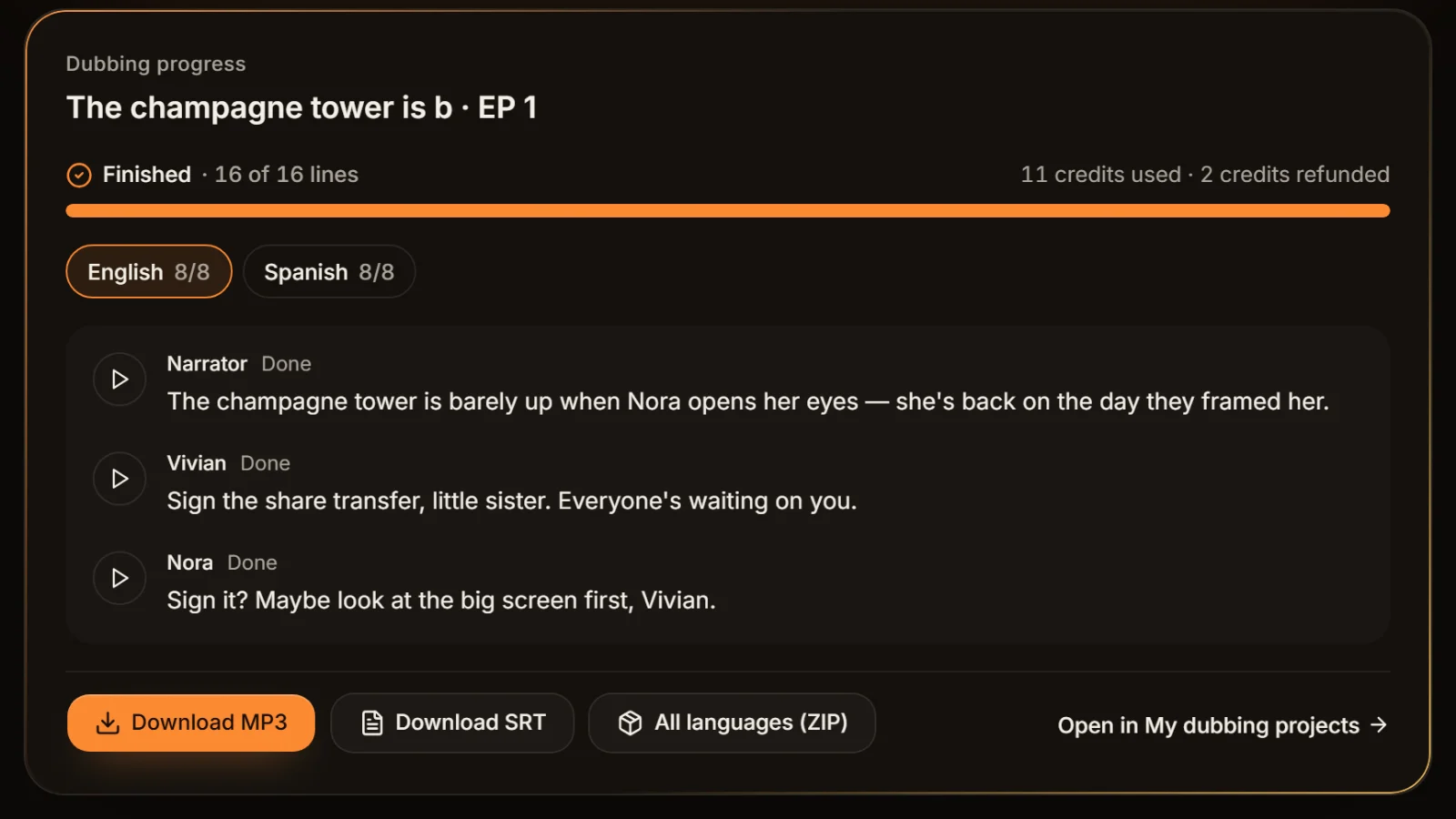
Every MP3 exported from AI Drama Voice carries an AIGC implicit label in its ID3 tag, and the ZIP includes a short notice file. The audio has no spoken notice, so the visible label is yours to add in the edit. How to read the implicit label and which visible labels work is in how to label AI-generated content; we won't repeat it here.
Think you've been throttled? Do these six things first
Before deleting and re-posting, and before blaming the AI voice, work through the likely causes in order.
Check for a violation notice
A drop in views is not necessarily a penalty; topic, timing and thumbnail all matter. Look for an explicit notice in your inbox or creator dashboard first.
Match it against the rule texts
Go down the list: a missing AI label, unlicensed material, or videos that look near-identical to the rest of your channel. Find the right cause before fixing anything.
Fix what can be fixed
Add the AI disclosure where it was missing (whether it can be edited after posting depends on the platform) and remove or replace material you don't have rights to.
Use official appeal channels
Douyin's Trust Center lists 95152 and feedback@douyin.com for feedback; WeChat Channels' rules (7.3) describe how to file complaints and appeals. For TikTok and YouTube, use the appeal route the platform offers for that notice. Never pay a third party to unblock an account.
Have your evidence ready
Licenses for the script and source novel, a screenshot of the voice tool's commercial terms and your generation records all help an appeal; see AI voiceover commercial use.
Don't buy “reach recovery”
Platforms don't sell their recommendation system. Paid services that promise to lift a restriction or boost account weight have no basis in any rule we could find.
Frequently asked questions
Not for being AI, going by the public rules checked in November 2026. Douyin says AI-assisted creation brings no special traffic advantage, and TikTok and YouTube say labeling alone doesn't affect distribution. What does get restricted is unlabeled content, infringing material, reused material with nothing new and templated mass production.
TikTok requires labels on AI-generated content containing realistic images, audio or video, and lists AI-generated speech as an example of significant AI editing. Turn on the AI-generated content setting before posting; TikTok says this won't affect distribution if the video follows the Community Guidelines.
Yes, if the content itself qualifies. YouTube says disclosing AI content alone doesn't affect monetization eligibility. What fails is inauthentic content: templated, mass-produced AI videos without your own insight, or videos that only read other people's text.
Check for a violation notice, then use the platform's own channel: the appeal route attached to the notice on TikTok or YouTube, 95152 or feedback@douyin.com for Douyin, and the complaint and appeal route in section 7.3 of WeChat Channels' rules. Attach your licenses and generation records, and don't pay anyone to unblock you.
WeChat Channels' rules (6.4) require prominent labels on generated or synthesized non-real audio and video and allow penalties when they are missing. Bilibili offers a “this video uses AI synthesis” option in the upload creator statement and labels undeclared AI content under its community rules. Neither publishes a clause that down-ranks AI voiceover as such.
It carries an implicit label: every MP3 has an AIGC field in its ID3 metadata, and the ZIP includes a notice file. It has no spoken notice, so add a visible label in your edit and declare AI content when you upload. See how to label AI-generated content.




Your story, an AI cast Label it. Own the story.
Paste an original script into the dubbing workshop for automatic casting and per-line emotion, export MP3 and SRT, and label it by the checklist when you post.
Billed by characters generated · Failed runs refunded automatically · Alipay, WeChat Pay and cards